

Deutsche Bank said the S&P 500 has risen in the 12 months following every U.S. midterm election since World War II, but warned that this cycle faces an unusual challenge: index concentration is now higher than in any of the historical periods covered by its study.
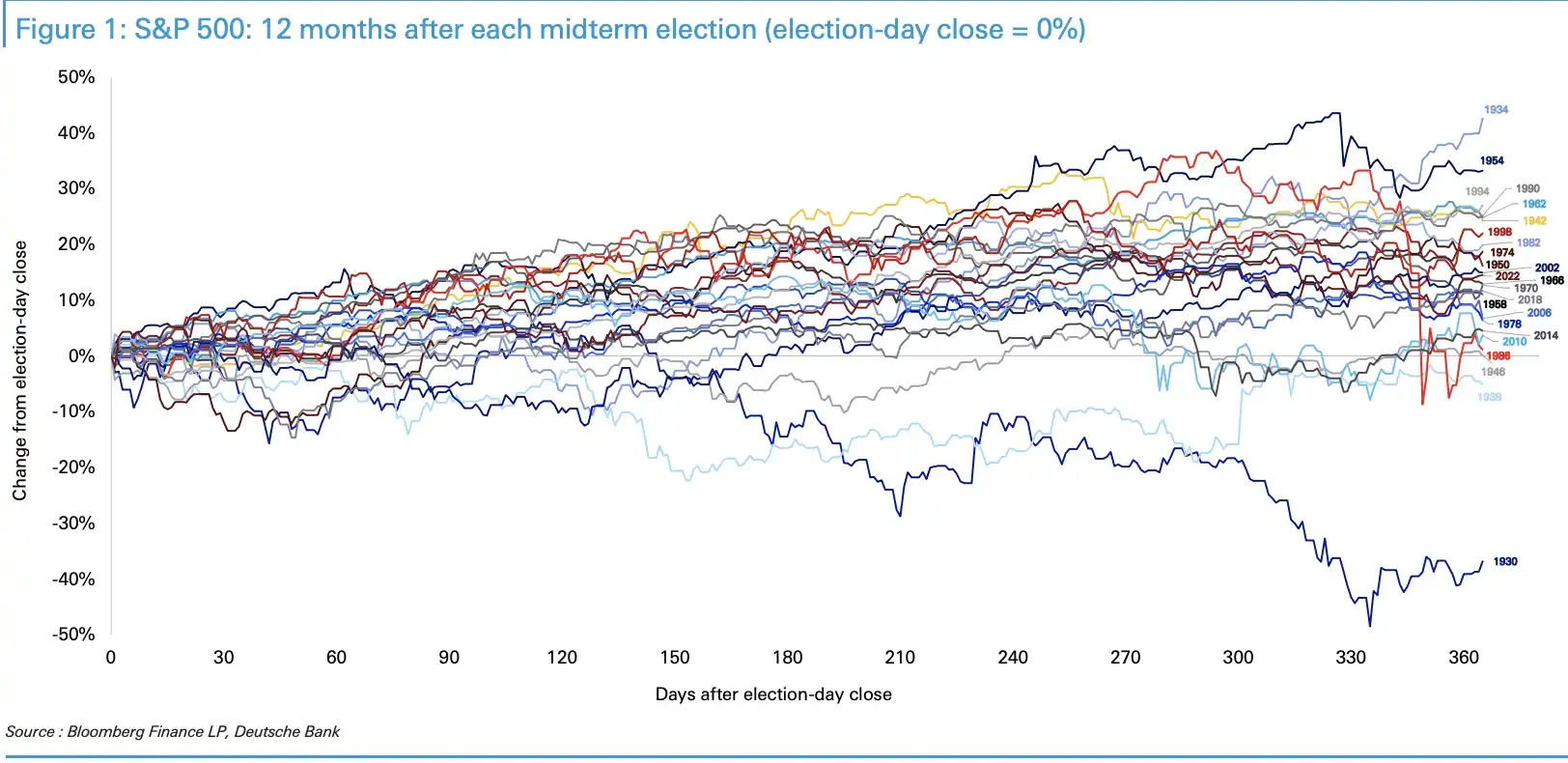
According to the bank’s latest research, the S&P 500 posted positive returns in all 20 post-midterm 12-month periods since 1946, with an average gain of 14.4%. Deutsche Bank strategists said the record stands well above the market’s performance in ordinary years, yet added that the outcome this time may hinge heavily on a small number of mega-cap stocks.
On the rates side, Deutsche Bank’s fixed-income strategists said the 10-year U.S. Treasury yield has tended to move lower after midterm elections, especially when the result creates a “new divided government.” With markets expecting Democrats to have a high probability of winning the House of Representatives, the bank said pricing tied to policy gridlock could shape near-term rate moves.
Post-midterm returns have historically outpaced ordinary years
Deutsche Bank reviewed the S&P 500’s 12-month performance after each midterm election since 1930 and found a highly consistent pattern.
Since 1946, the index has risen after every midterm election over the following 12 months, giving that period a 100% win rate across 20 observations. The average gain was 14.4%, and the median gain was 13.7%.
Using the longer sample back to 1930, the bank found gains in 22 of 24 midterm cycles, or 92%, with an average return of 13.0% and a median return of 13.7%.
That compares with a 67% gain rate for all calendar years since 1928, with an average return of 8.1% and a median return of 11.6%. Since 1946, the average gain in ordinary years was 9.1%. Deutsche Bank said the year after a midterm election has therefore outperformed typical years by roughly 4 to 5 percentage points on average and by about 2 percentage points on a median basis. The figures refer to price returns and exclude dividends.
Only two negative cases appeared, both during extreme macro conditions
Out of the 24 observations, only two post-midterm 12-month periods ended in declines, and both came during severe macroeconomic stress.
In 1930, the Great Depression weighed on markets. Bank failures, deflation, and the Smoot-Hawley Tariff Act combined to pressure equities, and the S&P 500 fell 37% in the 12 months after the election. Deutsche Bank described that period as a “once-in-a-century financial and economic collapse, rather than a normal political cycle year.”
In 1938, the backdrop was also unusual. The 1937–1938 recession had just ended, Europe was under growing war pressure, and the market fell 5.1% in the 12 months after the election. The bank also said 1946 nearly became an exception, as postwar inflation and demobilization pressures dragged on the economy and left the market up just 0.1%.
Deutsche Bank ties the pattern to fading political uncertainty
The bank said the tendency for stocks to rise after midterm elections is rooted in the removal of political uncertainty.
Within the four-year political cycle, the midterm year has usually been the weakest phase for markets. Uncertainty around election outcomes and policy direction tends to peak before voting, and the market has often bottomed in the fall, with the historical average low arriving in late September. Once the election is over, investors are dealing with a known outcome. A divided government and policy gridlock, which are common post-midterm results, can reduce the risk of major policy shifts and support valuations.
Deutsche Bank also said 2026 has not followed the historical script exactly. The market did not see the usual sharp decline that often appears before midterms, but it has largely traded sideways since late May, which the bank said still reflects the typical softening seen before the vote.
The main risk this time is record-high concentration
Despite the strong historical pattern, Deutsche Bank said the central risk in the current cycle is the concentration of the index.
The report said S&P 500 concentration now exceeds that of any period in the historical sample, with a small number of mega-cap companies accounting for most of the index’s returns. That leaves room for a scenario in which most stocks rise but the index still falls because a few heavyweight names disappoint. Deutsche Bank said this is the most plausible way the 92% success rate could fail this time.
The bank also pointed to the Federal Reserve’s policy path as another major variable. It said the hiking cycle currently priced by markets is among the mildest in history. If the actual path of rate increases returns to more normal historical levels, that could pressure markets.
Rates research points to lower Treasury yields after midterms
Deutsche Bank’s fixed-income team said 10-year Treasury yields have generally moved lower after midterm elections over the past 60 years, and the decline has tended to be larger when the election result creates a “new divided government.” Markets usually read that outcome as a sign of policy gridlock and lower fiscal stimulus.
The report also said stock and rate moves after elections have shown a strong positive relationship. Historically, every 2% decline in the S&P 500 during the week after an election has corresponded to about a 10-basis-point drop in the 10-year Treasury yield. Because the election result is expected to have limited direct impact on policy, Deutsche Bank said rates are likely to take their cue largely from the direction of equities.
Putting the historical data alongside the current market structure, the bank’s overall view is that history still supports broader market gains over the next 12 months, with both average and median returns in double-digit territory. Whether that streak extends again, though, may come down to the performance of a small group of core index heavyweights.



