

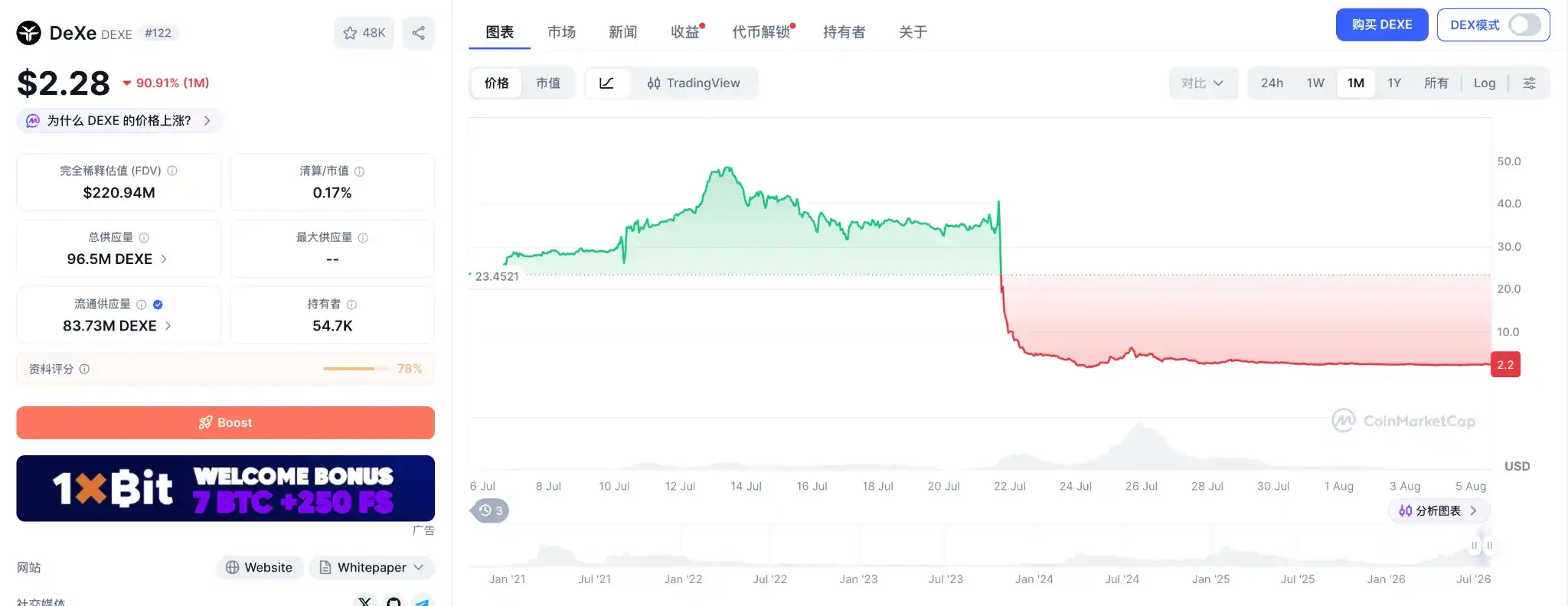
DEXE’s violent price swing in July 2026 has turned into a broader dispute over custody rails, exchange settlement, and the role of market makers. According to the source material, DEXE peaked at about $49.43 on July 12, began falling on July 13, and on July 21 alone slid from roughly $46.93 to $5.648 at one point, a drop of nearly 88% on the day. Measured from the peak, the token later fell as low as about $1.56 within 11 days, taking the total decline to 96.8%.
Much of the latest public suspicion traces back to posts by user @choc07_, who argued that institutional selling may have been involved and pointed at DWF Labs, Falcon Finance, and Ceffu. In the same thread, the user said a friend had lost nearly $1.7 million trading DEXE during the collapse. The cited post is here: https://x.com/choc07_/status/2084230250171605304.
The case has drawn less broad attention than some other crypto blowups, in part because the explanation is tangled. The route under discussion is not a straightforward story of a public DWF wallet sending tokens to an exchange and dumping them. The article instead lays out a more complicated framework involving Falcon, Ceffu, and Binance’s MirrorX mechanism, where assets held in custody may be mirrored into exchange trading accounts before on-chain settlement appears.
At this stage, the source says only a few points can be treated as confirmed from public information: during the crash window, a wallet labeled as Ceffu transferred large amounts of DEXE to Binance deposit addresses; DWF has a formal liquidity partnership with DeXe; and Falcon is deeply linked to DWF while openly supporting DEXE collateral, Ceffu custody, and mirrored trading structures.
Why DWF came under suspicion
DWF Labs is widely known in crypto as an investment and market-making firm. Its work typically includes project investment, token market making, liquidity management, and secondary market trading. In practical terms, once a project enters a liquidity arrangement with DWF, the firm may receive or borrow a quantity of that project’s tokens and deploy them across venues to provide market depth. To manage risk, that can sit alongside spot trading, derivatives hedging, cross-exchange rebalancing, and inventory control.
In April 2024, DeXe DAO passed a proposal to establish a liquidity partnership with DWF Labs. DWF also publicly said the cooperation had been approved through DeXe DAO governance and executed on-chain. The article adds that on-chain monitoring had previously shown DWF receiving 300,000 DEXE and later staking that batch for the long term.
Those public facts do not prove wrongdoing. They do show two things that matter to the current debate: DWF was formally brought in by DeXe as a liquidity partner, and DWF has historically held and controlled a meaningful amount of DEXE, giving it the operational ability to participate in market making, rebalancing, hedging, and inventory management in the token.
Falcon’s place in the story
The article treats Falcon Finance as the key piece that could explain how a larger pool of DEXE may have ended up inside institutional custody. Falcon is described as a protocol built around a synthetic dollar product, broad collateral support, and yield strategies. Users can deposit BTC, ETH, stablecoins, and other crypto assets as collateral to mint Falcon’s synthetic dollar, USDf, which gives them dollar liquidity without directly selling their original holdings. Falcon then applies yield and risk-management strategies around the collateral base.
DEXE is one of the collateral assets Falcon officially supports. That means, at least in theory, a DEXE holder could deposit DEXE into Falcon, mint USDf, and leave Falcon to manage custody, hedging, rebalancing, or trading against that position. The article also says Falcon is not limited to passively locking collateral in on-chain contracts. It can use institutional custodians and centralized exchange accounts for hedging, basis trades, funding-rate arbitrage, cross-market arbitrage, and liquidity management.
If a collateral asset swings sharply, if exposure rises too far, or if preset risk thresholds are hit, Falcon could theoretically reduce that exposure, sell spot, adjust derivatives positions, or liquidate collateral to protect USDf solvency and system stability. On that reading, Falcon would not only be able to receive DEXE. It would also have the rules and the trading capacity to dispose of DEXE, hedge it, or sell it under certain conditions.
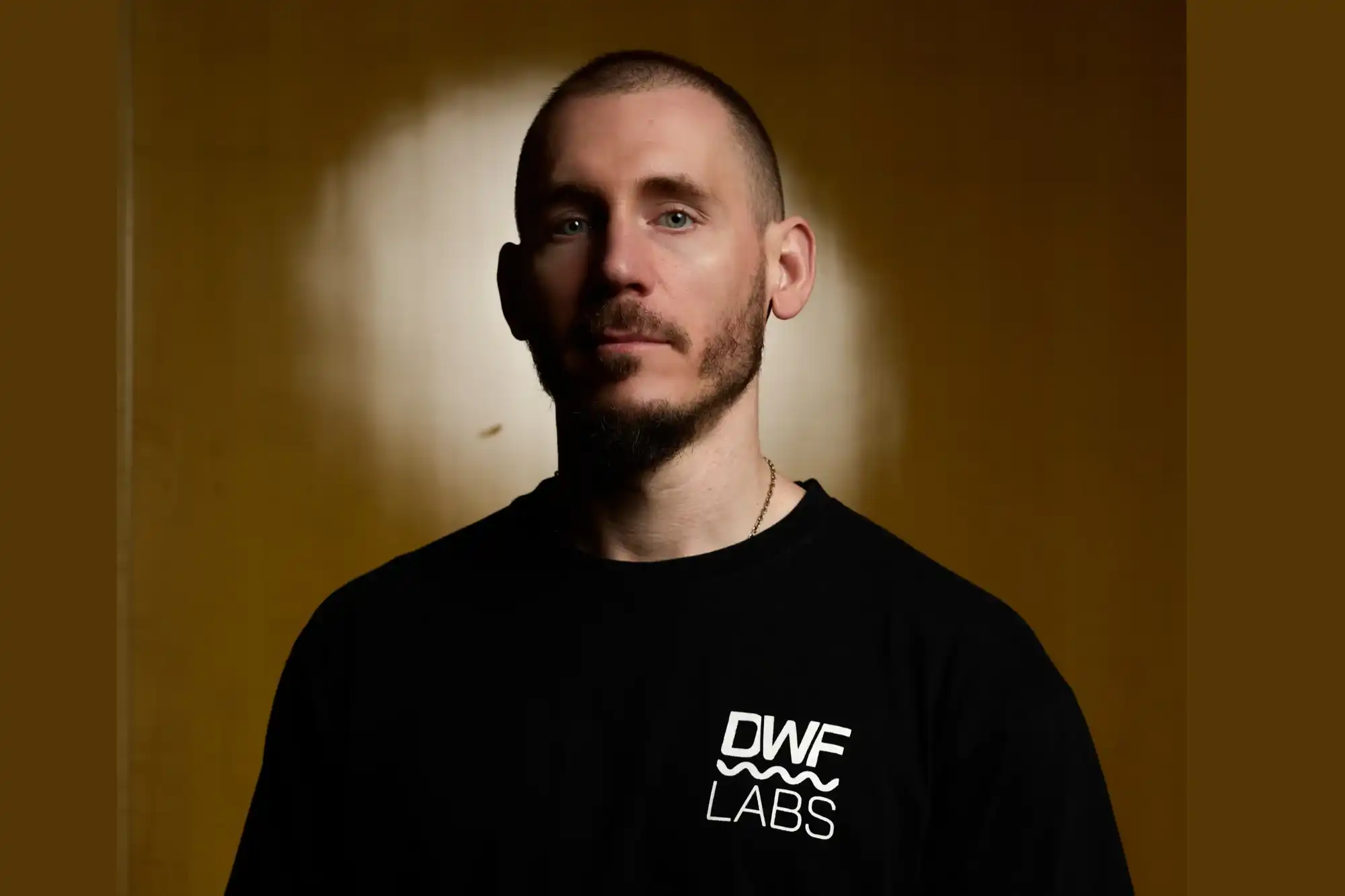
The tie to DWF is what has made Falcon central to the speculation. Falcon has described itself as a protocol supported by DWF Labs. DWF managing partner Andrei Grachev, known on X as @ag_dwf, is also presented as one of Falcon’s core leaders. The article says that creates obvious overlap in personnel, resources, trading capability, and risk infrastructure. DWF has also publicly framed Falcon as an extension of its asset-pricing, risk-management, and institutional trading capabilities.
Ceffu and MirrorX
Ceffu, formerly Binance Custody, is an institutional digital-asset custody platform. For large clients, leaving all assets in exchange hot wallets for long periods can raise platform and counterparty risk, while also creating problems around internal permissions, asset segregation, audit requirements, compliance, and controls. Ceffu’s role is to keep the real assets inside a separate custody framework while still allowing those assets to support trading, hedging, and treasury management.
The address at the center of this case is 0x3a3C006053a9B40286B9951A11bE4C5808c11dc8, which Etherscan labels as Ceffu 2. The article says large amounts of DEXE moved from that address into Binance-linked deposit infrastructure.
MirrorX is what makes the timeline harder to interpret. Under the mechanism described in the source, a client can place real assets into a Ceffu Prime Wallet and map a proportionate balance into a designated Binance sub-account. The real tokens stay in Ceffu custody, but the client gets mirrored balance or trading capacity on Binance for spot, margin, or derivatives activity.
That creates a possible sequence where real DEXE remains inside Ceffu, a mirrored balance appears first on Binance, the client trades or hedges there, and only later does on-chain or off-chain settlement move the actual tokens. If that is what happened, the timestamp visible on-chain would not necessarily match the time when the sale or hedge was actually executed.
The article therefore frames the public roles this way: DWF is DeXe’s liquidity partner and has market-making and risk-management capacity; Falcon supports DEXE as collateral and can run yield, hedging, and risk strategies around custodied assets; Ceffu acts as the custody layer and, through MirrorX, can connect those assets to Binance trading accounts.
The on-chain transfers cited as evidence
The Ethereum contract for DEXE is listed in the article as 0xde4EE8057785A7e8e800Db58F9784845A5C2Cbd6, with the token page here: https://etherscan.io/token/0xde4ee8057785a7e8e800db58f9784845a5c2cbd6.
The Ceffu address is linked here: https://etherscan.io/address/0x3a3C006053a9B40286B9951A11bE4C5808c11dc8, and its token page here: https://etherscan.io/token/0xde4ee8057785a7e8e800db58f9784845a5c2cbd6?a=0x3a3c006053a9b40286b9951a11be4c5808c11dc8.
The source cites on-chain analyst Ai Yi, who counted six transfers from Ceffu to Binance starting on July 13, 2026, totaling 797,917.24 DEXE. Based on token prices at the time each transfer occurred, that amount was worth about $6.15 million. The article points to the original analysis and secondary references here:
- https://x.com/ai_9684xtpa/status/2080677489383469496
- https://x.com/wublockchain12/status/2080698854362734808
- https://foresightnews.pro/news/detail/109461
- https://www.binance.com/en-JP/square/post/348291840298913
That July 13 starting point matters because DEXE hit about $49.432 on July 12 and started declining the next day. The article’s reading is that once DEXE rolled over from its peak, the Ceffu custody system kept sending nearly 800,000 DEXE into Binance during the same broad decline window.
A separate investigator extended the time frame back to February 2026 and counted eight transfer routes from the Ceffu address to Binance deposit addresses, totaling 854,149.537853 DEXE. The cited links are https://x.com/banbendaan/status/2083020239676256584 and https://x.com/banbendaan.
The largest single transfer, according to the article, came on July 22, 2026 and amounted to about 719,727 DEXE. Investigators identified two main paths: one directly from Ceffu to Binance Deposit, and another from Ceffu to an intermediate wallet, 0x98e50F194d975A9fcC25428433233dD876F51d32, then on to Binance Deposit. The article cites this Binance Square post and the Etherscan page for the intermediary address: https://www.binance.com/en/square/post/348892685508641 and https://etherscan.io/address/0x98e50F194d975A9fcC25428433233dD876F51d32.
That timing is one of the main reasons MirrorX has become part of the discussion. DEXE’s sharpest collapse was on July 21, when it fell from about $46.93 to about $5.648 at one point. But the largest on-chain transfer, roughly 719,727 DEXE, showed up on July 22, after the main crash had already happened. Read literally, that transfer could not directly explain the selling on July 21. The article says MirrorX offers a technical explanation for the gap: the mirrored trading activity may have happened earlier, while settlement of the real DEXE only appeared later.
The source also notes a small test transfer before some of the larger movements. It points to a transfer of about 2 DEXE sent from the intermediary address 0x98e50..., with transaction hash 0x59393f3a6919b54a38474f9fae3f95dade9da388e7cfb09f4843f159fb069b1c. The references are https://etherscan.io/tx/0x59393f3a6919b54a38474f9fae3f95dade9da388e7cfb09f4843f159fb069b1c and the receiving address page at https://etherscan.io/address/0xA072A49B9DF8b07f493E38EE4991B7CbA7296593. The article says such small tests are common before a large institutional transfer, typically to confirm the destination, deposit channel, token contract, and exchange crediting flow.
Stacked together, the on-chain evidence in the article supports a narrower set of conclusions than many posts on social media suggest. It indicates that Ceffu 2 is a labeled institutional custody address, that large DEXE balances were held there, and that those balances moved into Binance deposit infrastructure during and around the crash. It also shows that the biggest transfer came after the steepest selloff, and that MirrorX could theoretically explain why trading activity might precede visible on-chain settlement. What it does not prove on its own is who instructed those transactions or whether DWF directly controlled them.
Why Falcon is seen as the most complete public explanation
The article argues that DWF’s earlier public holding of 300,000 DEXE is too small to fully explain the roughly 800,000 DEXE transferred into Binance-linked addresses in this episode. If the tokens were tied to DWF, they may not have come solely from a visible DWF market-making wallet. A larger source would need to be involved.
On public records, Falcon is presented as the only known framework that can account for how that quantity of DEXE might have entered Ceffu. Falcon openly lists DEXE as supported collateral, and users or institutions can deposit DEXE there to mint USDf. According to the article, Falcon’s published deposit process makes clear that user collateral is not necessarily left in ordinary on-chain contracts and may enter third-party institutional custody, including Ceffu. The source cites https://falcon.finance/falcon-finance-hits-100m-tvl-in-closed-beta and https://docs.falcon.finance/mechanism/user-deposit-process.
The article says Falcon has also publicly disclosed the use of Ceffu and MirrorX as custody and over-the-counter settlement infrastructure. In that setup, the real assets can remain in Ceffu while Falcon uses mirrored positions on exchanges such as Binance for spot, margin, derivatives trading, and hedging.
At the same time, the source says the DeXe project side can largely be excluded from this particular transfer path. It states that public on-chain records do not currently show the DeXe Foundation or DAO treasury depositing large amounts of DEXE into Ceffu, and that much of the project’s supply remains in the DAO treasury, team lockups, and other known contracts. DeXe has also publicly said the foundation and treasury did not sell into this event.
The article adds that it has not found comparable public paths involving other common market makers such as Wintermute, GSR, or Jump, nor clear records of them using Ceffu at scale for DEXE. That still does not eliminate all alternative explanations. Ceffu is a general institutional custodian, so any large client with enough DEXE could theoretically have deposited tokens there independently.
Still, based on what is publicly documented, the source says Falcon is the only known entity that checks all of these boxes at once:
- it officially supports DEXE as collateral;
- it can aggregate DEXE from multiple users and institutions;
- it explicitly uses Ceffu for custody;
- it explicitly uses MirrorX for mirrored settlement and trading access;
- it has the operational ability to execute trades, hedges, and risk actions on Binance.
That is why the article narrows the most plausible public route to Falcon itself, or large institutional clients who deposited DEXE through Falcon. In that view, Falcon could have pooled more DEXE than DWF’s visible 300,000-token history suggested and then placed those balances into Ceffu’s custody and settlement stack.
Because Falcon and DWF are so closely linked, this is where public suspicion converges. The article stops short of claiming proof. It presents a pathway that appears consistent with the available transfer records and the public business setup of Falcon, Ceffu, and MirrorX.
Past controversies that shaped the market reaction
The article says DWF has faced similar criticism before in episodes involving sharp token rallies, steep reversals, market-making accounts, and exchange deposits near local highs. It names ESPORTS, SIREN, YGG, DODO, C98, and CYBER as past cases that drew comparable debate.
The most developed precedent in the piece is YGG in 2023. There, DWF was described as a major partner and market maker for YGG. After Andrei Grachev publicly promoted the token, the price rose sharply, and on-chain data later showed DWF-linked addresses sending nearly 5 million YGG to Binance near elevated price levels. The token then fell back significantly.
The article also points to a May 2024 Wall Street Journal report that said Binance’s internal market-surveillance team had investigated DWF’s trading behavior and concluded the firm engaged in more than $300 million in suspicious wash trades in 2023, while also allegedly manipulating YGG and at least six other tokens. According to the article, the team formally recommended ending Binance’s relationship with DWF, but Binance ultimately found the evidence insufficient, and the staff involved in the investigation were later removed. DWF denied market manipulation at the time and characterized the criticism as competitor-driven FUD.
Older disputes around DODO, C98, and CYBER were framed in similar terms: a partnership announcement or visible wallet activity was followed by a fast rally and then a sharp retreat. The article says the community eventually described a recurring pattern in such cases, where a large token position is acquired through OTC deals, investment, or market-making arrangements; trading activity and momentum are amplified through market-making accounts; tokens are later transferred to exchanges at higher levels; and prices retrace heavily after that. Those moves, in turn, are often defended as routine market making, hedging, or inventory management.
The source says the same script returned in 2026. In May, ESPORTS suffered a one-day crash of more than 90%, wiping out over $100 million in market value. On-chain data cited in the article showed about 19.9 million ESPORTS, worth roughly $13.9 million at the time, moved to a Kraken address linked to DWF about five days before the collapse. The project later accused its market-making partner of selling tokens without authorization. In June, SIREN surged and then saw two separate crashes of more than 90%. According to the article, on-chain analysis showed a single entity controlling about 88.5% of SIREN at one point, with wallet clusters pointing toward DWF Labs, and investigator ZachXBT discussing the link publicly on multiple occasions.
That history helps explain why DWF became the main suspect again once DEXE unraveled. The article’s position is that the broad trading pattern now under discussion in DEXE looks similar to previous episodes that had already damaged DWF’s standing with parts of the market.
DWF’s response
On Aug. 4, DWF Labs co-founder Andrei Grachev published a statement about DEXE trading. The article says he stated that DWF bought a large amount of DEXE in 2024, sold part of it in 2025 for profit, then bought heavily again around Oct. 10, 2025, and used short positions in the first half of 2026 to hedge unrealized gains.
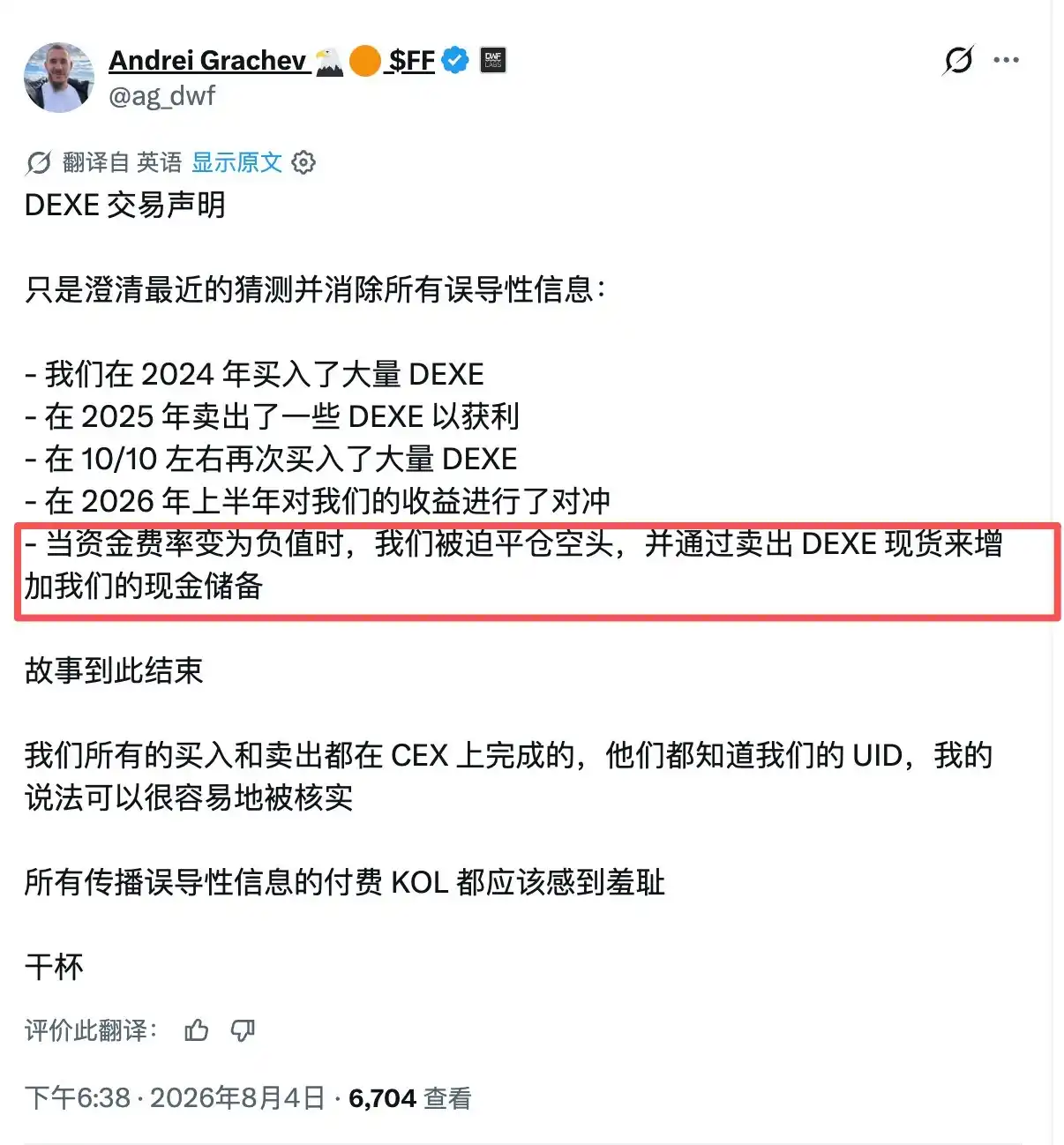
In Andrei’s account, DEXE perpetual funding later turned negative, making the short expensive to carry, so DWF closed those short positions. At the same time, it sold some DEXE spot holdings to raise cash reserves. In other words, DWF did not deny trading or selling DEXE. It said those transactions were profit-taking, hedging, and cash management. The source links the statement here: https://x.com/ag_dwf/status/2084589747633111463.
The article says that statement confirms several points that had already been suspected: DWF held a large DEXE position over time, sold some spot, held short exposure in DEXE, and reduced both short and spot risk in the first half of 2026.
It also says the statement left several core questions unanswered:
- Andrei did not disclose how many DEXE were sold, when the spot sales occurred, or at what average execution prices, leaving outsiders unable to judge whether selling clustered near the top or just before the crash.
- DWF did not provide the size, entry time, entry price, or close time of its short positions, nor did it explain whether those shorts generated outsized gains during DEXE’s decline.
- DWF did not say whether it used Ceffu to custody DEXE or whether it controlled or used Binance MirrorX sub-accounts connected to the asset. The statement also did not explain the nearly 800,000 DEXE that moved from Ceffu into Binance around the collapse.
- DWF did not clarify its exact relationship with Falcon in connection with these DEXE balances. Whether Falcon held or managed large amounts of DEXE, whether it traded through Ceffu and MirrorX, and whether DWF personnel participated in that activity remain unresolved.
- Although Andrei repeatedly said exchanges could verify all trading through account UIDs, DWF did not itself publish account records, nor did it say it would accept an independent third-party audit or release redacted trade data.
So while DWF has acknowledged buying, selling, and shorting DEXE, the article says its public response still does not provide enough detail to show those actions were only ordinary risk management rather than an important factor in causing or amplifying the collapse.
What DeXe, Falcon, Binance, and Ceffu have said
DeXe Protocol responded on July 28. According to the article, the project said the protocol functioned normally throughout the volatility and suffered no exploit or other security incident. It also said neither the DeXe Foundation nor the DAO treasury sold DEXE in this cycle or profited from the price swings. DeXe added that there was no verified explanation for the extreme rise and fall in the token, so it would not speculate on the cause. The statement is here: https://x.com/DexeNetwork/status/2082113197956321310.
That response largely separates the project side from direct selling allegations. At minimum, the article says it rules out a protocol exploit, foundation-led selling, or DAO treasury dumping based on the project’s own public statement. What it does not address is DWF’s specific trading activity, Falcon’s possible DEXE balances, the beneficial owner of the tokens in Ceffu, or whether those balances were mirrored into Binance and traded there.
Falcon Finance, according to the article, has not issued a dedicated response to the DEXE crash or the large Ceffu-to-Binance transfers. That silence matters because Falcon sits at the center of the publicly documented route under discussion. It supports DEXE collateral, uses Ceffu for institutional custody, and can deploy mirrored positions on centralized exchanges for trading, hedging, and risk management. The unanswered questions are straightforward: how much DEXE collateral existed on the platform before the crash, whether large DEXE balances entered Ceffu custody, whether the drawdown triggered de-risking, spot sales, or liquidations, and whether the roughly 800,000 DEXE transferred to Binance came from Falcon-managed assets.
Binance and Ceffu have not issued public statements on the case either. Ceffu has not disclosed the client ownership behind the DEXE in question or said whether Falcon was involved. Binance has not published the holder identities, trade records, or settlement data for any relevant MirrorX sub-accounts. For that reason, outside observers can see the tokens move from Ceffu into Binance Deposit addresses, but they cannot determine from public evidence alone whether those balances were already mirrored into Binance and traded before the on-chain transfers appeared.
The article ends with a point that has become central to community pressure: if Andrei is correct that exchanges hold DWF’s full UID-linked trading history, then Binance should theoretically be able to confirm when DWF bought, sold, closed shorts, and reduced spot inventory, and whether those actions directly overlapped with DEXE’s extreme moves.