
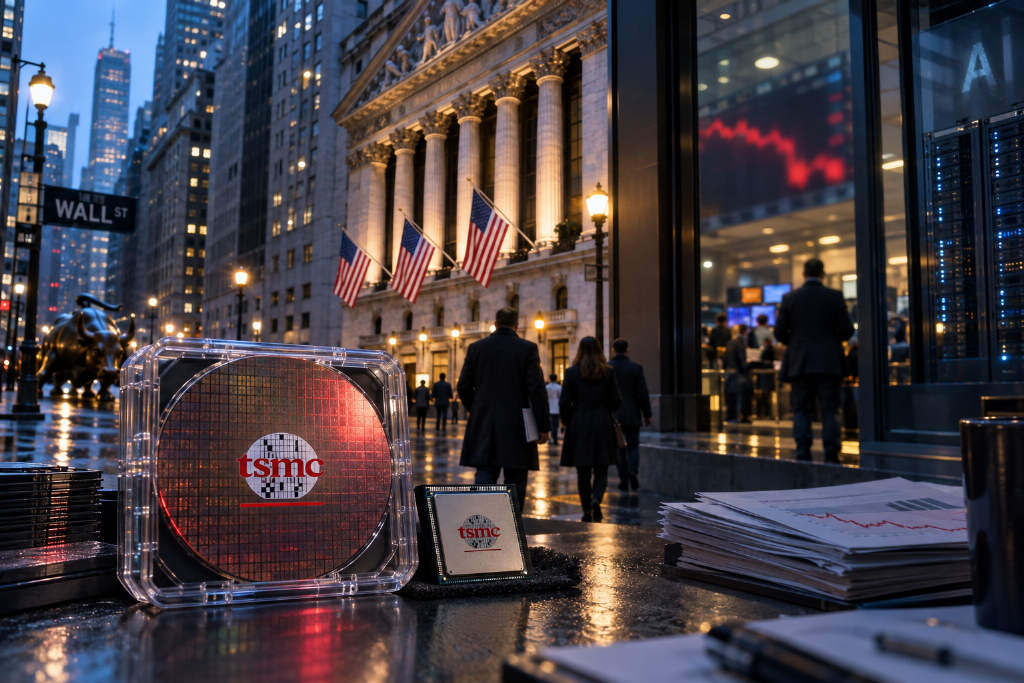
U.S. stocks bounced back on Thursday after opening lower. The Dow Jones Industrial Average rose more than 550 points, the Nasdaq ended just above the flatline, and the Philadelphia Semiconductor Index fell for a seventh straight session. Taiwan Semiconductor Manufacturing Co. posted nearly 70% year-over-year profit growth and issued fourth-quarter revenue guidance above expectations, but its shares still closed lower. Healthcare, materials and financials led the market, while inflation and debt tied to AI companies stayed at the center of investor attention.

Dow gains 1.08% while chip stocks remain under pressure
The Dow rose 1.08% to 52,177.69, up 556.21 points on the day. The S&P 500 added 0.33% to 7,744.06, and the Nasdaq edged up 0.08% to 26,713.03. The Russell 2000 gained 1.38%, while the VIX fell 2.43% to 16.46.
The Philadelphia Semiconductor Index was down more than 4% at one point before trimming its loss to 0.88% by the close, marking its seventh consecutive daily decline. The Nasdaq Golden Dragon China Index rose 1.96% to 5,770.91.
Eight of the 11 S&P 500 sectors ended higher. Healthcare rose 1.84%, materials gained 1.71%, and financials advanced 1.38%. Consumer discretionary, real estate, communication services, industrials and consumer staples also closed higher. Energy fell 1.55%, information technology slipped 0.54%, and utilities lost 0.21%.
Moves among the so-called Magnificent Seven were mixed. Microsoft rose 1.08%, Alphabet Class A gained 0.45%, and Amazon added 0.27%. Nvidia fell 1.84%, Tesla lost 1.29%, Apple slipped 0.28%, and Meta dipped 0.11%. Server makers continued to weaken, with Dell down about 6.9% and Hewlett Packard Enterprise down about 7.1%, while Micron rebounded 1.87%.
The 10-year U.S. Treasury yield fell to about 5.09%, and the 2-year yield dropped to about 4.75%. WTI crude futures rose 3.03% to $97.97 a barrel, while Brent crude slipped 0.13% to $105.92. COMEX gold futures gained 2.06% to $4,192.50 an ounce. As of about 8:45 a.m. Beijing time, Bitcoin was around $82,300 and Ether was around $2,440.
TSMC lifts full-year growth forecast, but its U.S. shares fall 1.80%
TSMC reported third-quarter revenue of NT$1.494 trillion, up 50.9% from a year earlier. Net profit reached NT$763.06 billion, up 68.7% year over year. Gross margin came in at 66.4%, below 67.7% in the second quarter.
Advanced process technologies remained the company’s main source of revenue. Two-nanometer chips accounted for 8% of wafer revenue, 3-nanometer chips made up 33%, and 5-nanometer chips contributed 28%. Technologies at 7 nanometers and below together accounted for 79%.
For the fourth quarter, the company forecast revenue of $52.3 billion to $54.3 billion and gross margin of 65% to 67%. It also raised its full-year U.S. dollar revenue growth forecast to about 44%. Management said demand for advanced nodes remained strong, the 2-nanometer business was growing quickly, and capital expenditure for this year would stay in the $60 billion to $64 billion range.
Even so, TSMC’s U.S.-listed shares fell 1.80% to $422.25. The earnings report suggested there has been no clear cooling in chip orders recently. But concern across the semiconductor sector is no longer limited to demand. Investors are also watching where customers will find the money to keep expanding data centers, and whether those investments will generate matching returns. Strong earnings were not enough to reverse the sector’s slide.
CoreWeave swings from a near 10% drop to a near 6% gain after Jensen Huang comments
CoreWeave fell about 9.5% early in the session before reversing and closing up 5.94%.
Jensen Huang said that day that CoreWeave’s capabilities were strengthening, its financing costs had actually declined, and he did not believe the company needed Nvidia to step in with a rescue. After those remarks, CoreWeave rapidly cut its losses and turned higher by midday.
Its bonds, however, remained under pressure even as the stock rebounded. Yields on some CoreWeave bonds rose above 15%, and the cost of credit default protection stayed elevated. The company posted about $9.4 billion in capital spending in the second quarter, versus roughly $680 million in operating cash flow over the same period, leaving expansion funding far above cash generated by operations.
Huang’s comments eased tension among shareholders, but bond investors’ concerns about debt repayment have not faded. Whether the company can deliver projects on time, collect payments from customers, and keep securing financing may matter more than a one-day rebound in the stock.
PPI jumps past forecasts, while retail sales get a boost from gasoline prices
U.S. producer prices rose 1.3% month over month in September, the biggest increase since March 2022. They were up 6.3% from a year earlier, the highest reading since December 2022. Energy prices rose 10.8% on the month, and service prices increased 0.8%.
Retail sales released the same day rose 0.8% from the prior month, above expectations of about 0.3%. Gas station sales climbed 6.4%. Excluding autos and gasoline, retail sales increased only 0.2%, while the control group used to estimate GDP goods consumption rose 0.1%. Higher oil prices lifted spending at the pump, while gains in other categories were limited.
After two straight days of stronger-than-expected inflation readings, Treasury yields still moved lower and the U.S. dollar also weakened. Volatility in tech shares increased and Treasuries drew buying interest. Within equities, healthcare, materials and financials led, helping the Dow outperform the Nasdaq. Most sectors closed higher on Thursday, but chip and server names remained weak.
What the market is watching next
At 11:30 a.m. Beijing time, Federal Reserve Chair Waller is scheduled to speak with International Monetary Fund Managing Director Kristalina Georgieva in Bangkok. With the Fed approaching its pre-meeting blackout period and both CPI and PPI coming in above expectations, whether he signals another rate increase is the key issue for the day.
Later on Thursday, the U.S. will release September import and export price indexes at 8:30 p.m. Beijing time, followed by September industrial production at 9:15 p.m. The first report may offer another look at imported goods inflation, while the second will show how manufacturing output is holding up.