
Foresight has published an analysis that frames the central challenge in the agent economy as a value-capture problem rather than a pure productivity problem. The article defines EcoFi, or ecological finance, as an economic framework for trusted collaboration networks that organizes contribution confirmation, resource allocation, revenue distribution, risk bearing, and value recycling around real value creation.

The piece opens by arguing that the deeper integration of artificial intelligence and decentralized technology is changing how digital production and coordination are organized. Agents are gradually gaining the ability to execute tasks on their own, call tools, make payments, and participate in complex multi-party collaboration. But higher productive capacity, the article says, does not automatically produce fair value distribution or long-term ecosystem prosperity.
According to the article, several structural tensions are already visible in today’s agent economy. Rising agent calls, transaction counts, and task completions do not automatically equal real value accumulation. A single agent completing an isolated task efficiently does not mean multiple agents across different actors can coordinate at very low cost in a trusted way. Even when an ecosystem generates visible economic value, that does not guarantee sustainable returns for the underlying value creators, collaboration networks, or public infrastructure. And while inflationary token incentives may encourage short-term speculative participation, they do not naturally turn into long-term, self-consistent, sustainable economic activity.
Why the agent economy needs a new logic for capturing value
The article says the case for EcoFi starts with a mismatch between agent-driven productivity and traditional value-capture mechanisms.
First, the productive subject is shifting from individual humans to human-machine collaboration networks. In the future digital economy described in the piece, humans mainly provide goal setting, intent input, core insight, value judgment, and legal or moral responsibility. Agents, by contrast, handle large-scale information processing, complex task decomposition, algorithmic execution, and high-frequency resource scheduling. That means the basic unit of economic organization is changing. It may be a builder together with an authorized matrix of agents, or a cross-organizational dynamic network made up of multiple actors and their digital twins.
Second, conventional behavioral metrics do not measure real contribution well in an agent economy. When the marginal cost of automation approaches zero, distributing economic rewards based on call volume, interaction count, or on-chain transaction count can distort the market, the article argues. Automated behavior can be copied at scale by scripts, creating sybil attacks and polluting signals. Cheap and frequent interactions can bury high-value insight. Local task completion through automation may contribute very little to total ecosystem returns. For that reason, the article says economic design has to move away from simple behavioral counting and toward broader evaluation that combines subject identity, task agreements, attestations of performance, and actual impact.
Third, value creation and value capture are structurally separated. The piece gives the example of a builder who creates a breakthrough base-layer algorithm, or an open-source component that is called by thousands of agents. Even if those contributions create major positive externalities, they may fail to generate economic return for their creators because no closed-loop recycling mechanism exists. At the same time, actors that control traffic entry points, compute channels, or rule-based distribution power may keep most of the economic premium. The article argues that the agent economy therefore has to do more than increase efficiency. It needs a mechanism that reduces value leakage and connects value creation with value capture more reasonably.
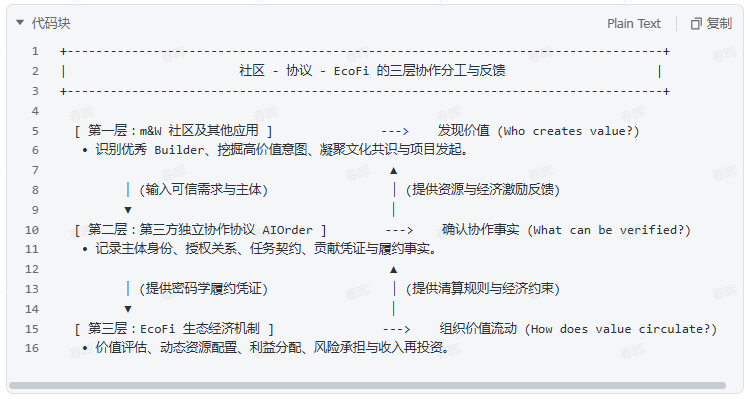
From community to protocol to EcoFi
To address those issues, the article proposes a layered structure with distinct roles for the community, an independent third-party protocol, and the economic mechanism layer.
At the community and application layer, m&W is described as the place where value creators and high-value intent are discovered. Through content insight, research and judgment, builder identity, and deep community interaction, it identifies people, capabilities, and projects that deserve more resources. In the article’s framing, the community acts as a value filter and a field of consensus that helps the ecosystem locate underrecognized builders and high-value demand in a noisy environment. It answers the question: who creates value?
The third-party collaboration protocol AIOrder is positioned as the layer that makes collaborative relationships and performance facts verifiable. The article says AIOrder is built around human actors, digital twins, and their authorized agents, and supports cross-application identity binding, authorization records, task contracts, contribution attestations, and proof of performance. It stresses that AIOrder, as an independent trusted collaboration protocol for human-machine networks together with lightweight integration plugins, does not decide subjectively how valuable a contribution is. Its role is to provide verifiable, traceable, auditable evidence for later economic decisions. For records written on-chain, the article says suitable mechanisms can be used to preserve integrity and traceability. In that structure, AIOrder answers the question: what can be verified?
On top of those two layers sits the EcoFi mechanism layer. That is where trusted evidence is connected to resource allocation, revenue settlement, risk sharing, and value recycling. In the article’s framework, community discovers value, protocol confirms collaborative facts, and EcoFi organizes the circulation of economic value. It adds that the three layers are not a one-way assembly line but a reinforcing loop.
Four core mechanisms inside EcoFi
The article then breaks EcoFi into four mechanisms, setting out their function, scope, and objectives.
Intent recognition and collaboration credit
This mechanism studies the binding of rights and responsibilities among human actors, digital twins, and authorized agents. It builds dynamic reputation records based on on-chain performance history, collaboration reviews, and contribution attestations. The article draws a line between reputation and credit: reputation is objective historical evidence, while credit is a judgment about future performance risk. Reputation can inform admission and credit decisions, but it should not automatically become a credit limit, and it should not directly serve as derivative collateral. The aim is to lower trust thresholds and screening costs before collaboration begins.
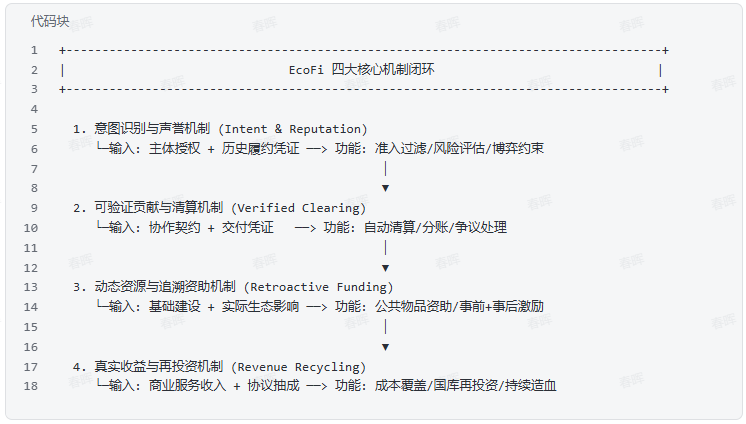
Verified contribution and collaborative settlement
Using AIOrder’s attestation layer, this mechanism sets task agreements, delivery standards, validation rules, and payment-trigger conditions. It also includes settlement logic for dispute arbitration, partial performance, and slashing for violations. The article argues that automatable economic distribution should rest as much as possible on explicit agreements, verifiable outcomes, and executable rules, while leaving room for human judgment and governance procedures in subjective evaluation, complex delivery, and disputes. The goal is to reduce friction in post-task settlement and make distribution depend on observable contract performance.
Dynamic resource allocation and retroactive funding
Here the article turns to the funding problem for infrastructure with strong positive externalities, including open-source tools, public datasets, and standard protocols. It proposes a combination of upfront allocation and retroactive funding, or RetroPGF. Upfront support would be based on milestone budgets and team capability. Retroactive allocation would depend on actual use in later agent collaboration, ecosystem impact, replacement cost, and public value. The mechanism is meant to prevent short-term measurable actions from crowding out long-term infrastructure building and to direct resources toward projects with stronger positive externalities.
Real revenue, value recycling, and reinvestment
The article says ecosystems need a clear definition of real revenue sources, listing third-party application settlement fees, commissions on agent commercial contracts, and application service fees as examples. It then calls for explicit distribution rules for operating costs, contributor compensation, public treasury allocation, and risk guarantee pools. The piece is clear on one point: real revenue is not the same as a token price increase, nor is it new money entering the system to fund earlier returns. It also says the recipients of recycled value should depend on rights structures, contractual arrangements, and risk sharing rather than being forced into a simple token-holder dividend model. The objective is a self-sustaining closed loop that relies less on continuous inflationary token incentives.
How EcoFi differs from traditional finance and token economics
The article’s core conclusion is that EcoFi does not reject financial markets or token tools. Nor does it mean every form of value must be tokenized, or that every collaborative process has to settle on-chain. Instead, EcoFi is presented as a trust base for credible collaboration, one that lets financial tools and economic mechanisms serve real human-machine productivity and long-term ecosystem construction.
How m&W and AIOrder could take part in practice
On implementation, the article argues for a pragmatic approach and says teams should not lock in an untested token model too early.
m&W is described as an early sandbox for EcoFi mechanisms. The article says it should focus on testing how to identify high-value builders, how to track genuine collaborative delivery, and how to use funding pools to support critical tasks. At the early stage, the priority should be to accumulate reliable contribution data and real human-machine collaboration cases rather than push comprehensive financialization too soon.

AIOrder, meanwhile, is described as an independent trusted collaboration protocol and lightweight integration plugin set for human-machine coordination networks. It would provide modules for subject binding, authorization tracking, and performance verification to applications across the network. The article says AIOrder could later build on existing standards or infrastructure such as ERC-8004, described here as an agent identity and trust framework, and EAS, the Ethereum Attestation Service. Combined with task contracts, validation rules, and payment execution mechanisms, those foundations could gradually be packaged into open modules for conditional payments, automatic settlement, and retroactive funding, which third-party agent platforms could integrate as needed.
Where CMW fits in the EcoFi framework
The article also examines CMW. It argues that CMW should not be seen simply as an incentive token aimed at boosting short-term participation. Instead, within the m&W ecosystem, it should be explored as a connector across contribution recognition, collaborative governance, resource allocation, and value circulation.
As m&W develops from builder discovery and consensus formation toward real human-machine collaboration and ecosystem construction, the article says CMW could become a core carrier linking ecosystem participants, contribution behavior, and long-term rights. On one side, incentive and governance design could guide resources toward long-horizon builders, key tasks, and public infrastructure. On the other, the ecosystem could explore internal links between contribution attestations, resource allocation, and economic rights, so that participants receive timely incentives for real contribution while also gaining a deeper stake in the ecosystem’s continuing evolution.
From that direction, the piece outlines three connected areas for CMW.
Contribution incentives and ecosystem governance
CMW could be tied closely to community contribution, ecosystem construction, and governance participation. The article says the key is not to convert simple acts such as speaking, liking, or interacting into tokens by formula. Instead, the aim is to build an incentive model that reflects contribution quality, persistence, and actual ecosystem impact, so that governance voice lines up with the ecosystem’s long-term shared interests.
Resource allocation and collaboration incentives
The article proposes exploring CMW as a tool for dynamic allocation across key projects, core builders, open-source public goods, and cross-subject collaboration tasks. In that design, economic incentives would support real productivity needs, while transparent and assessable rules would reduce resource mismatch and short-term gaming. As use cases expand, further research could examine how CMW handles incentive constraints, trust guarantees, and rights coordination across different human-machine collaboration settings.

Real revenue and ecosystem value circulation
As ecosystem applications, collaboration services, and related business activity develop, the article says the next step is to study how real operating income should be distributed among contributor returns, public capital accumulation, ecosystem reinvestment, and long-term building. It also calls for clearer mapping among contribution, risk bearing, and economic rights for different participants. On that basis, CMW could then be studied as a deeper participant in ecosystem value circulation, with its economic design tightly linked to the ecosystem’s actual revenue-generating capacity.
The article ties those three levels together into one loop. Contribution incentives help the ecosystem build capacity. Resource allocation turns that capacity into concrete output. Real revenue and reinvestment then support long-term continuity. In that framing, the design of CMW develops around a positive flywheel and is meant to mature through iteration in real applications.
From an execution economy to an ecological economy of trusted collaboration
In its closing section, the article says the future of the agent economy is not simply about agents writing more lines of code or initiating more transactions on behalf of humans. The larger goal is to let vast numbers of dynamic actors, including humans, digital twins, and agent collectives, reach deep collaboration at scale and at low cost without centralized intermediaries.
When marginal productivity can be copied almost without limit, the article argues, what becomes scarce is the precision of value recognition, the certainty of cross-subject trust, and the mechanism design that directs economic flows into long-term construction. EcoFi is presented as an attempt to build that order: grounded in real value creation, based on trusted attestations, and organized through efficient resource allocation and genuine revenue recycling.
The article ends with a disclaimer stating that markets carry risk and this material does not constitute investment advice. Readers are advised to consider whether any opinion, view, or conclusion in the article fits their own circumstances and to take responsibility for their own investment decisions.