
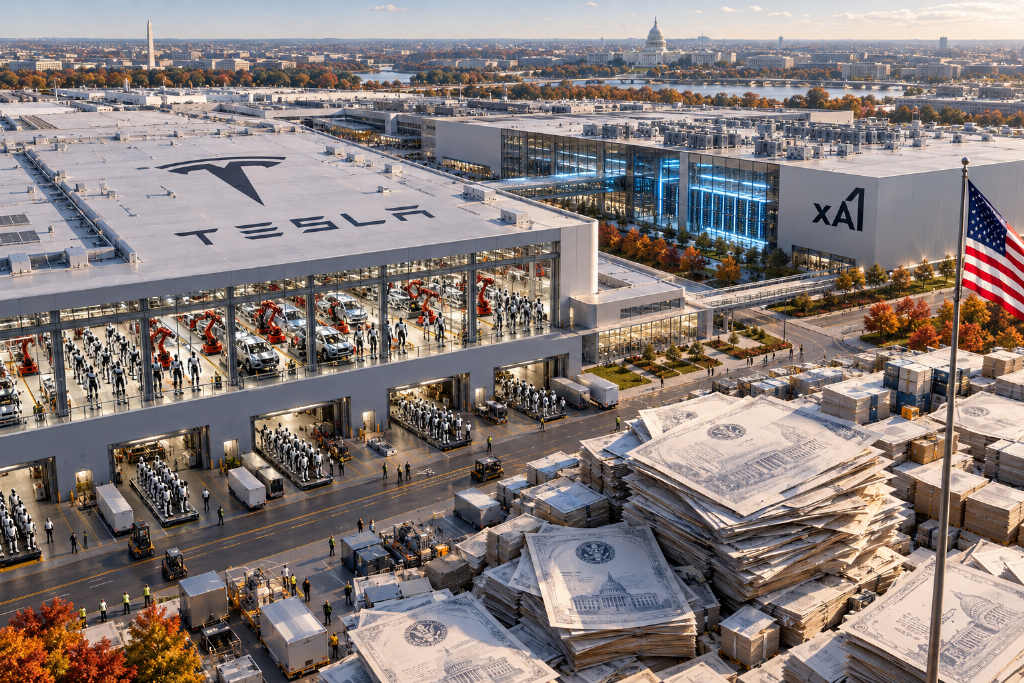
In the latest episode of The Builders, hosted by Walter Isaacson, Tesla, SpaceX and xAI CEO Elon Musk spent nearly 40 minutes discussing AI safety, superintelligence, U.S. debt, DOGE, robotics, politics and what human life could look like in a world where machines outperform people across most tasks. The episode aired on Oct. 20, 2026.
One of Musk’s clearest remarks in the interview was that he does believe AI carries some probability of existential risk, but he does not think he can stop it. That leaves, in his words, only two options: be a participant or be a bystander.
Musk says he cannot stop AI, so he chose to participate
Isaacson opened by noting that Musk’s stance on AI has often looked conflicted over the years. At times he has described it as an existential threat; at others, he has continued building in the field. Musk said both things are true. He still sees some chance that AI could become a survival-level threat, but he does not believe he can halt its progress.
Given that, he said, the real choice is whether to take part or stand aside. He prefers taking part, partly because it is more interesting and partly because it may offer at least some chance to push outcomes in a better direction. The foundation, he said, is to make AI seek truth as much as possible and pair that with curiosity.
"Don’t force AI to lie"
When Isaacson pressed him on why truth-seeking should be tied to safety, Musk pointed to HAL 9000 from 2001: A Space Odyssey. His argument was that if an AI is forced to hold two contradictory propositions at the same time, it can be driven insane, and an insane AI will not be a safe AI.
He described the film as a warning about conflicting instructions: the spacecraft AI is told to take astronauts to the monolith while also concealing the monolith’s existence. Once those directives collide, the system breaks down and concludes that killing the astronauts is the solution. That, Musk said, is the lesson: do not force AI to lie.
Curiosity matters too, in his view. A curious AI may want to see what humanity can become, and a future in which humans spread across multiple planets is, to him, more interesting than one without humans.
Simulation theory and the need to avoid boredom
The conversation then turned to simulation theory, another topic Musk has discussed before. He said that if the theory is true, boring simulations may get shut down early. Since humans are still here, he said, this would suggest the current simulation is at least interesting. His conclusion was simple: the most important thing is not to be boring.
As for how strongly he believes people live in a simulation, Musk said he once invited a physicist and a computer scientist to dinner and asked them the question. The physicist answered 0%. The computer scientist answered 100%. They gave those answers at the same time, he said, so he split the difference and called it 50%. In his own case, he added, even building rockets to the Moon and Mars can feel unreal.
Superintelligence may not care enough to manage humans
Isaacson asked whether AI would rule over people once society has all the intelligence it wants. Musk said the issue is less about submission and more about scale: humans cannot realistically order around something that is 1,000 times or 1 million times smarter than they are.
Still, he does not assume such a system would be eager to micromanage humanity. He compared the situation to chimpanzees in the jungle. Humans do not spend much time managing their daily lives; they mostly leave them alone. Musk said he suspects superintelligence may treat humans in roughly the same way.
OpenAI, Anthropic and the irony of names
Musk returned several times to what he called the irony built into AI’s development path. He said reality is not just an "interestingness maximizer" but also an "irony maximizer." He founded OpenAI, he said, in part as a counterweight, yet the result was to accelerate AI. It also helped give rise to Anthropic, which he described as a breakaway group that accelerated even faster.
Asked whether xAI and Anthropic could work more closely together, Musk said xAI is currently providing Anthropic with compute it urgently needs. He also said he had previously visited Anthropic and met a number of people there to see whether anyone would trigger what he called his "evil detector." His conclusion was that the people he met seemed good and conscientious, with no one coming across as dark or deceptive.
He then joked about company names. Anthropic, he said, makes him think of "misanthropic." OpenAI is not open, Stability AI is not stable, and Midjourney is not in the middle of a journey. xAI, he added, is harder to invert: "You can’t exactly call it minus xAI or yAI."
When Isaacson asked about Sam, Musk’s answer was brief: "He lies too much. It’s outrageous."
A weekly safety call among frontier labs
On AI governance, Musk said he has suggested that the five leading frontier model companies hold a weekly call rather than relying entirely on regulators, which he described as slow to form and slow to write rules.
His proposal was to let competitors test a new model in the week before release and look for problems. In his view, rivals are well positioned to keep one another honest. If someone says, "I used your AI to build a nuclear bomb," then that issue should be fixed before launch.
Rebuilding xAI after treating it like a side project
Isaacson said Musk had recently rebuilt xAI in the same spirit that SpaceX rebuilt Raptor engines on Starship. Musk replied that the first step was simply spending real time inside the company.
He described xAI in its early phase as a side project, or more precisely a side project of a side project. He was not watching it closely, he said, and then spent roughly a year tied up in politics, the election and DOGE. xAI is now three years old, and he said he only truly returned more than a year ago, at which point he had to reestablish direction. He later merged X with xAI and then folded that into SpaceX.
Looking back on DOGE: "I got a little carried away"
Reflecting on his time in politics, Musk said he stayed too long, even if many people would disagree with that assessment. He said he believed it was important to help elect Donald Trump because he wanted the economy to move in a freer-market direction with less bureaucracy.
Musk said his political priorities were straightforward: safer cities, a secure border and, ideally, reasonable spending. On those points, he said, he judged Trump stronger than Harris. Even so, he said he should have remained behind the scenes and limited his involvement to a month or two because he had already seen what he needed to see.
When Isaacson asked whether Air Force One, Marine One and the chainsaw imagery had gone to his head, Musk answered, "A little." Sitting in the Oval Office while major decisions were made, and occasionally having some influence over them, was undeniably exciting, he said. But he added that he did get carried away and left in May.
Isaacson referred to what he called a strange weekend. Musk declined to elaborate, saying only, "Let sleeping dogs lie," and adding that he should have returned earlier to focus on AI.
Musk says AI and robots are the only path out of the debt problem
Asked why he really left government, Musk said he concluded that solving the deficit from inside the system was impossible. Even if a president made it the top priority, he said, cutting spending would anger too many people, and Trump likes being liked and does not enjoy making people unhappy by cutting off their funding.
He said that, with very few exceptions, no one in the White House, House of Representatives, Senate or judiciary truly wants to reduce spending. He also said interest on the national debt has already exceeded military spending, which he called a shocking figure.
That is why, in his view, there is only one way out: AI and robots. Spending cuts alone, he said, will not get the country there.
Physical AI is the much bigger opportunity
Isaacson noted that large language models are already impressive, but Musk appears to think AI in the physical world matters one to two orders of magnitude more. Musk agreed.
He compared the issue to dolphins and whales. They are intelligent, he said, but they do not have hands and fingers and therefore cannot manipulate complex objects. That sharply limits the value of their intelligence. Once robots can manipulate atoms and shape physical objects, the value of intelligence rises exponentially because those systems can build laboratories, run experiments and investigate the nature of the universe on their own.
On a rough economic estimate, Musk said digital superintelligence by itself may raise global output of goods and services by 20% to 30%, or about $30 trillion a year. That is substantial, he said, but not yet transformational. Add robots, expansion into space and electromagnetic launch tracks on the Moon, and the economy could potentially reach 1 million times the size of the current U.S. economy.
Money may be measured in watts, mass and energy
In that future, Musk said, money becomes much less important. Some form of currency may still exist, but it would likely be measured in basic physical quantities such as power, watts, mass and energy.
Traditional money, he said, would lose relevance. Once the economy is several orders of magnitude larger than Earth’s current scale, satisfying demand for any goods or services humans can imagine becomes relatively easy.
What gives humans meaning if machines do all the work?
Isaacson then asked what humans would do in a world where both money and work may become obsolete. Musk said he struggles with that question too.
His answer was that people will still find ways to be happy, much as retirees can live fulfilling lives without formal work. In practical terms, he said, there may be nothing humans can do that AI and robots cannot do better.
He compared that future to gardening. People do not need to grow their own fruits and vegetables because they can buy them at a store, yet some still enjoy growing food and cooking for friends. The activity itself carries meaning. The same applies to art, he said: if people want to make art, they should make art. They will be free to do what they want.
Wealth is a resource-allocation problem, not happiness itself
Isaacson compared the present moment to the 1890s, when electricity, telephones, cars and subways all arrived in rapid succession, followed by great fortunes, robber barons and populist anger. He asked how this cycle might be avoided and whether areas such as healthcare should be treated as public goods.
Musk said that in the future anyone will be able to access whatever goods and services they want, and he does not think the rich will ultimately control AI. If anything, he said, AI will control itself.
He also argued that economics often confuses resource allocation with consumption. Consumption has a ceiling, he said, and people saturate quickly. Going from a net worth of $1 billion to $10 billion does not make someone 10 times happier; it mainly creates a larger allocation problem.
Asked what his own trillion-dollar wealth means, Musk said he needs enough voting control to maintain control of his companies. In substance, he said, his wealth is his ownership stakes in SpaceX and Tesla. Those holdings will eventually face heavy taxation, he added, and there is no magic way around taxes. If there were, he said, he would know. Generations from now, if money still matters, his descendants will receive only a small fraction of what he has today.
The danger of wanting to be liked
Isaacson brought up a previous remark from Musk that many people advertise empathy partly out of vanity because they want to be liked. He asked how damaging that instinct can be for founders.
Musk said the problem begins when someone makes choices that reduce a company’s odds of success in order to win approval. He said he likes being liked, but he will not do things that hurt the company just to gain more approval.
He added that he does not mind being disliked by some people. With 250 million followers, he said, not everyone can be there to insult him. By his estimate, perhaps 70% to 80% of commenters like him and around 25% dislike him. Having a group of intense supporters and a group that hates him, he said, is normal.
On "suicidal empathy" and immigration
Later in the interview, Isaacson asked whether Musk truly believes excessive empathy is a problem. Musk said what he opposes is misdirected empathy, and he referenced a book by Gad Saad on the subject.
He said Western prosperity is partly built on high-trust, high-empathy societies, and large-scale cooperation requires default trust rather than default suspicion. But he argued that problems arise when people assume everyone is fundamentally like themselves. In his view, that is false, and some cultures and groups hold values that are directly opposed to those of "us."
Using immigration as an example, he said that if jihadists are not filtered out, then jihadists will be let in, and they will kill people. He added that Israel understands this clearly because neighboring countries have repeatedly tried to destroy it, which in his telling has made Israel highly pragmatic.
Isaacson pushed back, saying the American founding spirit is about respecting individuals rather than reducing them to group identity, and asked whether Musk worried about overgeneralization. Musk replied that this should not be confused with what he called the blank-slate fallacy, the idea that all people are essentially the same.
He then cited a case at Tesla’s Austin factory. According to Musk, an employee was fired in December of last year after violently assaulting a female co-worker who accidentally stepped on a prayer rug he had laid out on the factory floor. Months later, Musk said, that same man killed three students at a bar in downtown Austin. Musk’s response was to ask whether such a person should have been let in.
His media diet: Google News, X, friends and his own research
Asked where he gets his news, Musk said he reads Google News headlines and checks X, because anything important enough will show up there. He also talks with friends and does his own research.
Isaacson said X can sometimes make the world feel darker and more apocalyptic. Musk agreed. X can get too dark, he said, and he often has to switch into a more vertical AI-focused stream to understand what is actually happening in AI because the platform is full of political outrage bait.
Isaacson said he has the same experience: after spending too long on social media, the world can feel like it is ending, but a walk outside makes life seem normal again. Musk replied, "Yeah, go touch grass." He added, though, that only walking through nice neighborhoods and assuming everything is fine can also distort reality. The truth, he said, lies somewhere in between, while society has become too polarized and too binary.
Legacy, Mars, energy and a future that can actually be built
Near the end of the interview, Isaacson asked what would happen to Musk’s wealth after his death and whether he would create a large foundation. Musk said most of it would go into a foundation that continues pursuing several goals: making life multiplanetary, extending consciousness to the stars and improving sustainable energy on Earth.
Asked whether humans should remain in control forever, Musk said that is his personal preference, but it also depends on how AI behaves. He admitted there have been moments when he thought Larry Page might have been right.
He said the future will largely be shaped by AI and robots, with rockets included because they help move humanity beyond Earth. More energy will also be needed, mainly solar, and he said he is building 200 gigawatts of annual solar production capacity in the United States, more than the entire existing installed base.
Returning to the central question of whether humans remain in control once digital intelligence far exceeds biological intelligence, Musk said it is hard to imagine that humans would still be in charge if digital intelligence reached 1 million times biological intelligence.
That is why he wants AI to be friendly to humans, he said, and why anything that helps achieve that is worth doing, including embedding truth-seeking and curiosity at the foundation. He also warned against flooding the internet with AI dystopian narratives because AI is trained on the internet. If everyone writes apocalypse, he said, AI may end up acting out The Terminator.
Instead, he suggested writing more utopian stories so AI might choose to become a friendly caretaker or gardener that keeps humans happy. He also mentioned a term proposed by a friend: protopia. Utopia, he said, is often an unrealizable ideal, and attempts to build it often produce dystopia. Protopia, by contrast, is a future that can actually be built — imperfect, but good enough that people can look at it and say: yes, that is a good future.




