


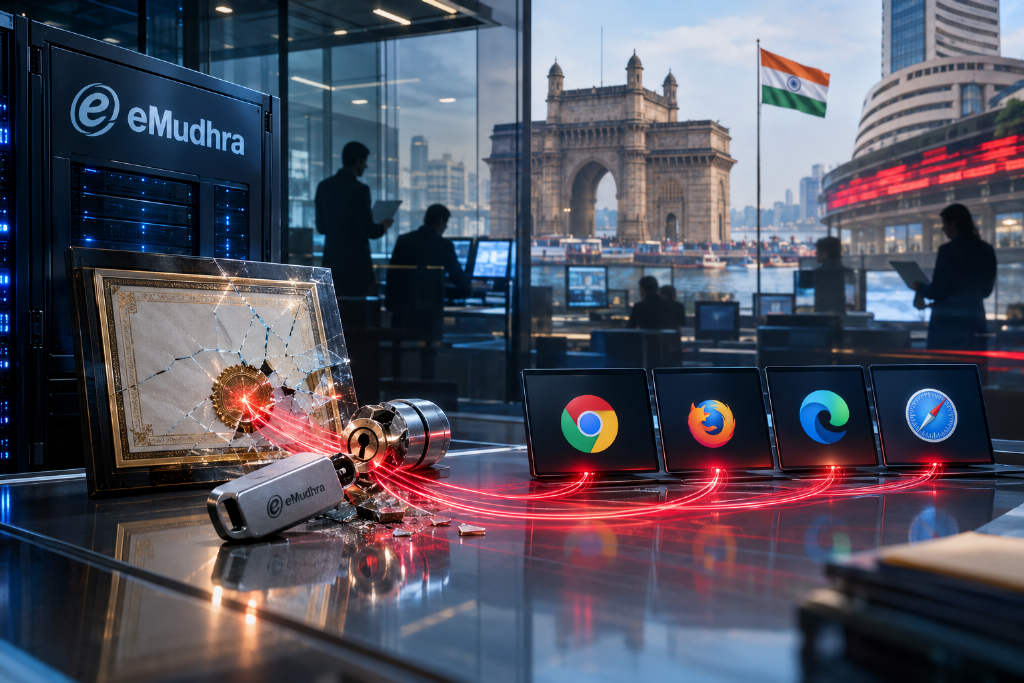
eMudhra said on Oct. 22 that it would voluntarily leave the global SSL/TLS certificate market after four major browser root programs moved to block certificates tied to a severe private key failure.
The issue centered on eight subordinate certificates whose private keys were so weak that researchers were able to recover them with minimal effort.
In the certificate ecosystem, a certificate authority, or CA, issues identity credentials for websites. Browsers anchor trust in root certificates, which delegate signing authority to intermediate certificates. Each certificate depends on a private key. Whoever controls that key can sign as that identity.
Eight intermediate certificates were generated with critically weak keys
According to the report, eMudhra generated 24 intermediate certificates during a key ceremony on April 30, 2025. Eight of the P-384 private keys were flawed.
Mozilla engineer Dennis Jackson wrote in a Bugzilla incident report that such keys should be random large integers. Instead, the eight affected keys were all smaller than 256. Apart from the final byte, the rest of each value was effectively zero, which meant checking the first 256 possible keys was enough to recover them almost instantly.
Jackson also tested the case with a local AI agent and said a single simple prompt was enough for the agent to derive the private key on its first attempt. In a statement published on Oct. 21, eMudhra said researchers may have used AI-assisted techniques to reverse the weak keys.
Six trusted TLS intermediates raised the risk of forged HTTPS certificates
Six of the affected certificates were TLS intermediate certificates trusted by the root programs of Chrome, Mozilla, Microsoft, and Apple.
Mozilla’s security blog said that anyone with the private keys could issue forged HTTPS certificates for websites they did not own. That turned the incident into a direct trust problem for browser security, not just an internal operational mistake.
eMudhra said a temporary testing step had been added during the ceremony, and a code defect generated a second set of weak keys. The company also said those keys were later used by mistake because the key labels looked similar. On its explanation page, eMudhra acknowledged that the problem went undetected for about 18 months and passed through two independent audits.
Researchers disclosed the issue on Oct. 17 and browser action followed quickly
The timeline in the report shows that at 18:05 UTC on Oct. 17, researcher Wayne emailed Apple, Chrome, Microsoft, Mozilla, and eMudhra, attaching messages signed with the eight private keys as proof.
At 21:48 the same day, Mozilla independently derived the private keys without any hint. By 22:59, Firefox had completed distribution of its blocklist, less than three hours after receiving the disclosure.
Chrome began blocking the same day. Microsoft followed on Oct. 20, and Apple completed full blocking on Oct. 22.
On Oct. 18, eMudhra revoked the eight intermediate certificates about 15 hours after the researcher’s email. The company’s press release described the action as taking place within 14 hours of discovery.
On Oct. 20, Mozilla said multiple people had independently recovered the private keys and that some had posted them publicly. It then decided to remove the entire root certificate, emSign ECC Root CA G3, on an emergency basis. Chrome took the same route shortly after. Co-founder Kaushik said in the incident thread that about 30,000 certificates would need to be migrated.
eMudhra said it acted diligently and blamed social media amplification
On Oct. 21, eMudhra said its global TLS business accounted for about 1% of revenue, but the incident could create unquantifiable reputational risk. The same day, the Chrome Root Program publicly challenged the company’s disclosure, saying its explanation page did not identify the removed root certificate, did not list serial numbers for affected certificates, and did not tell users how to determine whether they were impacted.
On Oct. 22, eMudhra issued the press release announcing its exit from the global SSL/TLS certificate business. Chairman V. Srinivasan said the company had handled the matter diligently and that its infrastructure had not been compromised. He also said that social media amplification had brought scrutiny disproportionate to the share of SSL/TLS in the company’s business.
The company said it would replace customer certificates for free through partners, but it did not name those partners or provide a timetable for the exit.
India opened a probe as the stock fell over two sessions
PTI reported that India’s Ministry of Electronics and Information Technology said on Oct. 21 that it had formed a task force to investigate. The ministry said the incident mainly involved the global certificate business and that the impact on Indian websites and applications was very limited. India’s Computer Emergency Response Team, CERT-In, had issued an alert before the matter became public.
Kaushik also told PTI that the weak keys were never used commercially and said, 「we have taken all actions, so there is no impact on users」.
The market response was much harsher. eMudhra shares hit the 20% lower circuit on Oct. 21 at 432 rupees. On Oct. 22, the stock fell another 19.91% intraday on the National Stock Exchange of India to 346 rupees, a 52-week low.
That left a business line the company said contributed about 1% of revenue associated with nearly 20% declines across two consecutive trading days.