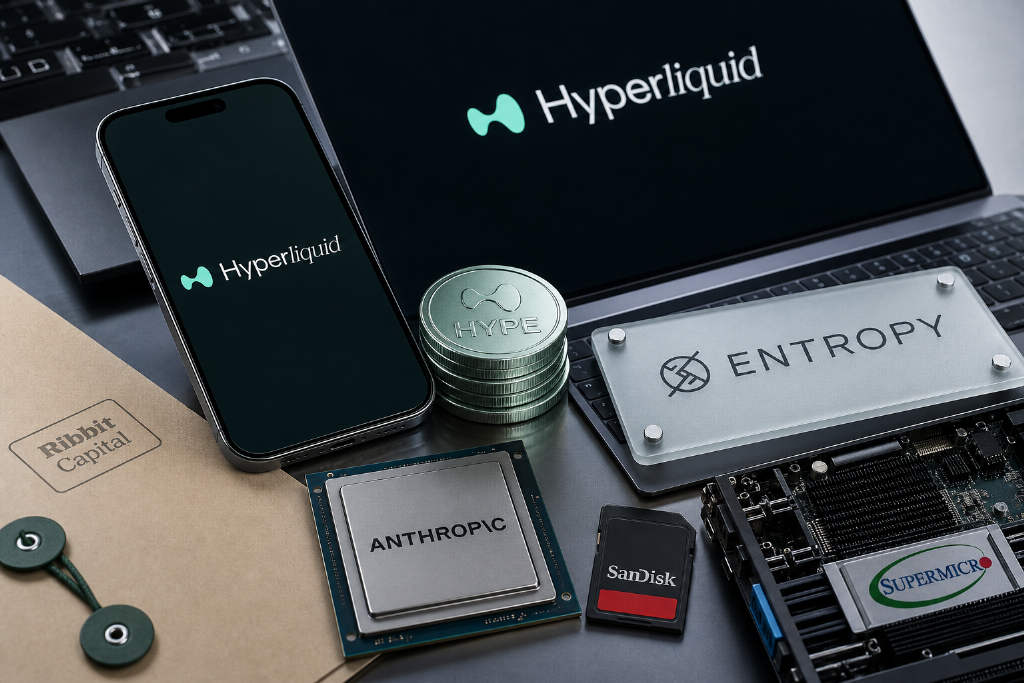
Entropy has raised $14 million in a funding round led by Ribbit Capital and secured about $40 million in HYPE staking support, with its first markets now live on Hyperliquid. The product drawing the most attention is a pre-IPO perpetual contract tied to AI company Anthropic’s valuation. Entropy describes that market as 「the first liquid way to trade Anthropic」.
Foresight News wrote that as HYPE keeps setting fresh all-time highs, attention around Hyperliquid has shifted more closely toward the HIP-3 market segment. Entropy is one of the latest names to emerge from that trend.
Funding and launch details
Entropy said on Aug. 24, 2026 that it had completed a $14 million raise led by Ribbit Capital. It also received roughly $40 million worth of HYPE staking support, and its initial markets have already gone live on Hyperliquid.
The company has publicly identified only Ribbit Capital as the lead investor. It has not disclosed other participating firms, the round stage, or its valuation.
Team background
Based on information released by Entropy, its team includes researchers and traders from Citadel Securities, Optiver, Polymarket, and Millennium.
Those backgrounds line up closely with the product the team is building. Citadel Securities and Optiver are known for market making, liquidity provision, and complex market trading. Millennium is a large investment management firm. Polymarket built order book-based markets for event outcomes. Foresight News said the mix points to strengths in market structure, price formation, liquidity, and trading product design.
Entropy has not published a full founder list on its website or in its documentation. The project’s X account follows several team members, including @Kintsugi_IO, identified as CEO, along with @meower888 and @newpageIO, who previously worked in Chinese-language business development at Polymarket.
What is known about Ribbit Capital
Ribbit Capital is the only investor named in the round. The firm focuses on financial services and fintech, with investments spanning payments, banking, insurance, consumer credit, securities trading, and crypto finance.
The article lists several Web3-related portfolio companies and projects linked to Ribbit Capital, including Coinbase, Fireblocks, Aave, Morpho Labs, Arbitrum, Blockaid, Chainalysis, and Bridge, the stablecoin platform acquired by Stripe.
Entropy’s role inside Hyperliquid
Entropy is a HIP-3 market deployer on Hyperliquid, using the deployer code 「io」.
HIP-3 is Hyperliquid’s market deployment framework for independent teams. A deployer that meets staking and other requirements can use Hyperliquid’s underlying order book, margin, and liquidation infrastructure to build and run its own perpetual markets. The deployer chooses reference assets, sets market parameters, and maintains the oracle.
That means Hyperliquid provides the trading and clearing rails, while Entropy designs and deploys the specific markets. Entropy says it aims to support contract trading tied to global equities, commodities, indexes, pre-IPO companies, and cryptocurrencies.
Markets currently listed
According to the official asset directory, the markets currently listed by Entropy include:
- ANTH, a pre-IPO perpetual contract tied to Anthropic;
- SNDK, a stock perpetual contract tied to SanDisk;
- SMCI, a stock perpetual contract tied to Super Micro Computer, which is not yet live on the platform.
The problems Entropy says it is trying to solve
Entropy argues that while the Hyperliquid ecosystem has made progress with HIP-3 markets, some non-crypto assets still lack mature trading structures. The project groups the current issues into four main categories.
- Pre-IPO products are often short-dated, making it hard to track changes in private-company valuations over longer periods.
- Private companies do not trade continuously, and related markets often have little or no liquidity.
- Perpetual contracts tied to listed equities or public indexes can face high funding rates.
- When the underlying market is closed but the perpetual market keeps trading, thin order books can make manipulation easier.
To address those issues, Entropy puts most of its design work into the oracle system and the funding-rate model.
Oracle design for pre-IPO markets
For pre-IPO companies such as Anthropic, Entropy uses a liquidity-weighted oracle. The system draws on two types of prices at the same time.
- External prices from multiple private-market data sources.
- Internal prices from the midpoint of Entropy’s own order book, smoothed through a moving average.
The weighting between the two depends on executable two-sided depth in the order book. If there is meaningful real depth on both sides, the internal price gets a larger weight, allowing the order book to take part directly in price discovery. If the market is thin or only one side has depth, the system cuts the weight of the internal price and leans more heavily on outside valuation data.
Orders placed too far from the current price and unlikely to trade receive lower weight as well. As long as external data remains available, its share in the pre-IPO oracle never falls below 5%, which is meant to keep the internal book from drifting fully away from outside reference points.
Oracle setup for listed stocks and public indexes
For listed stocks and public indexes, Entropy separates the oracle into regular trading hours and market-closed periods.
When the main public market for a stock or index is open, the oracle takes the public market price directly. Even so, the internal order book still affects the mark price. During regular trading hours, the mark price is the average of two values: the public market price and the 3-minute moving average of the midpoint from Entropy’s order book.
In practice, the oracle stays fully anchored to the public market during open hours, while the mark price reflects both the public venue and Entropy’s own book. The design is intended to capture real trading on Entropy without breaking away from the public market reference.
Once the main market closes and public pricing stops updating continuously, Entropy switches to the liquidity-weighted oracle. At that point, as in the pre-IPO setup, the oracle consists of an internal price and an external price. The external leg comes either from approved after-hours venues or from the last public price before the main market close. The system then assigns weights based on executable depth in Entropy’s order book. Deeper books give the internal price more weight, but the outside reference still keeps a minimum 5% share.
How funding rates are handled
In perpetual futures, funding rates help keep contract prices from drifting too far from oracle prices. For listed equities and public indexes, Entropy adjusts funding-rate intensity based on whether the main market is open.
- During regular trading hours, funding uses 0.5x the result of Hyperliquid’s standard formula.
- When the market is closed, the multiplier falls to 0.125x.
Entropy’s reasoning is that once the underlying public market stops trading, its own order book may begin reflecting new after-hours information. If funding remains too strong, traders could end up paying elevated costs simply because the contract has moved away from the last public price.
Pre-IPO markets also use weaker funding pressure, with a 0.125x multiplier. Entropy says private-market valuations update infrequently, and external oracle data can lag behind new information already reflected in the order book. A lower funding intensity is meant to avoid overcharging traders when the market discovers a price before outside valuation sources catch up.
Trading fees and Growth Mode
Entropy follows Hyperliquid’s HIP-3 fee structure. Before accounting for user volume tiers, HYPE staking discounts, and referral rebates, the standard rates are:
- Maker: 0.030%
- Taker: 0.090%
That schedule is 2x the base rate charged in perpetual markets run directly by Hyperliquid validators. The related protocol fees are split evenly between Hyperliquid and the market deployer.
Entropy’s documentation says ANTH, SNDK, and SMCI all launched with Growth Mode enabled. Under that setting, fees, rebates, and tier-counted volume are all scaled to 10% of their normal level, a 90% reduction. Based on the published base rates, the effective figures in Growth Mode are:
- Maker: 0.003%
- Taker: 0.009%
The actual rate a user pays can still differ because it also depends on weighted 14-day trading volume tiers, HYPE staking discounts, and referral rebates.
The Ventuals example
Foresight News also pointed to Ventuals, another Hyperliquid ecosystem project focused on pre-IPO perpetuals, as a useful reference case.
Ventuals had received support of more than 500,000 HYPE and generated more than $650 million in cumulative trading volume, but the team still announced in June 2026 that it would stop operating and join another team inside the Hyperliquid ecosystem. Its HIP-3 markets were later settled and shut down.
That case shows that even strong HYPE staking support and large cumulative volume do not guarantee long-term operation for a HIP-3 market. A deployer may still wind down markets because of its business model, team changes, weak liquidity, or strategic shifts.
Early-stage participation risks
Foresight News concluded that Entropy is still in an early stage. The project is trying to build a perpetual pricing and trading mechanism for assets in traditional markets that are hard to trade continuously, while supporting a wider range of underlying asset types.
Its core framework is straightforward. Where a reliable public price exists, it uses the public market as the anchor. Where continuous public pricing is missing, it shifts the weighting between outside data and internal book prices according to real executable depth.
For users, the article said that participation still involves trading risk, market continuity risk, and the risk that airdrop expectations may not materialize. It also said traders should weigh fees, funding rates, spreads, and slippage before entering the market. The original piece added a disclaimer that markets carry risk and the article does not constitute investment advice.