
A post on X on Sept. 7 claimed Ethereum’s next major upgrade would let users pay transaction fees in stablecoins rather than ETH. The line spread quickly, and Ethereum community member Leo Lanza pushed back within an hour, saying the protocol would not accept USDC as gas. Gas settlement on Ethereum would still be done in ETH, even if the user-facing payment experience looked like a USDC payment.
EIP-8141 moves onto the roadmap for the 2027 Hegotá fork
At the Aug. 27 Ethereum All Core Developers Execution meeting, EIP-8141 was moved from Considered for Inclusion, or CFI, to Scheduled for Inclusion, or SFI. That places it on the formal roadmap for the 2027 Hegotá hard fork, the next major protocol upgrade after Glamsterdam later this year.
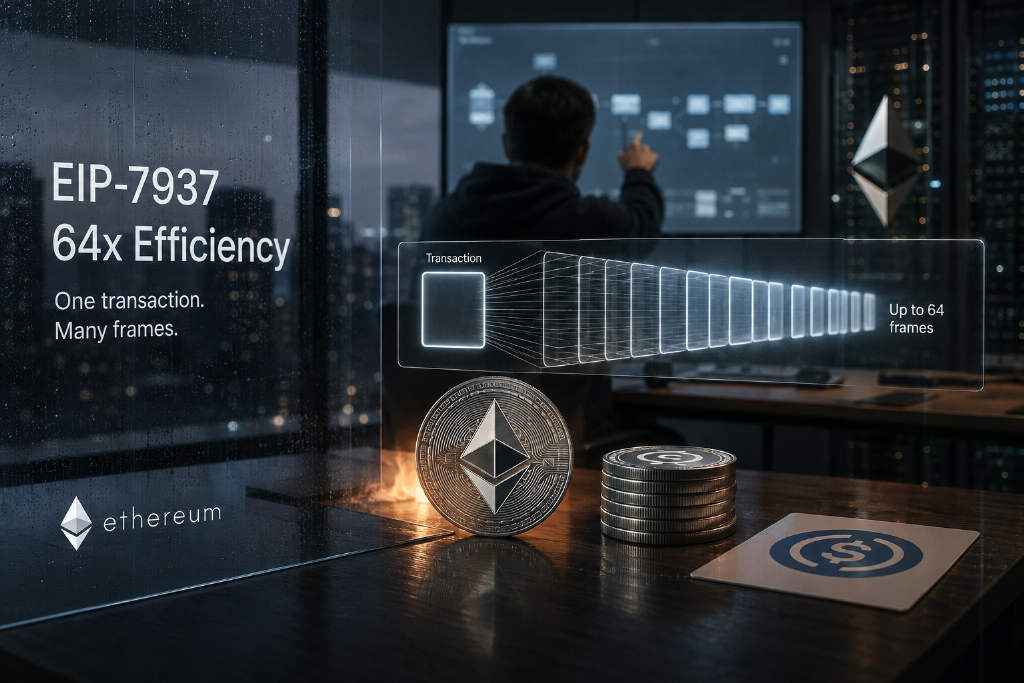
The proposal is called Frame Transactions. It was co-authored by 10 contributors, including Vitalik Buterin. The core idea is to break a single transaction into as many as 64 programmable frames. Each frame can handle a separate function, such as authentication, gas payment or execution, while remaining atomically linked to the rest of the transaction.
That design would let the account sending assets differ from the account paying gas. A payments app could cover gas on a user’s behalf. A DeFi protocol could fold the gas cost into its own service fee. A wallet could deduct the equivalent amount from a user’s stablecoin balance, then use its own ETH reserves to settle the onchain fee.
From the user’s perspective, that can look like paying gas in USDC. At the protocol layer, though, the chain still receives ETH from start to finish.
Under the proposal, the intrinsic cost of a frame transaction is about 12,000 gas, with roughly 475 additional gas for each extra frame. The article says that overhead is small relative to the flexibility the format introduces.
Buterin wrote in an X post on Sept. 6 that work on Frame Transactions had been moving forward quietly over the past few months. Even so, EIP-8141 is still in Draft status, and the specification may change. Activation is still at least a year away.
How it differs from ERC-4337
The user experience behind gas sponsorship is not new. ERC-4337 has been live on Ethereum mainnet since March 2023. It uses smart contract wallets, bundlers and paymasters to produce a similar result: users sign a UserOperation, a bundler packages and submits it, and a paymaster covers the ETH gas fee.
According to the article, ERC-4337 has so far supported more than 40 million smart accounts and over 100 million UserOperations. EIP-8141 overlaps heavily with ERC-4337 at the feature level, but it is aimed at replacing structural weaknesses in that system.
The problem with ERC-4337, as described in the piece, is that it sits outside the Ethereum protocol. UserOperations travel through a separate alt-mempool, bundlers operate offchain, and the EntryPoint contract serves as a singleton hub. As a result, gas costs for ERC-4337-based operations are around 20% to 40% higher than for ordinary externally owned account, or EOA, transactions.
The bundler market is also concentrated. The three largest operators — Pimlico, Stackup and Coinbase — handle about 78% of UserOperation volume.
EIP-8141 is meant to bring those functions into the protocol itself. Frame Transactions would become a native Ethereum transaction type, type 0x06, removing the need for bundlers, an alt-mempool and the EntryPoint contract. In the article’s framing, gas sponsorship, key rotation, multisig, social recovery and even post-quantum signature schemes could become native account capabilities rather than wallet-specific add-ons.
Why the proposal does not automatically erase ETH demand
The concern behind the viral post was straightforward: if users no longer need to hold ETH, they no longer need to buy ETH, and ETH demand would collapse. The article argues that each step in that chain is too simplistic.
What EIP-8141 changes is the distribution of ETH demand, not necessarily the aggregate amount. Under the current model, anyone who wants to do anything on Ethereum usually needs to buy a small amount of ETH first and keep it in a wallet for gas. That spreads gas demand across millions of individual accounts, often with balances of only a few dozen dollars, leaving a large pool of inactive gas reserves.
EIP-8141, along with the paymaster model already running under ERC-4337, would shift that demand toward a smaller set of wallet operators, paymaster providers and app developers. Those entities would need to hold larger ETH balances to keep sponsoring gas. Because they consume gas more frequently than ordinary users, their ETH turnover would also be higher.
The article compares the shift to a highway toll system moving from cash booths to electronic toll collection. Before the switch, every driver needed to carry coins. After the switch, drivers no longer need cash, but the toll operator still has to settle with the road operator in large amounts. The total toll revenue does not change. What changes is who holds the money.
On Ethereum, validators would still receive ETH in the end. That does not change at the protocol level. The EIP-1559 base fee burn mechanism would also remain intact, with the base fee still denominated in ETH and burned on every transaction.
That leads to a narrower conclusion. EIP-8141 may reduce the retail pattern in which each user must buy a small amount of ETH. At the same time, it may concentrate that demand in professional infrastructure operators that buy ETH in larger size and at higher frequency.
A four-layer gas value chain
If EIP-8141 is activated on schedule in 2027, the article says Ethereum’s gas value chain could be split into four layers: users hold stablecoins or other ERC-20 assets; wallet providers or paymaster services collect those assets and buy ETH in bulk; applications absorb gas costs through revenue or direct user charges; and validators receive ETH while the base fee continues to be burned.
In that setup, the application layer stands to gain the most, according to the article. A DeFi protocol or payments app currently has a conversion bottleneck when a user is told to go buy some ETH and move it into a wallet first. That step can turn away potential users who already hold stablecoins. Removing the friction could improve the path from registration to a first transaction.
The piece cites an official Ethereum estimate that ERC-4337 alone brought 20 million new smart accounts in 2024, representing 7x annual growth. A native version of those capabilities through EIP-8141 could accelerate that trend.
Stablecoin issuers could also benefit. If sponsored gas becomes routine, users could hold USDC or USDT by default and still complete all onchain actions. In that model, stablecoins move beyond passive storage assets and become a direct payment medium for blockchain activity. Meanwhile, paymasters buying ETH onchain to pay gas would create a continuing conversion flow from stablecoins into ETH.
ETH ownership could become more concentrated
The article describes the shift as a structural migration in ETH ownership: away from fragmented retail balances and toward larger institutional-style holdings. Total demand may not decline, and it could even rise if conversion improves, but the holder profile would change. Instead of millions of users each holding a small amount of ETH, a few dozen paymasters and wallet operators could end up holding large balances.
That could also alter how ETH prices are formed. Small retail purchases look like light but persistent flow, usually with limited price impact. Concentrated institutional buying arrives in blocks and could create stronger upside pressure when gas demand is high, while weaker periods could also bring more concentrated selling. The article says ETH volatility could start to resemble a wholesale commodity pricing pattern more closely than before.