

Ethereum restructures around three power centers
On July 1, Ethereum Institutional was formally launched to consolidate Ethereum Foundation-related market development efforts into a single team. Its mandate is straightforward: pitch Ethereum’s tokenization and stablecoin capabilities to banks and asset managers, and convert institutional interest into real deployments. Just days earlier, Ethlabs emerged as another major new entity. It was founded by five former senior Ethereum Foundation researchers and is focused on two areas that sit at the heart of Ethereum’s next phase: improving onchain settlement efficiency and building a stronger monetary narrative around ETH.
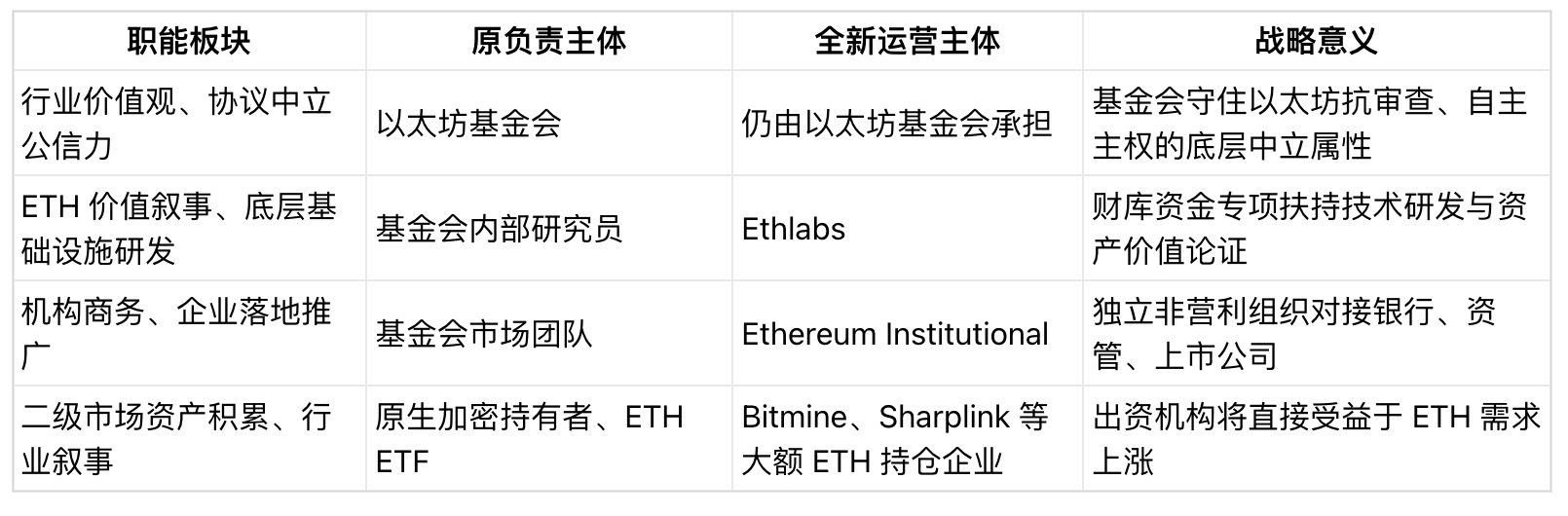
Both organizations are backed by Bitmine, Sharplink, and Ethereum co-founder Joe Lubin. Their arrival is not an isolated development. It comes at a time when senior turnover inside the Ethereum Foundation has accelerated. On June 18, co-executive director Hsiao-Wei Wang announced her departure. Tomasz Stańczak had already submitted his resignation earlier. Over the past five months, at least eight executives have left the Foundation, underscoring a broader internal transition.
The institutional logic behind this restructuring had already been signaled in March 2026, when the Ethereum Foundation released a new operating doctrine. In that framework, the Foundation positioned itself strictly as a guardian of sovereign user choice, censorship resistance, open-source code, privacy, and security. It explicitly rejected the role of Ethereum’s “parent company” and made clear that it does not possess final decision-making authority over the protocol. That stance intentionally leaves commercial execution outside the Foundation’s core mandate.
As a result, Ethereum now effectively operates through three distinct centers of influence. The Foundation is responsible for legitimacy, values, and long-duration protocol stewardship. Ethlabs takes on technical development and ETH value-capture narrative work. Ethereum Institutional handles business outreach, institutional relationship management, and the translation of industry demand into capital inflows and product deployment. This is not merely organizational cleanup. It is a structural answer to Ethereum’s long-running tension between neutrality and market expansion.
Why independent entities were necessary
The logic for spinning these functions out of the Foundation is rooted in credibility. A body that presents itself as neutral and standards-oriented cannot easily function at the same time as a promotional arm for ETH or a sales desk for enterprise adoption. If the same institution is both defining norms and marketing the asset, its neutrality becomes harder to defend. Ethereum appears to have accepted that these roles need to be separated if the Foundation wants to preserve legitimacy.
In this architecture, Ethlabs is tasked with improving core infrastructure and building a coherent thesis for ETH as a monetary asset. That includes reducing institutional concerns around settlement, scalability, and value accrual. Ethereum Institutional, by contrast, is the outward-facing commercial layer. It organizes forums, maintains relationships with major financial entities, and develops tailored pitches intended to move institutions from exploratory conversations to implementation and capital commitment.

The scale of those outreach efforts is already notable. According to Ethereum Institutional, the team has engaged with more than 500 tier-one banks, global asset managers, sovereign funds, custodians, and market infrastructure providers. Its institutional summit reportedly brought together more than 150 senior financial executives representing organizations with a combined $250 trillion in assets under management. That kind of network is one reason the ecosystem chose a standalone operating model rather than keeping the work inside the Foundation as an attached business unit.
Still, the separation creates a new trade-off. By externalizing enterprise development and ETH-facing narrative work, Ethereum solves an execution problem but also hands influence to entities with large direct exposure to ETH. In practice, the channels speaking to Wall Street are now financed by balance sheets that benefit materially from stronger ETH demand. Ethereum has opted for convenience and operational effectiveness, but that choice inevitably reduces distance between ecosystem strategy and whale interests.
Bitmine, Sharplink, and the balance-sheet alignment behind the model
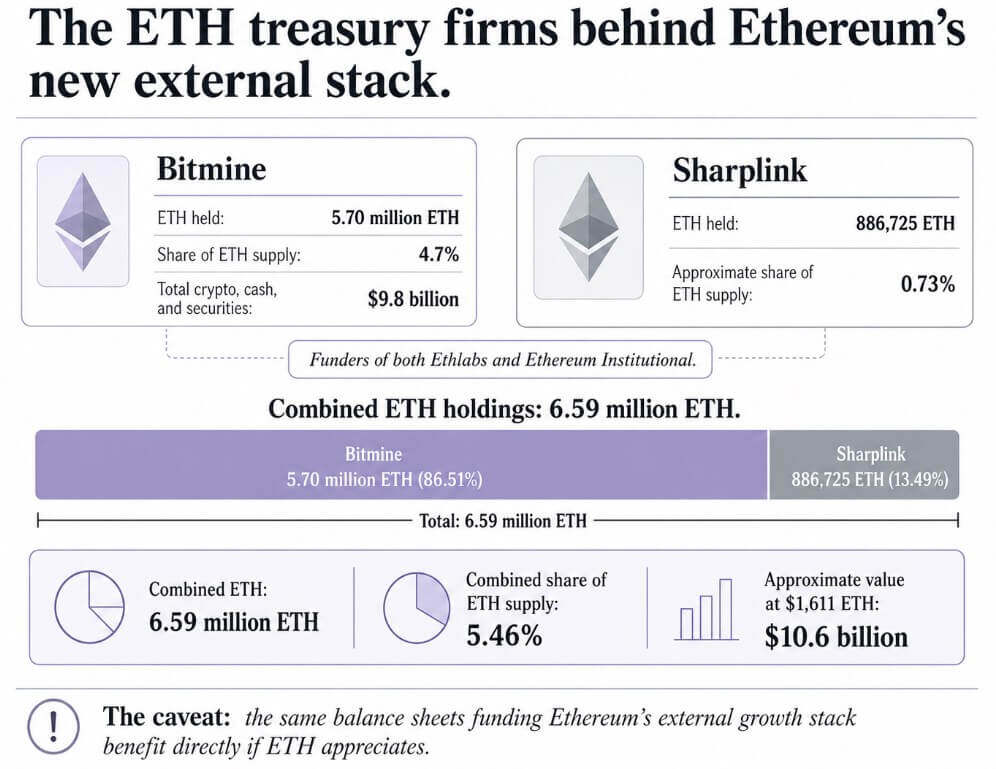
The funding side of this structure is where the incentives become impossible to ignore. Bitmine currently holds 5.7 million ETH, equal to about 4.7% of total ETH supply. Including cash and marketable securities, its total asset base stands at $9.8 billion. Sharplink holds 886,725 ETH and added another 10,000 ETH on June 28 at an average purchase price of $1,611.

Together, the two firms control 6.59 million ETH, or 5.46% of the 120.7 million circulating supply. At current prices, that combined holding is worth nearly $10.6 billion. Bitmine itself has a market capitalization of $6.55 billion, while Sharplink’s market value is above $1 billion. At that scale, even modest ETH price moves can produce mark-to-market balance-sheet swings measured in the hundreds of millions of dollars.
If the current functional split proves successful, those backers stand to benefit directly. Better infrastructure can improve Ethereum’s competitiveness. More mature institutional business development can increase actual deployment and demand for settlement. If demand for ETH rises as a result, the funding firms gain instantly because of the size of their holdings. Joe Lubin, by supporting both nonprofit entities, occupies a central position in this alignment structure. Bitmine and Sharplink, meanwhile, are no longer just investors with an interest in Ethereum. Their financial outcomes are deeply tied to ecosystem expansion.
Infrastructure progress matters more than narrative alone
The long-term success of this restructuring will depend less on messaging than on whether Ethereum can keep improving throughput, costs, and institutional-grade utility. On that front, the network has tangible progress to point to. PeerDAS is already live and can increase Layer 2 data-availability capacity by roughly 10x. The planned Glamsterdam upgrade, expected in the second half of 2026, is aimed at base-layer scaling, parallel transaction processing, and larger block payloads.

A June 2026 academic report found that aggregate transaction throughput across Ethereum mainnet and Layer 2 networks had doubled. Median mainnet fees declined from more than $2 to less than $0.02, while Layer 2 fees fell by more than 95%, reaching as low as $0.0015. Those figures support the argument that Ethereum is making meaningful progress in execution cost and scalability, particularly through its rollup-centric path.
At the same time, the report’s long-range outlook remains restrained. It suggested that before 2034, Ethereum mainnet would still process fewer than 100 transactions per second. It also estimated that Layer 2 throughput would not exceed Solana’s until March 2029, although Layer 2 fees would be far lower by then. This is crucial for assessing Ethlabs’ importance. Institutional adoption of Ethereum is increasingly dependent on Layer 2 expansion, interoperability, and standardization, rather than on the mainnet alone.
Ethereum does, however, retain overwhelming scale advantages in the markets institutions care about most. It currently hosts $157 billion in stablecoins, accounting for more than half of global stablecoin supply. It also holds $37.2 billion in DeFi total value locked, or about 62% of the sector. According to RWA.xyz, Ethereum supports $15.8 billion in tokenized real-world assets out of a total market size of $31.52 billion. Those numbers help explain why Ethereum remains the default institutional chain in many strategic discussions, despite continued debate over performance.

Bull and bear cases now hinge on ETH price and funding durability
The bullish thesis is straightforward. Citibank projects that the global tokenized real-world asset market could expand from roughly $17 billion today to $5.5 trillion by 2030, with a low-end estimate of $2.7 trillion and a high-end scenario of $8.2 trillion. If Ethlabs can keep shipping infrastructure and Ethereum Institutional can convert relationships into real balance-sheet commitments and deployments, then large ETH holders such as Bitmine and Sharplink would likely be among the earliest and biggest beneficiaries. In that scenario, Ethereum further entrenches itself as the default compliant settlement layer for digital assets, and ETH appreciates alongside that role.
The bearish thesis starts with the market itself. Citibank has cut its 12-month ETH target from $3,175 to $2,240, citing weak ETF demand and negative flows, and placed its bear-case scenario at $1,094. Standard Chartered takes the opposite view and continues to argue that ETH could reach $4,000 by the end of 2026. The gap between those forecasts highlights how uncertain the medium-term path remains, even among major institutions.
If ETH remains structurally weak, the risks to Ethereum’s new organizational model become more concrete. Should Bitmine and Sharplink continue trading at a discount relative to the value of their crypto holdings, their ability to fund Ethlabs and Ethereum Institutional could deteriorate over time. Even if the two nonprofit entities remain operational, the stability of their funding base would weaken. At that point, skepticism would likely intensify around whether these organizations are building durable institutional infrastructure or primarily reinforcing the investment case for ETH.

Regulation supports the broader adoption narrative, but it does not guarantee a bull market. In 2025, the U.S. passed the GENIUS Stablecoin Act, creating a federal regulatory framework for stablecoins. Visa, Mastercard, and a Coinbase-led consortium then launched the Open USD stablecoin. More regulatory clarity should increase institutional settlement activity across the digital asset sector, but that benefit is not exclusive to Ethereum. McKinsey’s estimate is also far more conservative than Citi’s, placing the 2030 tokenization market at about $2 trillion. The size of the opportunity itself remains contested.
Ultimately, Ethereum’s latest restructuring resolves one long-standing contradiction while creating another. It reduces the conflict between Foundation neutrality and commercial execution by moving business development and ETH narrative work outside the Foundation. But because those external entities are funded by firms holding enormous ETH positions, the ecosystem’s expansion model is now tightly linked to the balance sheets of large holders. The upside is sharper execution and deeper Wall Street engagement. The downside is a perception, and possibly a reality, of incentive concentration. Over the next year, ETH price action may be the single most important variable in determining which side of that trade-off dominates.