

The Ethereum Foundation Steps Back as Commercial Execution Moves Outward
On July 1, Ethereum Institutional announced its launch, bringing together Ethereum Foundation-related market development efforts into a dedicated organization focused on pitching Ethereum’s tokenization and stablecoin capabilities to banks and asset management firms. Just days earlier, Ethlabs had already emerged. It was founded by five former senior Ethereum Foundation researchers and is centered on two priorities: improving on-chain settlement efficiency and strengthening the broader monetary narrative around ETH.
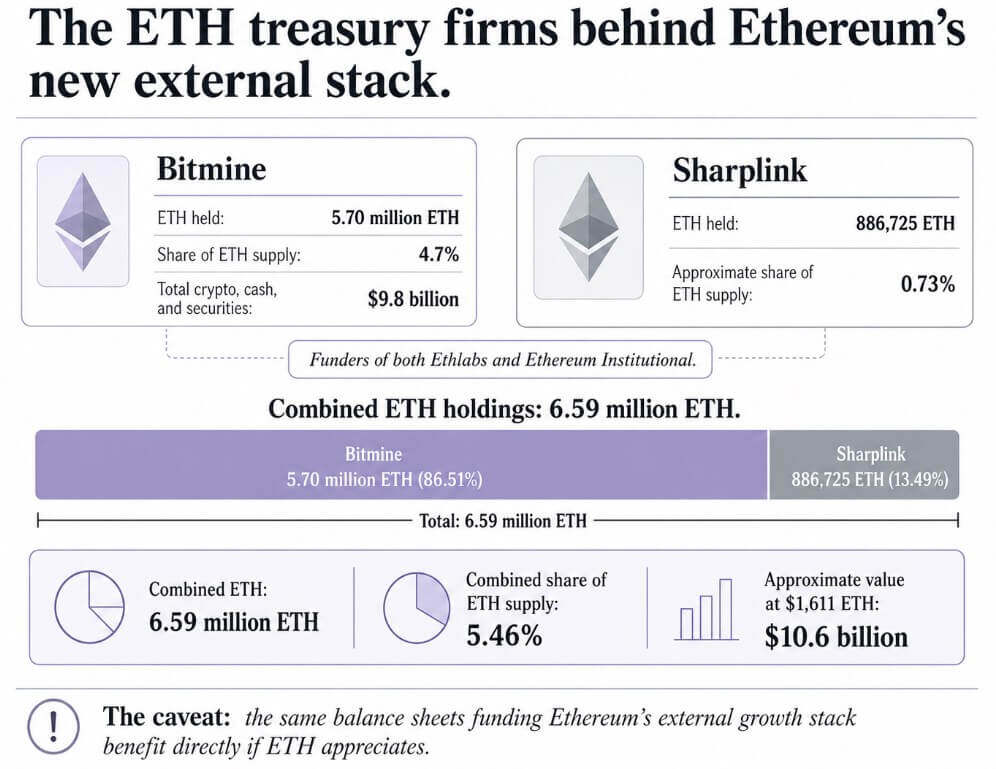
Both organizations are being funded by Bitmine, Sharplink, and Ethereum co-founder Joe Lubin. Their arrival is notable not only because of their mandate, but because of the timing. The Ethereum Foundation has been experiencing a prolonged wave of executive departures. On June 18, co-executive director Hsiao-Wei Wang announced her departure. Before that, Tomasz Stańczak had already submitted his resignation. Over the past five months, at least eight senior executives have left the foundation.
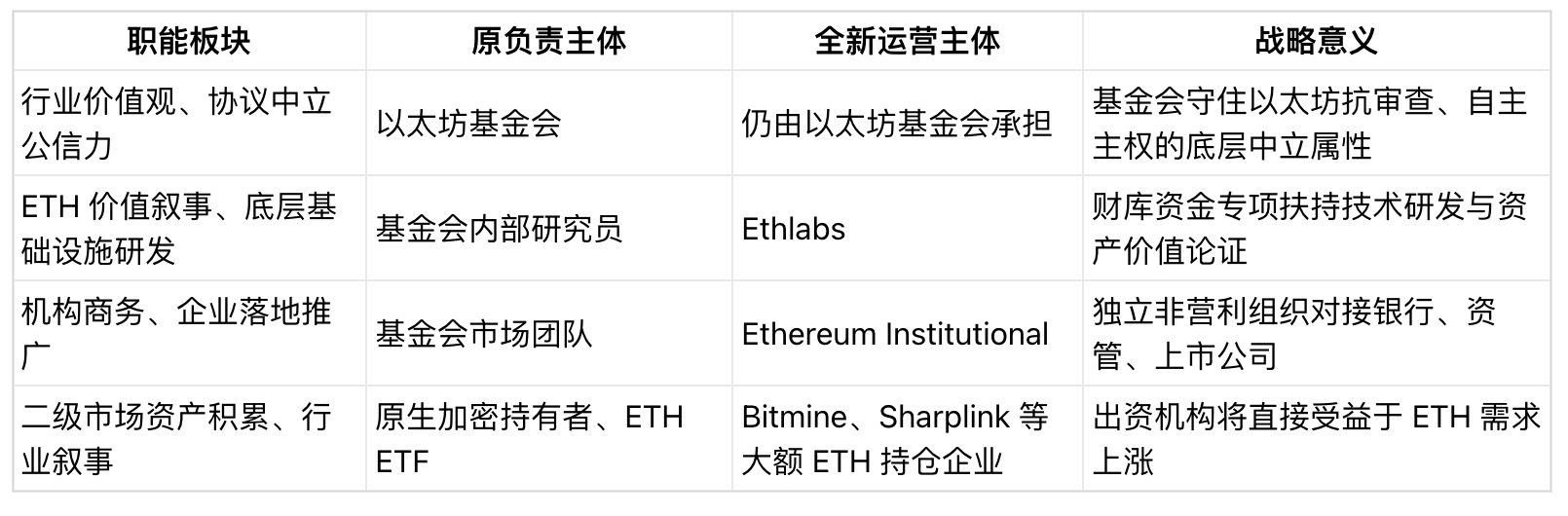
This is consistent with the foundation’s own strategic repositioning. In March 2026, the Ethereum Foundation published a new functional framework that narrowed its role to that of a guardian of sovereignty, censorship resistance, open-source code, privacy, and security. It explicitly declined to present itself as Ethereum’s parent company and did not claim final decision-making power over the protocol. That definition was not merely symbolic. It intentionally left a commercial vacuum to be filled by external organizations better suited to marketing, enterprise engagement, and value communication.
In other words, Ethereum is no longer trying to ask one institution to do everything. The foundation keeps the ideological and protocol center, while the tasks of selling Ethereum to institutions and refining ETH’s value proposition are being handled by separate entities. That division may improve execution, but it also changes where influence accumulates inside the ecosystem.
A Three-Center Power Structure Has Now Emerged
The result is a new three-part structure. The Ethereum Foundation remains responsible for legitimacy, long-term protocol direction, and normative principles. Ethlabs is taking over technical development tied to throughput, settlement readiness, and the argument for ETH as a monetary asset. Ethereum Institutional is handling the commercial layer: industry forums, institutional relationships, outreach campaigns, and turning strategic interest into deployable capital.
There is a clear reason these teams are being run independently rather than from inside the foundation. A neutral standards-setting organization cannot simultaneously act as an ETH promotion arm and an enterprise sales department without damaging its credibility. By splitting the functions, Ethereum is attempting to preserve neutrality at the core while allowing more aggressive market-facing execution at the edge.
Ethereum Institutional has already disclosed substantial reach. According to the organization, it has engaged with more than 500 tier-one banks, global asset managers, sovereign wealth funds, custodians, and market infrastructure providers. Its Ethereum institutional summit brought together more than 150 senior financial executives, representing institutions with a combined $250 trillion in assets under management. That scale helps explain why the work was not left as a side function inside the foundation. The network effects of institutional adoption now require a dedicated interface with traditional finance.

The broader significance is that Ethereum has moved from a relatively diffuse governance and business posture to a more explicit division of labor. The new structure may reduce confusion and sharpen accountability, but it also creates a more visible map of who holds strategic influence in protocol values, infrastructure direction, and institutional access.
Major ETH Holders Are Now Funding the Institutional Push
The benefits of the split are obvious: the execution gap between the Ethereum Foundation’s principles and the market’s demands can be bridged more efficiently. But the cost is equally clear. The channels used to communicate with Wall Street and to frame Ethereum’s institutional case are now tied to parties that hold very large ETH positions and therefore have direct economic exposure to the outcome.
Bitmine currently holds 5.7 million ETH, representing about 4.7% of total ETH circulating supply. Including cash and marketable securities, its total asset base stands at $9.8 billion. Sharplink holds 886,725 ETH and on June 28 added another 10,000 ETH at an average price of $1,611. Combined, the two firms hold 6.59 million ETH, or 5.46% of the 120.7 million ETH circulating supply, with a position valued at nearly $10.6 billion at current prices.
Their corporate market values also matter. Bitmine’s market capitalization is $6.55 billion, while Sharplink’s exceeds $1 billion. If the new organizational model proves effective, both companies stand to benefit directly. Better infrastructure, lower friction for institutional onboarding, and stronger ETH positioning as a settlement and treasury asset could all increase demand for Ethereum. Given the size of their holdings, even modest changes in ETH price can translate into balance-sheet moves worth hundreds of millions of dollars.

Joe Lubin sits near the center of this arrangement by backing both nonprofit organizations. That does not automatically invalidate the model, but it makes the ecosystem’s incentives far more legible. Ethereum has chosen convenience and execution speed over maximal insulation from concentrated capital interests. That choice may accelerate progress, but it also ensures that future debates around independence, narrative control, and governance legitimacy will become sharper rather than weaker.
Scaling Progress Is the Technical Foundation of the Institutional Thesis
Ethlabs is not merely a messaging vehicle. Its importance depends on whether it can help close the gap between Ethereum’s current performance and the demands of large-scale financial settlement. On that front, there are concrete developments. PeerDAS is already live and can raise layer-2 data availability capacity by roughly 10x. The planned Glamsterdam upgrade, scheduled for the second half of 2026, is aimed at base-layer scaling, parallel transaction processing, and larger block payloads.
A June 2026 academic report indicated that combined throughput across Ethereum mainnet and layer-2 networks had doubled. It also showed a major decline in costs: median mainnet fees fell from above $2 to below $0.02, while layer-2 fees dropped by more than 95%, reaching as low as $0.0015. Those numbers are central to Ethereum’s institutional pitch. If the chain can preserve security while pushing execution to lower-cost layers, it becomes far more viable as a financial settlement stack.

At the same time, the long-term outlook in that report was far from euphoric. It projected that before 2034, Ethereum mainnet would still process fewer than 100 transactions per second. It also suggested that only by March 2029 would layer-2 throughput surpass Solana, although at that point layer-2 fees would be far lower. This is a crucial nuance. Ethereum’s institutional future does not rest on mainnet speed alone. It depends on whether layer-2 scaling and standards adoption can form a coherent, reliable operating model for enterprises.
That is precisely why Ethlabs matters. The institutional case for Ethereum is no longer only about ideology, decentralization, or developer culture. It increasingly depends on whether the ecosystem can turn modular scaling into a stable product that large financial actors can actually use with confidence.
Ethereum Has Scale, but the Bull Case and Bear Case Both Remain Intact
The bullish side starts with Ethereum’s existing footprint. The network currently hosts $157 billion in stablecoin value, accounting for more than half of the global stablecoin market. Its DeFi total value locked stands at $37.2 billion, representing about 62% of the sector. According to RWA.xyz, tokenized real-world assets on Ethereum amount to $15.8 billion, compared with $31.52 billion across the broader category. Ethereum remains the leading public blockchain in all three segments.
Citibank projects that the global tokenized real-world asset market could grow from the current $17 billion to $5.5 trillion by 2030, with a low-end estimate of $2.7 trillion and a high-end estimate of $8.2 trillion. If Ethlabs continues to improve the infrastructure layer and Ethereum Institutional can convert relationships into real capital deployment, heavy ETH holders such as Bitmine and Sharplink could emerge as early beneficiaries. In that scenario, Ethereum would strengthen its position as the default compliant settlement layer for digital assets, and ETH’s value would likely benefit in parallel.

The bearish side begins with price and funding sensitivity. Citibank cut its 12-month ETH price target from $3,175 to $2,240, citing weak ETF demand and negative net inflows, and placed its bear-case scenario at $1,094. Standard Chartered, by contrast, maintained a projection that ETH could reach $4,000 by the end of 2026. The gap between those forecasts illustrates just how uncertain the short-term market outlook remains.
If ETH stays weak for an extended period, and if Bitmine and Sharplink continue to trade at discounts to the value of their holdings, their ability to fund Ethlabs and Ethereum Institutional would likely deteriorate. Even if both nonprofits remain operational, the market could increasingly question whether their primary purpose is to build usable institutional infrastructure or to support a higher ETH valuation narrative. That tension cannot be ignored because the entire expansion model is tied, at least financially, to actors with very large ETH exposure.
Regulatory Tailwinds Help, but They Are Not Unique to Ethereum
Regulation supports the broader institutional settlement story, but it does not guarantee that Ethereum alone will capture the upside. In 2025, the U.S. GENIUS Stablecoin Act established a federal regulatory framework for stablecoins. Following that development, a consortium including Visa, Mastercard, and Coinbase launched the Open USD stablecoin. Better regulation is likely to expand the addressable market for all public blockchains that can support compliant digital asset settlement, not just Ethereum.

Forecasts for market size also remain highly contested. While Citibank sees a path to $5.5 trillion by 2030, McKinsey is far more conservative and estimates the tokenization market could be around $2 trillion by that time. That divergence matters because Ethereum’s new institutional structure is being built partly on the assumption that the tokenization opportunity is large enough to justify dedicated infrastructure and enterprise outreach at scale.
Ultimately, Ethereum’s reorganization solves a real contradiction. The foundation can preserve neutrality while specialized external institutions focus on commercialization and technical readiness. But the arrangement also embeds a new dependency: the ecosystem’s expansion machinery is financed by firms that own massive amounts of ETH and therefore benefit directly from stronger demand and higher prices. The upside is faster execution and sharper institutional alignment. The downside is that funding durability, narrative legitimacy, and strategic independence are now more tightly linked to ETH market performance.
That is why the next year matters so much. If ETH stabilizes or strengthens and institutional adoption deepens, the new model may look like a highly effective division of labor. If ETH remains weak and capital support shrinks, the same structure may be criticized as a concentrated attempt to engineer value capture around large holders. For now, both outcomes remain plausible, and Ethereum’s commercial future is increasingly being shaped at the intersection of protocol neutrality, scaling progress, and whale-backed capital formation.