

A new Ethereum structure is emerging as the foundation steps back from commercial execution
On July 1, Ethereum Institutional announced its launch, bringing Ethereum Foundation-related market outreach under a more dedicated structure. Its mandate is straightforward: promote Ethereum’s tokenization and stablecoin capabilities to banks, asset managers, sovereign funds, custodians, and core financial market infrastructure providers. The timing is notable because the launch reflects a broader strategic reorganization rather than a simple branding exercise.
Just days earlier, Ethlabs had already appeared with a different but complementary mission. The organization was formed by five former senior Ethereum Foundation researchers and is focused on two areas that matter directly to institutional adoption: improving onchain settlement efficiency and strengthening the broader monetary narrative around ETH. In practice, that means not only helping Ethereum scale better, but also giving institutions a clearer framework for viewing ETH as a core monetary asset within an increasingly tokenized financial system.
Funding for both new organizations comes from Bitmine, Sharplink, and Ethereum co-founder Joe Lubin. That detail is central to the story, because these are not detached ecosystem grants from a neutral treasury. They come from actors with meaningful exposure to ETH and a clear economic interest in Ethereum’s long-term success. The architecture may be more efficient than the old model, but it is also more explicitly tied to financial incentives.
The transition is happening amid sustained leadership turnover at the Ethereum Foundation. On June 18, co-executive director Hsiao-Wei Wang announced her departure. Before that, Tomasz Stańczak had already submitted his resignation. Over the past five months, at least eight senior executives have left the foundation. Against that backdrop, the emergence of new external bodies looks less like an isolated initiative and more like the institutionalization of a broader shift in how Ethereum governance-adjacent functions are carried out.
The Ethereum Foundation redefined its role, creating space for outside operators
The foundation had already prepared the ground for this transition in March 2026, when it published a new functional charter and redefined its role. It described itself as a steward of values such as sovereignty, censorship resistance, open-source development, privacy, and security. Crucially, it said it is not Ethereum’s parent company and does not possess final authority over protocol decisions. That framing matters because it narrows the foundation’s mission and makes room for other institutions to handle areas the foundation can no longer credibly own.
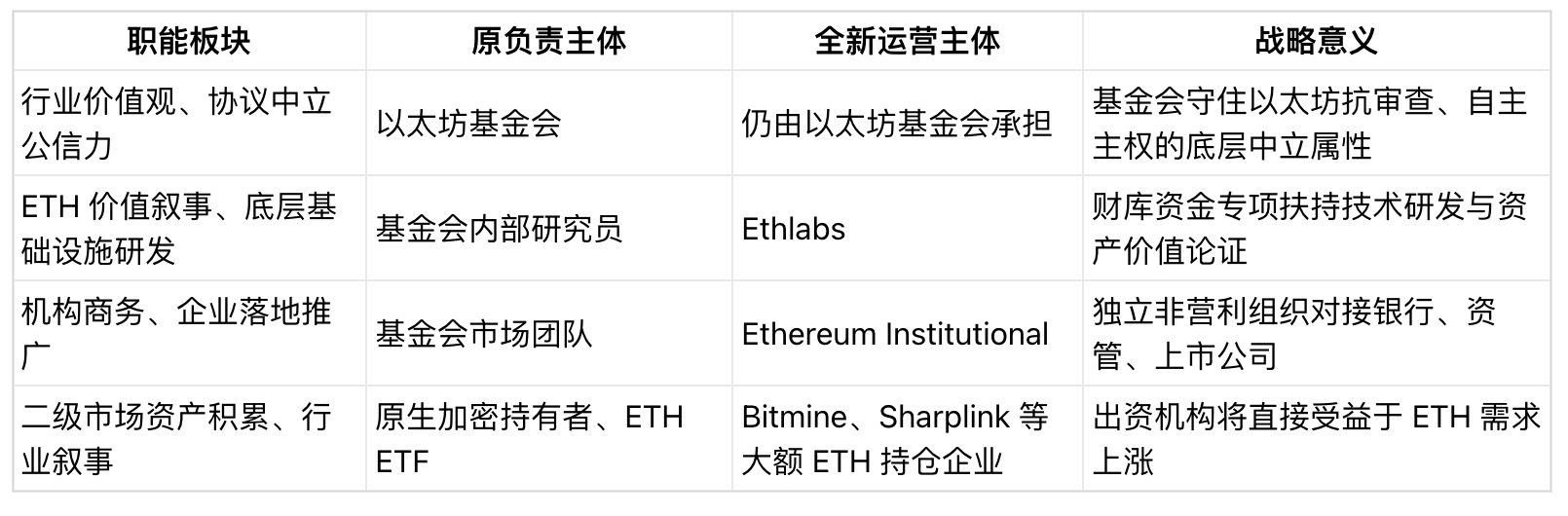
Under this newer model, the Ethereum Foundation protects legitimacy, long-term vision, and core principles. Ethlabs takes over infrastructure development and the work of articulating ETH’s value capture logic. Ethereum Institutional handles relationship-building, institutional sales, and strategic adoption efforts. The split is operationally clean: one body protects neutrality, another improves technology and asset logic, and a third turns industry interest into actual capital deployment.
The reason for the separation is not hard to understand. A body that presents itself as a neutral standards steward cannot easily function as an ETH marketing arm or a corporate sales team without weakening its own credibility. If the same institution both defines norms and actively promotes a specific asset to enterprise buyers, the perception of neutrality quickly becomes compromised. Ethereum’s answer has been structural separation rather than internal compromise.
This solves a real execution problem. The foundation can remain principled and protocol-focused, while more commercially oriented groups can pursue partnerships, roadshows, and tailored institutional pitches. But the trade-off is equally clear: the voice speaking to Wall Street is no longer the foundation. It is increasingly external organizations funded by large ETH-aligned balance sheets.
Three power centers are now visible across the Ethereum ecosystem
As a result, Ethereum now appears to have three distinct power centers. The Ethereum Foundation holds symbolic legitimacy and anchors long-term protocol values. Ethlabs is responsible for technical development, infrastructure enhancement, and strengthening the investment case around ETH. Ethereum Institutional manages outward-facing institutional strategy, including direct engagement with banks, asset managers, sovereign capital, and industry operators. Each center has a different source of authority, and each serves a different strategic need.

Ethereum Institutional has already disclosed the breadth of its network. According to the organization, it is currently connected with more than 500 institutions, including tier-one banks, global asset managers, sovereign funds, custodians, and market infrastructure providers. Its Ethereum institutional summit brought together more than 150 financial executives, representing organizations with a combined $250 trillion in assets under management. Those numbers help explain why this commercial function was spun out instead of left inside the foundation as a secondary activity.
From an organizational standpoint, the arrangement offers speed, specialization, and focus. An external institution can cultivate relationships, build bespoke narratives, and maintain regular commercial contact in ways that a values-first nonprofit foundation often cannot. That makes Ethereum’s institutional push more credible in practical terms. At the same time, however, it shifts influence toward actors who are not merely evangelists but stakeholders with direct market exposure.
That is the central tension in the new model. Ethereum has preserved the foundation’s neutrality, but it has done so by relocating commercial influence. The ecosystem has chosen convenience and execution capacity over a more fully insulated structure. For institutional adoption, this may be effective. For questions of independence and narrative control, it creates an entirely new layer of scrutiny.
Bitmine, Sharplink, and Joe Lubin sit at the center of the financial incentive structure
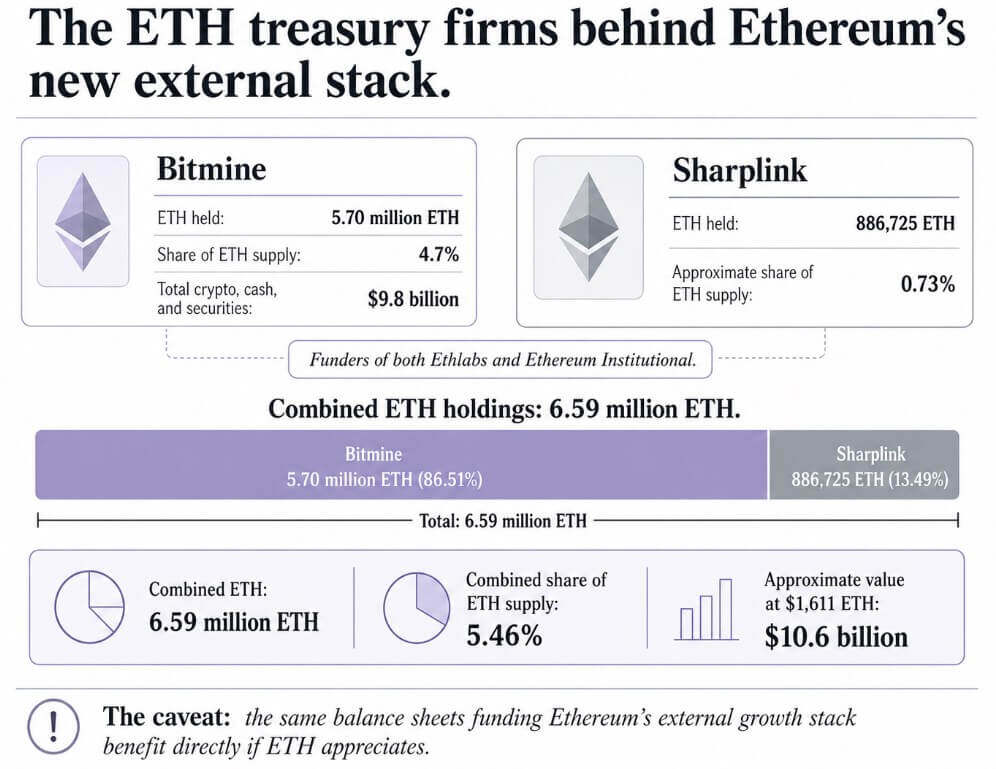
The backing entities are not minor participants. Bitmine currently holds 5.7 million ETH, equivalent to about 4.7% of Ethereum’s total circulating supply. Including cash and marketable securities, its total asset base stands at $9.8 billion. Sharplink holds 886,725 ETH and added another 10,000 ETH on June 28 at an average price of $1,611. These are not symbolic treasury positions. They are strategically significant holdings whose value moves materially with the ETH market.

Together, the two firms hold 6.59 million ETH, accounting for 5.46% of the 120.7 million circulating supply. At current prices, the combined value of those holdings is close to $10.6 billion. Bitmine itself has a market capitalization of $6.55 billion, while Sharplink’s market value exceeds $1 billion. Given that scale, even modest percentage changes in ETH can translate into hundreds of millions of dollars in mark-to-market impact.
If the new operating model succeeds, these funders benefit in multiple ways. Improved infrastructure and stronger institutional distribution would likely raise demand for Ethereum-based settlement, tokenized assets, and stablecoin rails. That in turn could strengthen ETH’s market position and improve the value of the very holdings these entities already control. In that sense, the system is self-reinforcing: capital backs the ecosystem, ecosystem growth supports asset demand, and asset appreciation strengthens the funders’ balance sheets.
Joe Lubin’s role is also notable because he supports both nonprofit organizations while remaining one of Ethereum’s most visible long-term ecosystem figures. This places him near the center of a network where mission, infrastructure, institutional adoption, and financial upside all intersect. None of this proves improper alignment, but it does mean that the ecosystem’s new commercial layer is inseparable from concentrated ETH ownership and direct economic exposure.
Ethereum’s institutional case still depends on scaling, fees, and execution
The bullish case for this reorganization rests partly on real technical progress. PeerDAS is already live and can increase Layer 2 data availability capacity by roughly 10x. The next major step, Glamsterdam, is planned for the second half of 2026 and is intended to support base-layer expansion, parallel transaction processing, and larger block payloads. These are practical improvements, not abstract roadmap talking points, and they matter directly to institutions that care about throughput, certainty, and cost efficiency.

A June 2026 academic report found that transaction throughput across Ethereum mainnet and Layer 2 networks had doubled. Over the same period, median mainnet fees dropped from above $2 to below $0.02, while Layer 2 fees fell by more than 95% to as low as $0.0015. For institutional users evaluating settlement layers for stablecoins, tokenized funds, or other onchain financial products, those metrics are more meaningful than broad ideological claims.
At the same time, the report was restrained in its long-term performance outlook. It suggested that Ethereum mainnet may still process fewer than 100 transactions per second before 2034. It also projected that aggregate Layer 2 throughput would not surpass Solana until March 2029, though by then Layer 2 fees would be much lower than Solana’s. That implies Ethereum’s institutional competitiveness depends less on raw mainnet speed and more on successful execution of a modular scaling model built around Layer 2s and shared standards.
This is where Ethlabs becomes especially important. If Ethereum’s institutional pitch relies on scalable, low-cost, standardized settlement for real-world assets and regulated stablecoins, then the quality of the underlying infrastructure work is not secondary. It is the core of the thesis. The market can tolerate governance complexity more easily than it can tolerate weak performance or fragmented standards.
Ethereum still has the largest scale in stablecoins, DeFi, and tokenized real-world assets
Even with ongoing competition, Ethereum’s current footprint remains a major advantage. The network now hosts $157 billion in stablecoin market capitalization, representing more than half of the global total. It also holds $37.2 billion in DeFi total value locked, equal to 62% of the entire sector. These figures matter because institutional adoption tends to follow liquidity, tooling, and counterparties, not just marketing narratives.

Data from RWA.xyz shows that Ethereum supports $15.8 billion in tokenized real-world assets, compared with $31.52 billion across the full sector. That leaves Ethereum firmly in first place among public chains. For institutions considering where tokenized treasuries, funds, deposits, or other regulated instruments should live, existing market depth and established infrastructure can be more decisive than theoretical future performance on rival chains.
This installed base strengthens the rationale behind both Ethlabs and Ethereum Institutional. One can focus on making the system more scalable and institution-ready, while the other concentrates on converting existing market leadership into enterprise relationships and actual capital flows. The strategy is not being built from zero. It is trying to operationalize an already significant market position.
Price targets, regulation, and funding durability create a two-sided market outlook
The upside case is tied to the broader tokenization boom. Citi projects that the global real-world asset tokenization market could expand from about $17 billion today to $5.5 trillion by 2030, with a lower bound of $2.7 trillion and an upper bound of $8.2 trillion. If Ethlabs keeps improving the infrastructure and Ethereum Institutional succeeds in converting its deep network into real deployments, large ETH holders such as Bitmine and Sharplink could become early structural beneficiaries. In that scenario, Ethereum could emerge as the default compliant settlement layer for tokenized finance.
But the bearish case begins with price. Citi has cut its 12-month ETH target from $3,175 to $2,240, citing weak ETF demand and negative fund flows, and it places ETH at $1,094 in its bear-case scenario. Standard Chartered, by contrast, maintains a much more optimistic view and still sees ETH potentially reaching $4,000 by the end of 2026. The gap between those forecasts underscores the degree of uncertainty surrounding Ethereum’s near-term market path.

That uncertainty matters because the new institutional layer is funded by entities whose own financial capacity is linked to ETH market performance. If ETH remains structurally weak and if Bitmine and Sharplink continue to trade at discounts relative to the value of their underlying holdings, their ability to finance Ethlabs and Ethereum Institutional could shrink over time. Even if both nonprofits continue operating, questions would likely intensify around whether their primary purpose is to build genuinely usable institutional infrastructure or to strengthen the market narrative around ETH.
Regulation supports the broad institutional thesis, but it does not guarantee price appreciation for Ethereum specifically. In 2025, the U.S. GENIUS Stablecoin Act established a federal framework for stablecoins. A consortium involving Visa, Mastercard, and Coinbase then launched the Open USD stablecoin. Those developments can increase institutional settlement demand across the entire digital asset landscape, not only on Ethereum. Meanwhile, McKinsey projects a much smaller tokenized asset market of roughly $2 trillion by 2030, far below Citi’s more aggressive outlook. That gap highlights how uncertain the size of the opportunity still is.
In the end, Ethereum’s restructuring resolves one internal contradiction while creating a new external dependency. It separates the Ethereum Foundation’s neutrality from the ecosystem’s commercial push, which is strategically coherent. Yet it also ties funding, messaging, and business development more tightly to corporations with large ETH balance sheets. The upside is sharper execution and stronger Wall Street engagement. The downside is that the ecosystem’s commercial expansion machinery is now more exposed to ETH’s own market cycle. Over the next year, actual institutional deployments and ETH price performance will determine which side of that trade-off becomes dominant.