

Two New Organizations Mark a Formal Split in Ethereum’s Commercial Functions
On July 1, Ethereum Institutional announced its launch, taking over and consolidating the Ethereum Foundation’s market-facing efforts into a dedicated team. Its mandate is to pitch Ethereum’s tokenization and stablecoin capabilities to banks, asset managers, and other large financial institutions. A few days earlier, Ethlabs debuted as a separate initiative founded by five former senior Ethereum Foundation researchers. Its priorities are more technical and strategic: improving onchain settlement efficiency and reinforcing ETH’s monetary-asset narrative for institutional audiences.
Both organizations are funded by Bitmine, Sharplink, and Ethereum co-founder Joe Lubin. The timing matters. Their launch coincides with continued senior-level departures from the Ethereum Foundation. On June 18, co-executive director Hsiao-Wei Wang announced her exit. Tomasz Stańczak had already submitted his resignation earlier. Over the past five months, at least eight executives have departed from the foundation, signaling a meaningful transition in organizational structure and strategic priorities.
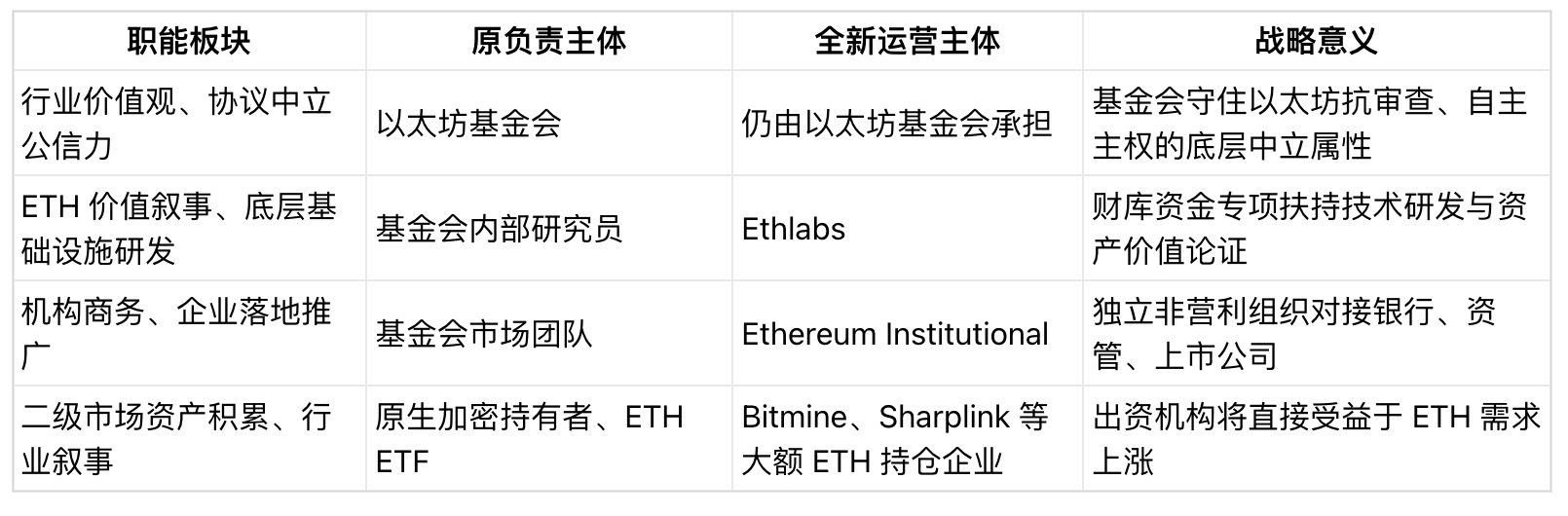
The institutional logic behind this shift was laid out in March 2026, when the Ethereum Foundation published a new operating doctrine. It explicitly stated that the foundation should be seen as a guardian of sovereign participation, censorship resistance, open-source development, privacy, and security—not as Ethereum’s “parent company,” and not as the ultimate authority over protocol decisions. That framing leaves a deliberate gap in execution, especially in the areas of commercial adoption, market education, and institutional sales. Ethlabs and Ethereum Institutional are effectively stepping into that gap.
Ethereum Now Has Three Distinct Centers of Power
The emerging structure is relatively clear. Ethlabs is taking responsibility for technology development and value-capture narrative work. That means building and refining core infrastructure while also strengthening the case for ETH as a monetary asset that institutions can understand, model, and potentially hold with greater conviction. Ethereum Institutional, by contrast, functions as the business-facing arm. Its job is to cultivate institutional relationships, organize industry forums, and turn general interest in tokenization and stablecoin settlement into real capital deployment and actual enterprise integrations.
The reason these functions are being externalized is rooted in credibility. A neutral standards-setting body cannot easily serve as an aggressive sales organization for ETH without compromising trust. If the Ethereum Foundation were simultaneously the ideological custodian of the ecosystem, the steward of open coordination, and the promotional department for ETH adoption, it would undermine the neutrality it now considers central to its legitimacy. By separating those roles, Ethereum is attempting to protect public credibility while improving execution speed.
As a result, three centers of influence have now taken shape. The Ethereum Foundation is responsible for legitimacy, long-term protocol values, and stewardship of core principles. Ethlabs handles research, infrastructure, and the narrative architecture around ETH’s economic role. Ethereum Institutional leads the institutional business development effort, especially with Wall Street and large financial organizations. For outside observers, this is a much more segmented and operationally legible model than the blurred arrangement that existed before.

Ethereum Institutional has already disclosed substantial reach. According to the organization, it is in contact with more than 500 institutions, including tier-one banks, global asset managers, sovereign wealth funds, custodians, and market infrastructure providers. Its Ethereum institutional summit reportedly brought together more than 150 financial executives from organizations representing a combined $250 trillion in assets under management. That scale of connectivity helps explain why the commercialization function was not retained as an internal department of the Ethereum Foundation.
Major ETH Holders Are Also the Primary Financial Beneficiaries
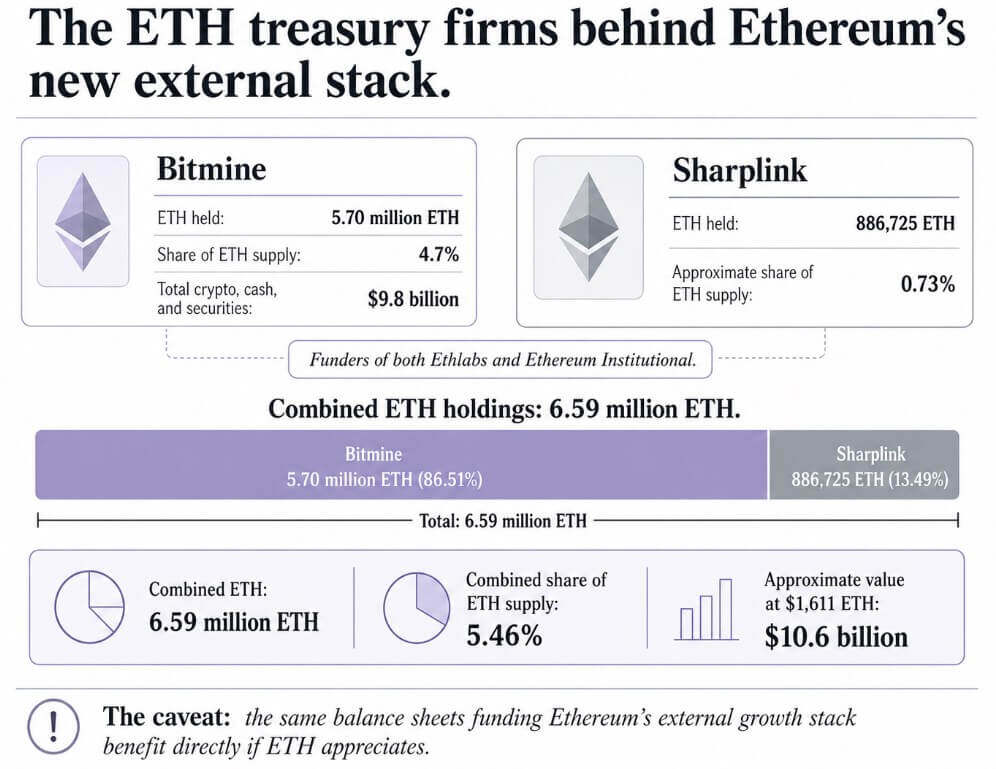
Handing business outreach and ETH-focused advocacy to independent groups solves one problem but creates another. The channels through which Ethereum now markets itself to Wall Street are heavily financed by entities that already own enormous ETH positions. In practice, this means some of the most important voices shaping institutional adoption are backed by organizations whose balance sheets are directly leveraged to the ETH price. Ethereum has chosen operational convenience and execution capacity, but at the cost of a looser separation between ecosystem development and holder incentives.
Bitmine currently holds 5.7 million ETH, representing about 4.7% of total ETH supply. Including cash and marketable securities, its total asset base stands at $9.8 billion. Sharplink holds 886,725 ETH and added another 10,000 ETH on June 28 at an average purchase price of $1,611. Combined, the two firms control 6.59 million ETH, or 5.46% of the 120.7 million circulating supply. At current prices, that stockpile is worth nearly $10.6 billion. Bitmine’s own market capitalization is listed at $6.55 billion, while Sharplink’s market cap is above $1 billion.

If the new operating model works, the economic benefits to those backers are obvious. Better infrastructure and stronger institutional onboarding could increase ETH demand, and even modest price moves would translate into hundreds of millions of dollars in mark-to-market changes for entities with positions that large. Joe Lubin, who supports both nonprofit organizations, sits near the center of this incentive system. The financial outcomes of Bitmine and Sharplink are therefore deeply intertwined with Ethereum ecosystem growth and with the success of these newly separated organizations.
The downside is equally important. If ETH remains structurally weak over a prolonged period, or if the equities of Bitmine and Sharplink continue trading at a discount relative to their crypto holdings, their ability to finance ecosystem-building efforts could shrink. Even if Ethlabs and Ethereum Institutional remain operational, funding stability would deteriorate. In that environment, the market could increasingly question whether these organizations exist primarily to build durable institutional-grade infrastructure or to support the price narrative around ETH itself.
Scaling Progress Is Real, but Institutional Adoption Still Depends on Layer 2 Execution
From a technical standpoint, Ethlabs is not dealing with abstract branding concerns alone. Its mission is linked to measurable performance bottlenecks. PeerDAS has already gone live and is expected to increase data availability capacity for layer-2 networks by roughly 10x. In addition, the Glamsterdam upgrade, planned for the second half of 2026, is aimed at improving base-layer scalability, enabling parallel transaction processing, and increasing effective block payload capacity.

An academic report published in June 2026 found that combined throughput across Ethereum mainnet and layer-2 networks had already doubled. During the same period, median mainnet fees fell from above $2 to below $0.02. Layer-2 fees declined by more than 95%, reaching levels as low as $0.0015. These numbers show that Ethereum’s scaling roadmap is producing tangible improvements in cost and throughput, which is critical for any serious institutional settlement pitch.
Still, the long-term performance projections in that same report remain sobering. It suggests that before 2034, Ethereum mainnet transaction processing will still remain below 100 transactions per second. Layer-2 throughput is not expected to surpass Solana until March 2029, although by then the cost of using Ethereum-aligned L2s would be far lower than Solana’s fees. This is a crucial point: Ethereum’s institutional case depends less on mainnet dominance than on whether the broader L2 ecosystem can deliver reliable scale and become a credible industry standard. That challenge sits squarely in Ethlabs’ remit.
Bullish and Bearish Cases Coexist in Plain Sight
The bullish case starts with scale. Ethereum currently hosts $157 billion in stablecoins, accounting for more than half of the global stablecoin market. It also holds $37.2 billion in DeFi total value locked, or about 62% of the entire sector. According to RWA.xyz, tokenized real-world assets on Ethereum amount to $15.8 billion, compared with a sector-wide total of $31.52 billion. In other words, Ethereum remains the leading public chain for several of the most institutionally relevant crypto verticals.

Citi projects that the tokenized real-world asset market could grow from about $17 billion today to $5.5 trillion by 2030, with a range spanning from $2.7 trillion on the low end to $8.2 trillion on the high end. If Ethlabs continues improving infrastructure and Ethereum Institutional successfully converts institutional relationships into deployed capital, then large ETH holders such as Bitmine and Sharplink could emerge as early beneficiaries. Under that scenario, Ethereum could strengthen its position as the default settlement layer for compliant digital assets, and ETH itself would likely capture part of that value accrual.
The bearish case begins with price and demand trends. Citi has cut its 12-month ETH target from $3,175 to $2,240, citing weak ETF demand and negative fund flows. It also outlined a bear-case scenario of $1,094. Standard Chartered has taken the opposite view, maintaining that ETH could reach $4,000 by the end of 2026. The scale of that disagreement is itself informative: the near-term outlook remains highly uncertain, even among major institutions evaluating the same asset class.
Regulation supports the broader bull thesis but does not guarantee Ethereum-specific upside. In 2025, the U.S. GENIUS Stablecoin Act created a federal regulatory framework for stablecoins. Visa, Mastercard, and a Coinbase-led consortium then launched the Open USD stablecoin. That kind of regulatory clarity can expand institutional settlement activity across the entire blockchain industry, not just Ethereum. Meanwhile, McKinsey’s estimate for the tokenization market in 2030 is only about $2 trillion, far below Citi’s upper-end scenario. That gap highlights how uncertain the total addressable market still is.

Conclusion: Ethereum Solved a Neutrality Problem, but Increased Its Funding Dependency
By splitting responsibilities and enabling Ethlabs and Ethereum Institutional to operate independently, Ethereum has addressed a long-standing internal contradiction. The Ethereum Foundation can preserve a neutral public posture while specialized groups focus on infrastructure, market development, and institutional adoption. That is a meaningful structural evolution, and it may improve both clarity and execution across the ecosystem.
At the same time, the arrangement comes with a sharper dependency on large ETH-backed balance sheets. The system now relies more directly on the willingness and financial strength of major ETH holders to keep funding adoption, narrative-building, and ecosystem expansion. The upside is a more professional, Wall Street-ready operating model. The risk is that the durability of that model is tethered to ETH price performance, equity valuations, and market confidence. Over the next year, the trajectory of ETH itself may determine whether this restructuring is remembered as a strategic breakthrough or as a fragile alignment of convenience and incentives.