
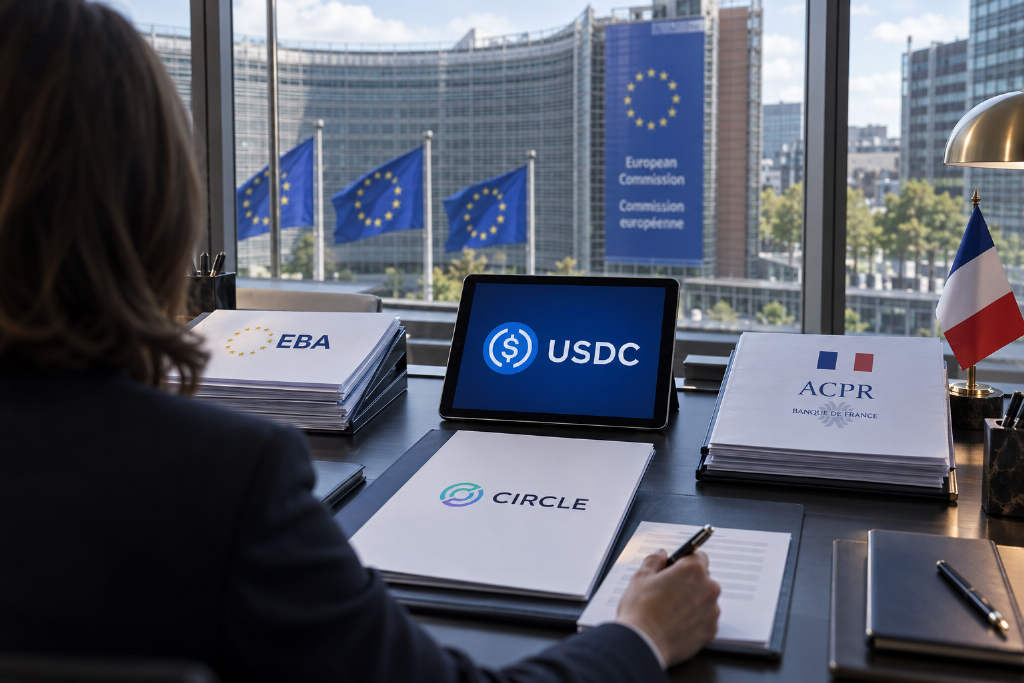
The European Union has designated USD Coin (USDC), the dollar-pegged stablecoin issued by Circle, as a "significant" electronic money token, or EMT, under the Markets in Crypto-Assets (MiCA) framework. EBA data cited in the report shows there are currently 45 electronic money tokens notified across the EU, and USDC is the first product to receive this "significant" classification.
The designation does not mean USDC only just obtained permission to operate in Europe. It also does not mean the token’s issuance model has changed. The main shift is that USDC has been moved into a higher tier of oversight, showing that the EU’s approach to large stablecoins is extending beyond basic compliance and into systemic risk management.
Why USDC was singled out
USDC is used widely in crypto trading, on-chain settlement, DeFi, and cross-border payments.
The report draws a distinction between stablecoins and other crypto assets: stablecoins are not meant to create value through price appreciation. Their core function is to maintain a peg to fiat currency. From a user’s standpoint, safety comes down to the issuance structure, the quality of reserve assets, liquidity, and whether redemptions can be completed smoothly.
Once a stablecoin reaches large enough scale, the risk is no longer confined to a single crypto platform. If the market faces concentrated redemptions, if reserve assets lack liquidity, or if the issuer runs into operational trouble, the impact can move through exchanges and payment businesses and reach a broader set of financial activities.
MiCA includes an upgraded supervisory mechanism for stablecoins that reach certain scale thresholds. In USDC’s case, being classified as a significant EMT means regulators will pay closer attention to reserve and liquidity management rather than limiting supervision to a basic review of the issuer’s operating qualifications.
The report also stresses what this designation is not. It is not a blanket seal of approval for USDC. The EBA decision raises the supervisory level; it does not exempt the token from scrutiny.
Dual supervision starts on Nov. 12, 2026
According to the EBA notice referenced in the report, USDC will move into a dual-supervision model starting Nov. 12, 2026.
The EBA will take direct responsibility for oversight of own funds, reserve assets, liquidity indicators, business recovery measures, and redemption plans. France’s Prudential Supervision and Resolution Authority (ACPR) will continue to handle corporate governance, qualifying shareholders, senior management appointments, outsourcing arrangements, and conflicts-of-interest reviews.
At the same time, the EBA has signed a memorandum of understanding with the New York State Department of Financial Services to strengthen information sharing tied to cross-border stablecoin supervision.
That setup shows stablecoin oversight is no longer a narrow, single-country compliance matter. For issuers operating across multiple regions, coordination between regulators is becoming increasingly important.
The report makes another clarification here: a redistribution of supervisory duties does not mean USDC is facing a shutdown, and it should not be read as a sign that something is wrong with reserve assets. The announcement is a regulatory upgrade, not a penalty, and not evidence of a crisis at the issuer.
Competition is shifting beyond scale
Over the past few years, competition in the stablecoin market has centered largely on liquidity, trading depth, real-world use cases, and exchange distribution.
As compliance requirements rise, issuers now have more to account for.
One factor is reserve-asset management. Issuers need not only to keep reserves aligned with circulation, but also to withstand pressure from concentrated redemptions during market stress.
Another is liquidity and risk response. Whether a stablecoin can meet redemptions in full during a run has a direct effect on market confidence.
There is also the matter of compliance cost and business scope. Tougher regulation means issuers must commit significant staffing and capital to reporting, risk controls, and coordination with multiple authorities. At the same time, compliant products may find it easier to enter traditional finance and enterprise payment settings.
Cross-border regulatory coordination is another point. Stablecoins can move internationally over blockchain networks, but issuers, reserve custodians, and user-facing services may be spread across different jurisdictions. Local standards and information-sharing arrangements can shape how the business operates.
Even so, the report does not argue that compliance alone will decide the market. Liquidity, fees, user experience, exchange support, and real business demand remain central. Regulation is one variable, not the whole story.
Three signals for the broader market
The report says USDC’s designation as a significant EMT sends at least three signals to the industry.
- First, MiCA stablecoin rules in the EU are moving from written legislation to direct application on real products. Issuers and service providers across the stack now have to deal with hard requirements tied to reserves, liquidity, and redemption mechanisms.
- Second, the connection between compliant stablecoins and traditional finance is likely to deepen, while entry thresholds rise at the same time. Companies looking to conduct stablecoin payments, custody, and related business in Europe may become more cautious in product selection and compliance-risk assessment.
- Third, over the long run, the outcome in the stablecoin sector will not be determined only by which issuer has the largest supply. The key differentiator may lie in how well a product balances capital efficiency, user experience, regulatory constraints, and risk controls.
The report also notes that this status for USDC does not mean other stablecoins will have to leave the European market, nor does it mean USDC will automatically gain market share. Each product’s regulatory standing, issuance structure, and business setup still need to be assessed on their own terms.
What the market will watch next
The report describes the EU’s decision to tighten oversight of USDC as a notable moment for the stablecoin sector.
It points to a clear trend: as stablecoins increasingly take on infrastructure roles in on-chain settlement and payments, regulators are looking past licensing and into the underlying risks tied to reserve assets, liquidity, and redemption capacity.
The next focus for the industry will be twofold. One is how strongly the new supervisory arrangement is enforced after Nov. 12. The other is whether additional stablecoins are later brought into the same level of regulatory assessment.
Competition among stablecoins is not stopping. The yardstick used to judge them, though, is getting broader.