
Stablecoin regulation in the European Union and the United States will reach two key milestones in January 2027. EU-authorized crypto-asset service providers must address existing exposure to non-compliant stablecoins by January 8, while the US Office of the Comptroller of the Currency (OCC) will put its final rule implementing the GENIUS Act into effect on January 18. In an article authored by Cobo, the company argues that institutions now need digital-asset infrastructure capable of handling different jurisdictional rules across custody, treasury management and on-chain transfers—not just wallets that support multiple tokens.
The two dates reflect a shift in the regulatory perimeter, the article says. Cross-border firms will need to identify more than a token’s symbol: relevant factors include its issuer, regulatory status, customer jurisdiction, transaction purpose and the service being provided.
EU guidance brings custody and transfers within scope
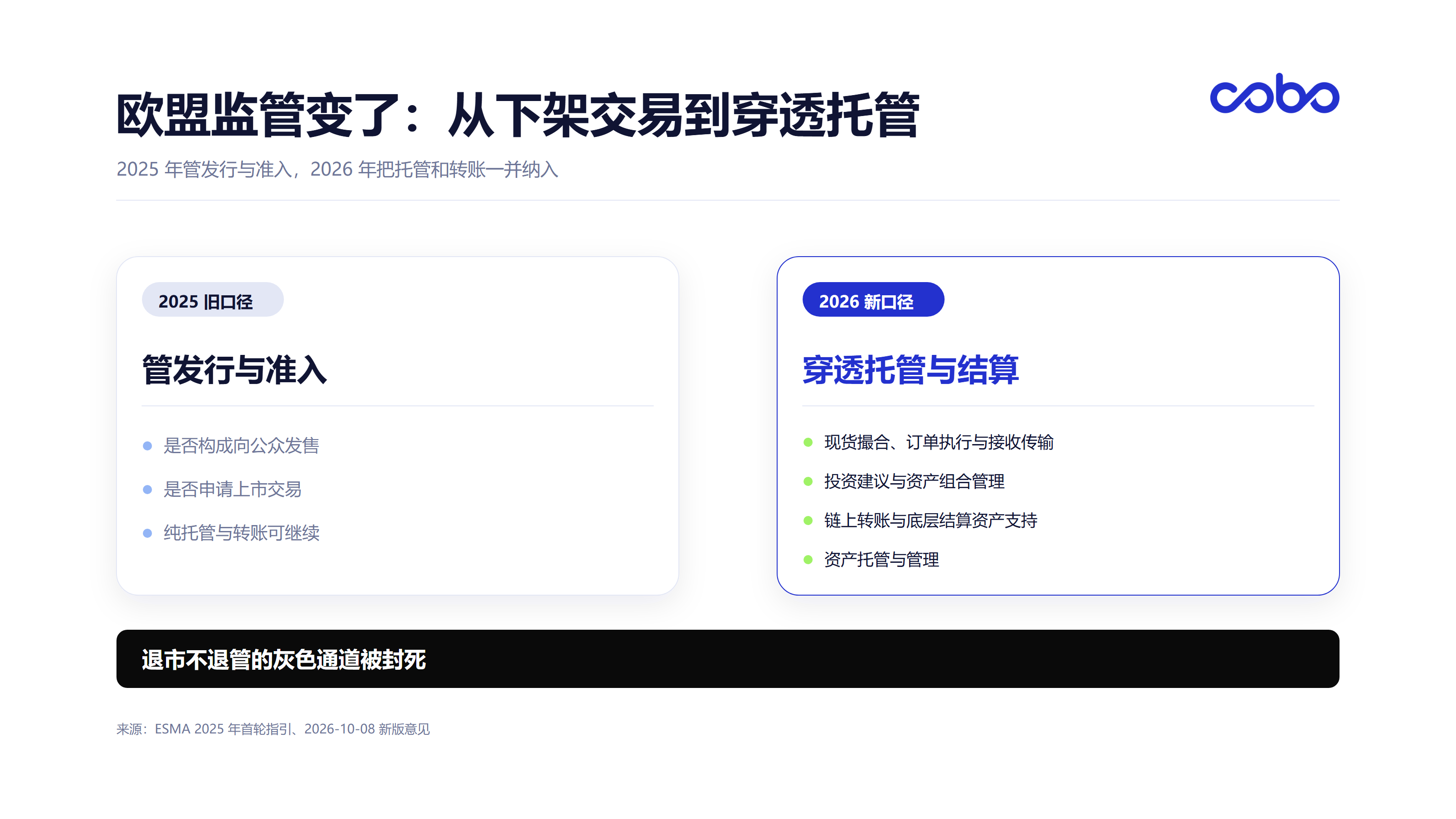
EU guidance evolved over the past year and more. In early 2025, European Commission Q&A documents and initial guidance from the European Securities and Markets Authority (ESMA) focused largely on whether a platform’s activity amounted to an offer to the public or an admission to trading. If a stablecoin issuer lacked EU authorization, platforms had to stop services that could constitute a public offer or trading admission.
During the transition period, ESMA said platforms could continue providing custody and transfer services on their own, allowing customers to hold existing assets and make necessary transfers. That helps explain why some European-compliant trading platforms continued to offer deposits, withdrawals or custody for assets such as USDT after delisting them in 2025.
ESMA changed its approach in an opinion issued on October 8, 2026. It told national regulators to require MiCA-authorized crypto-asset service providers (CASPs) to stop offering EU customers services involving non-compliant asset-referenced tokens (ARTs) and e-money tokens (EMTs). The scope includes spot matching, order execution and order reception and transmission; investment advice and portfolio management; on-chain transfers and support for underlying settlement assets; and custody and administration.
The revised guidance closes the route of removing trading pairs while continuing to serve non-compliant stablecoins through custody or transfer services. ESMA asked national regulators to ensure that licensed providers remediate their existing exposure within three months, setting January 8, 2027, as the deadline.

Requirements for compliant stablecoins are also becoming more specific. On October 14, the European Banking Authority (EBA) designated Circle’s USDC as the EU’s first e-money token of significant importance. From November 12, the EBA began directly overseeing USDC’s own funds, reserve assets, liquidity requirements, and recovery and redemption plans. France’s Autorité de contrôle prudentiel et de résolution (ACPR) remains responsible for other areas, including governance, outsourcing and conflicts of interest.
Cobo’s article characterizes this as a move beyond a simple permitted-or-prohibited distinction. The regulatory framework is developing around issuer authorization, reserve management, liquidity and continuing supervision. Compliance status is becoming a threshold for stablecoins seeking access to mainstream financial markets.
US rule details reserve, custody and liquidity requirements
The US is taking a different legislative route through the GENIUS Act, establishing a federal framework for payment stablecoin issuance and related activities. On October 21, 2026, the OCC published the final implementing rule, 12 CFR Part 15, which is scheduled to take effect on January 18, 2027. It covers reserve assets, redemption mechanisms, risk management, audit reports, custody, capital requirements and ongoing supervision of issuers.
The article says the EU and US approaches share a growing level of detail: both are moving beyond broad licensing rules and into reserve liquidity, segregation of asset ownership and custody practices. The US final rule adds a legal definition of a Payment Stablecoin Holder. It distinguishes beneficial owners, who hold the economic interest, from custodians that control assets on their behalf, laying a legal foundation for segregated custody and fiduciary responsibilities.
On liquidity, issuers must conduct stress tests to demonstrate their ability to convert assets into cash under extreme conditions. If redemption requests for a single brand exceed 10% of its circulating supply within 24 hours, the issuer must notify the OCC within 24 hours.
The final rule also changes how the interest ban will be assessed. It removes a draft provision that would have presumed that rewards provided by affiliates or third parties violated the ban. Instead, regulators say they will scrutinize rewards, distribution arrangements and revenue-sharing agreements case by case, based on their economic substance, during licensing and ongoing supervision. Cobo’s article says the approach has prompted a new contest between traditional Wall Street banks and stablecoin issuers over deposits and the movement of funds.
The EU remediation deadline and the US effective date are 10 days apart. Cobo says the cross-border model of relying on one public blockchain and a major dollar stablecoin to move global liquidity will face clearer jurisdictional boundaries after these rules take effect. The same stablecoin may face different requirements in different markets. Circle’s EU-licensed entity, Circle SAS, has received the relevant authorization, but that does not automatically give other dollar stablecoins the same regulatory status.
Three infrastructure priorities for institutions
Exchanges, cross-border payment providers and asset managers have little time to rely on manual delistings, currency conversions and spreadsheet reconciliation to meet the coming requirements. The article says an architecture built around a few major stablecoins such as USDT and USDC, with a multi-chain wallet for storage and transfers, may no longer meet institutional needs as rules diverge across jurisdictions. Cobo identifies three areas for infrastructure upgrades.
Identify assets by issuer and use case
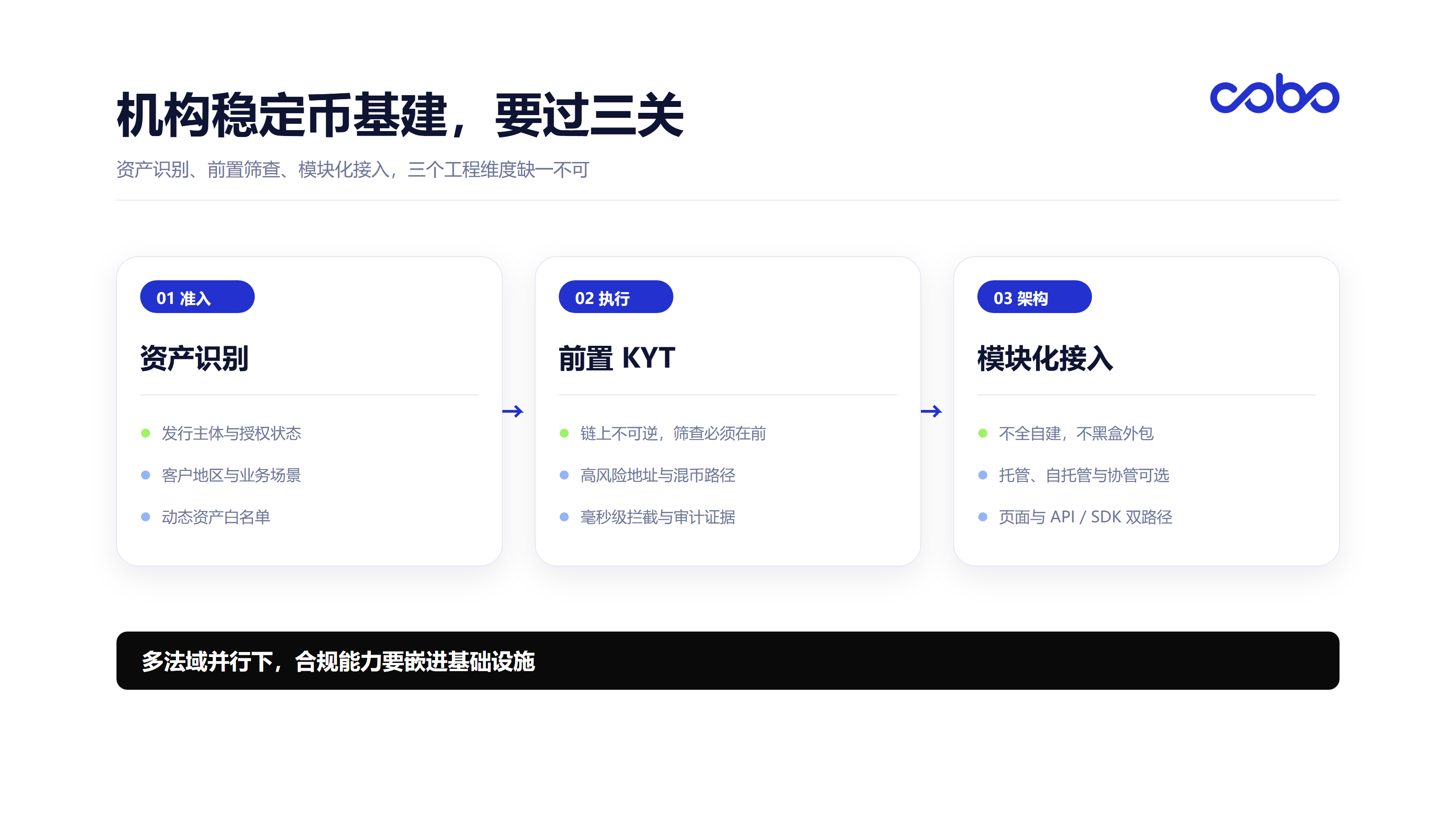
Systems need to recognize a stablecoin’s issuer, authorization status and permitted scope, then maintain dynamic asset allowlists for each jurisdiction in which a business operates. Compliance checks cannot stop at the token itself. They must connect the token and its issuer with the white paper, customer location and specific business use case.
Screen transfers before on-chain settlement
ESMA’s expanded scope includes transfer services, while the US is strengthening anti-money-laundering and source-of-funds scrutiny. Because a confirmed on-chain stablecoin transfer cannot be reversed, compliance checks need to take place before funds move.
Cobo says its enterprise stablecoin payment offering combines know-your-transaction (KYT) monitoring data with AI-assisted risk analysis. The company says the system checks for high-risk addresses, unusual mixing routes and links to restricted parties during millisecond-level payment and cross-chain consolidation flows, giving compliance teams pre-transaction controls and traceable audit evidence.
Use modular systems instead of choosing between full in-house builds and opaque outsourcing
For payment firms pursuing MiCA licenses or connecting to US-compliant channels, building from scratch across dozens of blockchains can take months. The work may include deposit and withdrawal consolidation, gas-fee management, multi-party computation (MPC) key security and risk controls for several jurisdictions, while regulatory details continue to change. Relying entirely on a closed third-party system, on the other hand, may raise concerns over independent control of assets and outsourcing-risk management.
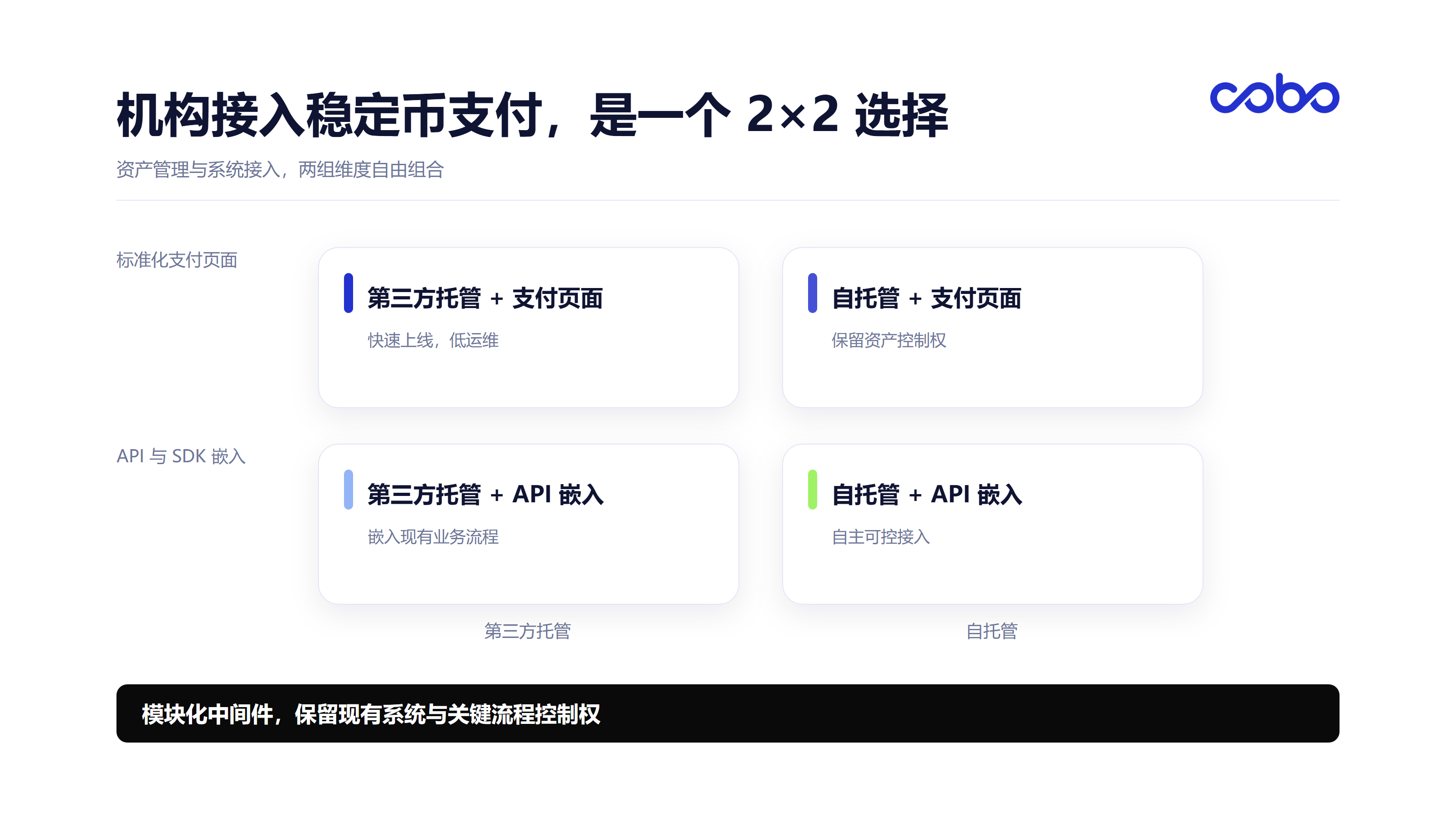
Cobo has proposed a 2×2 stablecoin infrastructure access matrix as a middle route. Depending on licensing status and risk preferences, a business can choose compliant third-party custody or self-custody and co-managed arrangements using MPC threshold signatures. The article says these options can avoid a single point of failure while preserving control over funds. Firms can use standardized payment pages for a faster launch, or integrate on-chain settlement, dynamic consolidation across currencies and compliance screening into existing payment gateways and treasury systems through APIs or SDKs.
Cobo says a modular middleware architecture can let institutions change supported assets for a particular jurisdiction without rebuilding their systems. They can retain existing licensed entities and core business flows while migrating to a stablecoin setup designed for multiple regulatory jurisdictions.
The article concludes that the EU’s January 8 ESMA deadline and the US rule’s January 18 effective date need not stop stablecoin expansion, but could bring an end to its earlier, less regulated growth phase. It frames the institutional challenge this way: multi-chain support addresses how assets move, while multi-jurisdiction compliance determines whether they can be managed and used lawfully. Cobo authored the article, which states that it is not investment advice and that investment involves risk.