
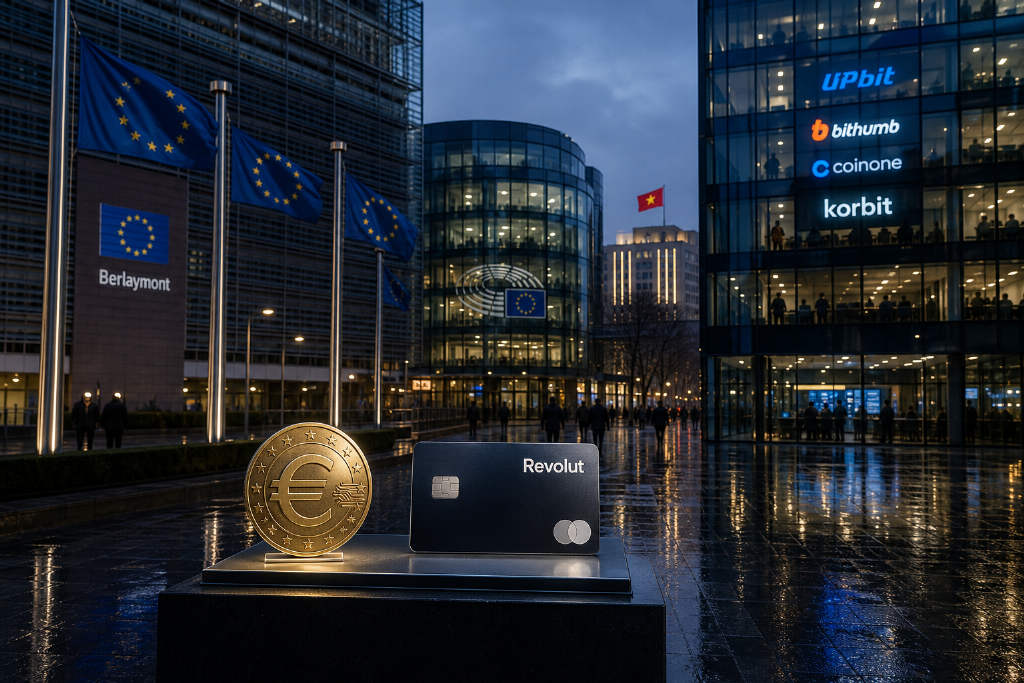
WuBlockchain’s daily selection of crypto news and weekly project roundup covered digital currency policy in Europe, spending growth in stablecoin cards, Tether’s response to the Bank for International Settlements, staking activity at major South Korean exchanges, licensing progress in Vietnam, and a broad list of project updates from the past week.
Forbes: Europe is moving toward a two-track digital currency market
According to Forbes, Europe’s digital currency market is taking shape around two parallel tracks: a central bank digital euro and privately issued euro stablecoins, with the private side reaching the market first.
Revolut has already started phased testing of EURR in Denmark, Poland and Portugal. The euro stablecoin runs on Ethereum and is issued by Bridge Building, a Stripe-owned company.
The European Central Bank has stressed that the digital euro will be built with a strong privacy design. For offline payments, transaction information would be known only to the two parties involved. For online payments, the Eurosystem would not be able to directly link transactions to an individual.
Forbes said Europe is pushing digital payments through both public digital money and private stablecoins in an effort to reduce reliance on dollar stablecoins and non-European payment infrastructure.
Redot says stablecoin payment card spending has passed $10.9 billion
Stablecoin payments firm Redot said in a new report that cumulative spending through global stablecoin payment cards has exceeded $10.9 billion, citing data from Paymentscan.
The report said the sector’s monthly processing volume has climbed from $60,000 per month three years ago to a level where the same amount can now be processed in about four minutes. July 2026 marked the industry’s highest single month on record.
Redot said clearer regulation, better user experience and major improvements in fiat entry and exit channels are the main reasons behind the jump. It also projected that the next $10 billion in card spending could be reached in just eight months, and that annualized stablecoin card spending could reach $50 billion by 2028.
Tether CEO pushes back on BIS criticism of stablecoins
Tether CEO Paolo Ardoino responded after a BIS official said stablecoins lack credibility for payments at scale and voiced greater support for tokenized bank deposits.
Ardoino argued that stablecoins are backed by 100% reserves in highly liquid assets such as U.S. Treasuries, while tokenized bank deposits are, in his words, essentially an uninsured “verbal promise” by banks and typically hold only about 10% of reserves in liquid assets.
He said the core concern for the BIS is that stablecoins are exposing what he described as the “emperor’s new clothes” of traditional finance. If users come to see fully reserved stablecoins as safer than deposit products built on fractional reserves and shift savings into what he called a better class of assets, the traditional financial system would face a major shock.
South Korea’s four largest exchanges hold about $3.4 billion in staked assets
As of the end of July, South Korea’s four KRW-denominated exchanges — Upbit, Bithumb, Coinone and Korbit — held about $3.4 billion in staked crypto assets. The number of staking users reached 1.2255 million, and users earned an average of about $7.57 million in staking rewards per month this year.
By staked asset value, Upbit remained the largest with about $1.764 billion, accounting for 51.78% of the total. Bithumb followed with about $1.481 billion, or 43.41%.
By user count, however, Bithumb has led Upbit since January this year. As of the end of July, Bithumb had about 592,700 staking users, or 48.37% of the total, while Upbit had about 359,500.
Vietnam has yet to issue its first crypto exchange license
Vietnam has not issued its first crypto asset exchange license, but five companies have already passed the first round of assessment.
The next step requires them to meet Level 4 information system security requirements and commit at least VND 10 trillion in capital, or about $383 million.
At the same time, new rules on penalties for crypto assets and market violations in Vietnam are set to take effect on Sept. 1. The report cited experts as saying domestic investors will not immediately be penalized that day for using unlicensed platforms. Under the current pilot arrangement, domestic investors will only be required to trade through licensed platforms six months after the Ministry of Finance grants a license to the first service provider.
Weekly project updates
LayerZero plans an institutional blockchain exchange this fall
LayerZero plans to launch a blockchain-based exchange aimed mainly at financial institutions this fall. The company previously said its new Layer 1 blockchain, Zero, will go live this fall and is being developed with partners including Citadel Securities, the Depository Trust & Clearing Corporation (DTCC), and Intercontinental Exchange (ICE), the parent company of the New York Stock Exchange.
LayerZero has said Zero is built for 24/7 capital markets, institutional clearing and stablecoin payments, and will include a dedicated trading environment.
Grayscale launches the first U.S. Zcash ETF
Grayscale launched the Zcash ETF, ticker ZCSH, on Aug. 25 and listed it on NYSE Arca. The product was converted from the Grayscale Zcash Trust and is the first U.S. exchange-traded product focused on ZEC.
According to Grayscale, as of Aug. 24, ZCSH had about $314 million in assets under management, held about 387,200 ZEC, and charges a 2.5% management fee.
Grayscale said that for up to 12 months after the registration statement becomes effective, management fee revenue from ZCSH will be used to support Zcash ecosystem development and product marketing. Data from The Block showed ZEC had gained about 45% over the past several days.
Ethena Foundation outlines four ecosystem updates
The Ethena Foundation announced four major ecosystem changes.
- It completed the buyback of all remaining locked tokens held by certain major seed-round investment firms that had sold any ENA during the past nine months.
- It entered into a master framework agreement with development entity Ethena Labs, under which protocol IP and all value accrual will belong exclusively to the foundation and be governed by tokenholders. Equity investors in Labs will no longer receive any protocol cash flow.
- It opened voting on a fee switch governance proposal designed to use net revenue from all Ethena business lines to programmatically buy back ENA on the secondary market.
- It reached agreement with the lead investor to release unvested tokens in order to eliminate future monthly VC unlock overhang, while team tokens will continue to follow the original vesting schedule.
Lido changes the EarnETH fee structure
Lido said it is changing the fee structure for the EarnETH Vault by cutting the fixed management fee and increasing the share tied to actual performance.
EarnETH previously used a fixed pricing model of 1% AUM management fee plus a 10% performance fee. Under the update, it will move to a variable, performance-leaning structure capped at 0.5% AUM plus a 20% performance fee. The initial implementation is set at a 0.2% AUM management fee and a 15% performance fee.
Lido said lowering the base AUM fee from 1% to 0.2% should reduce fixed holding costs during lower-yield periods, while a higher performance-linked fee should align protocol revenue more closely with actual user returns.
Flop Labs releases a draft tokenomics plan for FLOP
Flop Labs published a draft tokenomics plan for FLOP, saying there will be no VC allocation and no presale. The airdrop will target network participants including miners, validators, agents and early community members.
Based on the draft chart, FLOP’s total supply is expected to reach 17.2 billion tokens in year 10, with a terminal annual inflation rate of 0.6%.
Supply allocation in the draft is led by miners at 51.2%, or 8.8 billion tokens. Airdrops account for 20.4%, or 3.5 billion tokens, including 1.2 billion for miners, 310 million for validators, 1.2 billion for agents, and 790 million for reserve and incentives. Team and foundation receive 11.4%, or 2 billion tokens. Validators receive 6.8%, or 1.2 billion tokens. Brokers and agents receive 6.8%, or 1.2 billion tokens. Staking rewards account for 3.4%, or 600 million tokens.
In a video interview on the Altcoin Daily podcast, BitMEX co-founder Arthur Hayes introduced Flop Network as a new project and said the bet is that FLOP becomes the native currency used by AI agents to buy compute, store memory and carry out economic activity. He described it as another “binary bet” after perpetual swaps.
Coinbase brings tokenized stocks to Base
Base said tokenized stocks issued by Coinbase are now natively live on the network under the B20 standard.
The tokens represent real shares held 1:1 by a regulated custodian. In eligible regions, users can hold tokenized stocks of companies including Apple and NVIDIA through self-custody wallets, then trade, lend and use them across other DeFi applications in the Base ecosystem.
Base said tokenized stocks add a new class of assets to onchain finance, with 24/7 trading, collateral use and composability with decentralized protocols. Alpaca acts as the regulated broker and custodian for the assets, and more Coinbase tokenized stocks are expected to follow.
World Liberty wins conditional OCC approval for a national trust bank
World Liberty Financial, tied to the Trump family, has received conditional approval from the Office of the Comptroller of the Currency to establish a national trust bank.
One of the main goals is to expand the use of USD1 and place the stablecoin’s reserve assets inside its own banking structure to cut costs and strengthen compliance and market credibility.
Data showed that in the first 19 months of Trump’s second term, the OCC approved 22 bank charter applications, more than the total from the previous five years, with many applications coming from fintech and digital asset companies. World Liberty’s review took about 220 days, above the median of about 126 days during the current administration. Before final approval, the company still needs to meet conditions including external audits and capital adequacy.
Lisk proposes ending its DAO and burning 100 million LSK
The Lisk team submitted a governance proposal to end the Lisk DAO, shut down related governance infrastructure and burn 100 million LSK that had been scheduled to vest to the DAO Treasury between 2027 and 2033. That would reduce total supply from 400 million to 300 million LSK.
The proposal would also move about 47 million LSK that has vested or becomes available by 2026 to Lisk Ltd. In addition, stakers would be allowed to use an emergency unlock option and exit without penalty after a three-day wait.
Lisk had previously announced that Lisk Chain will shut down on Oct. 31. These changes still require governance approval before they can take effect.
The Sandbox promises 1:1 reimbursement after bridge exploit
The Sandbox said it will reimburse affected SAND holders at a 1:1 ratio after a bridge exploit.
According to the project, the attacker exploited contract configuration flaws on Base and BNB Chain on Aug. 21 and moved about 14.744 million SAND, worth about $700,000, out of the Ethereum vault.
Users who legitimately held bridged SAND on Base or BNB Smart Chain before the attack will receive an equal amount of Ethereum-based SAND from the project treasury. No new tokens will be minted, and claims are expected to open within two weeks.
The Sandbox also said unbacked SAND minted during the attack has been isolated and cannot be bridged or redeemed. The affected bridge contracts will be permanently disabled.
Ethena’s USDe reaches $320 million on Robinhood Chain in eight weeks
Ethena’s USDe surpassed $320 million eight weeks after launching on Robinhood Chain and now accounts for 42% of the chain’s stablecoin supply. That makes it the largest external dollar asset on the network, behind only Robinhood Chain’s native USDG.
Analyst Mesh said the growth came from the way the infrastructure was designed, Steakhouse Financial’s decision to make Ethena the main collateral issuer at the launch of Robinhood Earn, and the fact that 62% to 65% of liquidity allocated by the Steakhouse USDG Vault flowed into the USDe/USDG Morpho market. Borrowers deposited USDe into that market because it is the deepest collateral slot in the vault.