
China has tightened export controls on tungsten, citing the metal’s potential defense uses, a move that has driven a sharp global price surge and put fresh strain on supply chains tied to artificial intelligence and defense manufacturing.
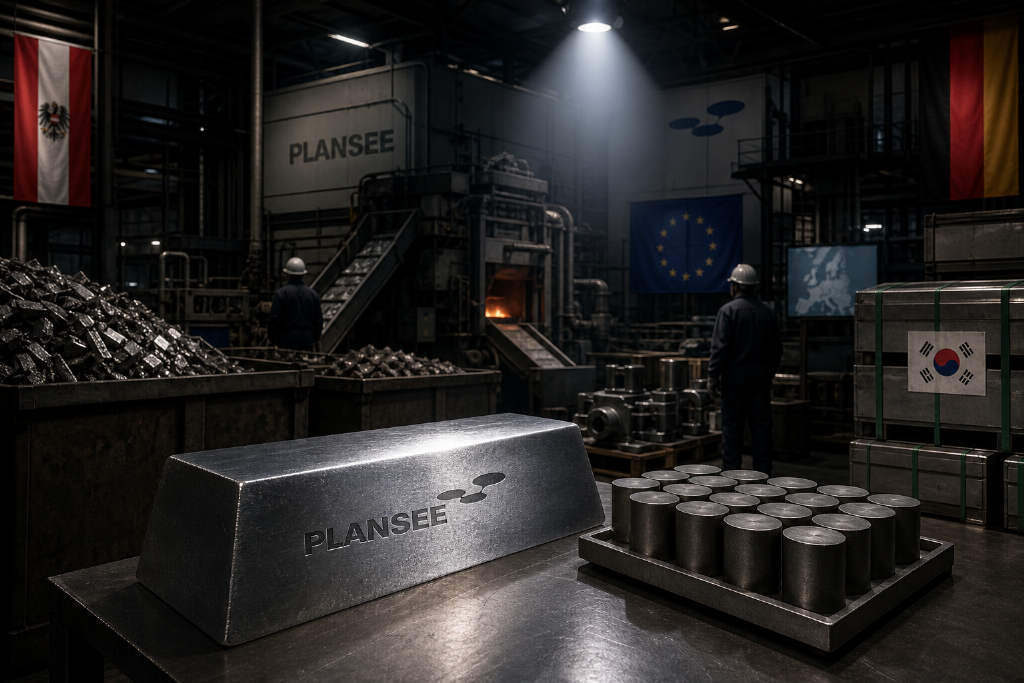
Austrian group Plansee said in an interview that it has signed a long-term contract with a mine in South Korea to secure stable raw material supply. The company said its operations have not been affected by China’s export restrictions. It is also stepping up local scrap recycling and accelerating the development of alternative materials.
Europe’s main tungsten supply responses
Recycling, local circular use and procurement diversification sit at the center of the European response. Plansee collects tungsten scrap across Europe and processes it through a production line in Germany, using its own refining know-how to reduce reliance on Chinese mined material.
To widen sourcing options, European companies are looking beyond China. Plansee has signed a long-term supply deal with a South Korean mine to secure tungsten feedstock from outside China.
Companies are also making use of open internal EU borders for cross-border production and logistics distribution. Plansee said it has built a coordinated production and logistics system between its plants in Austria and Germany to improve supply-chain flexibility.
AI, aerospace and defense remain highly dependent on tungsten
Tungsten’s hardness and heat resistance give it strategic importance in defense and AI-related industries. In civil and military aircraft manufacturing, the metal is widely used in drilling and cutting work on outer skin structures. Without it, related aerospace factories could face shutdowns.
In defense manufacturing, tungsten’s military protective applications have grown in importance, which the report describes as the main reason behind China’s tighter export controls.
In AI data centers, chips including CPUs, GPUs and AI processors rely heavily on tungsten plug and interconnect technologies to withstand electromigration risk under high-temperature, high-current operating conditions and keep very small circuit structures stable.
EU brings tungsten under the Critical Raw Materials Act
The report says China’s controls have pushed global tungsten prices up by several times, leaving European manufacturers under heavier pressure on working capital and inventories. At the same time, tungsten scrap generated in Europe continues to be exported to China, draining locally recoverable material from the region.
Industry participants said every gram of tungsten now carries value for the European market and that scrap produced in Europe should remain within the region for internal circulation. The European Union has already placed tungsten under the Critical Raw Materials Act, or CRMA.
Without a long-term system governing scrap retention and recovery, the report says, Europe’s dependence on external supply chains will be difficult to change.
Chip industry evaluates molybdenum as a substitute
As semiconductor manufacturing moves into advanced process nodes, traditional tungsten faces physical limits in resistance and gap fill at extremely small dimensions. Applied Materials is developing tungsten deposition technology aimed at lowering resistance.
At the same time, the industry is accelerating work on replacing tungsten with molybdenum, or Mo. According to the report, molybdenum offers lower resistivity and does not diffuse into dielectric materials, removing the need for an added high-resistance barrier layer. That can free conductor space and reduce material costs.
Major chipmakers are now gradually moving through validation of molybdenum-based materials, with expected step-by-step adoption in DRAM, 3D NAND and logic chip production lines.