
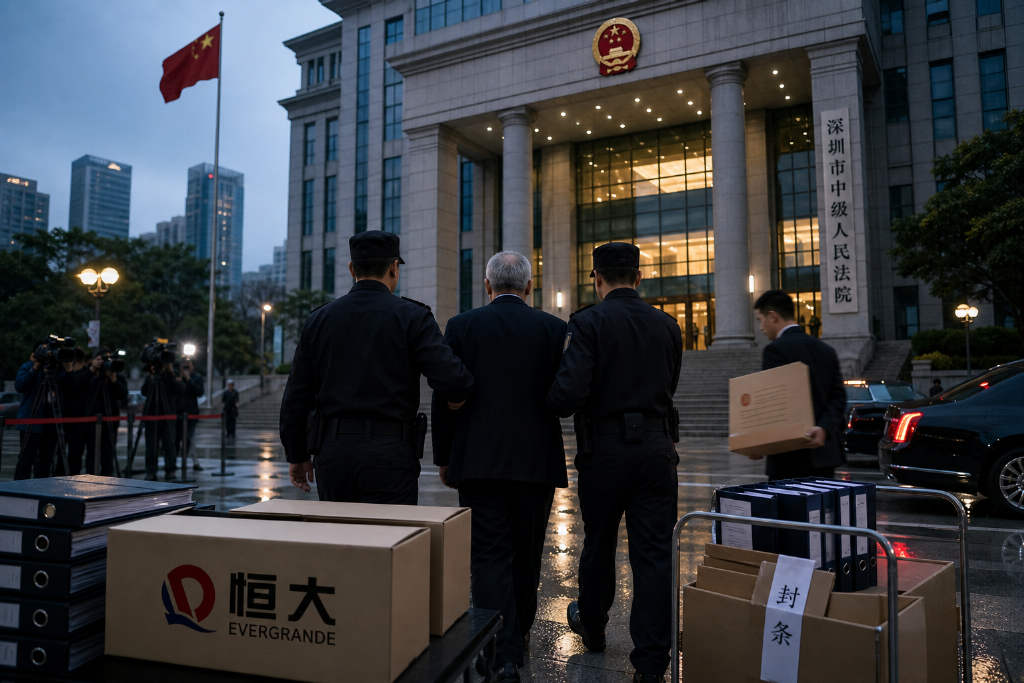
China Evergrande Group founder Xu Jiayin was sentenced to life imprisonment by the Shenzhen Intermediate People’s Court after being found guilty on multiple charges including financial fraud, illegal fundraising and bribery, according to BlockTempo. The court also deprived Xu of political rights for life and ordered the confiscation of all personal property under his name.
The ruling also targeted Evergrande’s corporate entities. Evergrande Group and Evergrande Real Estate were fined a combined 15.82 billion yuan, and the court said illegal gains would continue to be recovered, with any uncovered gap subject to repayment orders.
BlockTempo reported that Xu appeared in court on the morning of Aug. 20 with graying white hair. The first-instance verdict was delivered in Shenzhen, where the court said Xu had committed a series of offenses while serving as chairman of Evergrande Real Estate.
Corporate penalties totaled 15.82 billion yuan
According to the report, the court imposed an 8.82 billion yuan fine on Evergrande Group and a 7 billion yuan fine on Evergrande Real Estate, bringing the combined total to 15.82 billion yuan. The article also gave rough conversions of those penalties as about NT$41.76 billion and NT$33.1 billion, respectively.
The court said Xu used his position to direct financial fraud inside the group and diverted company assets under the guise of dividend payments, conduct that was treated as occupational embezzlement. It also found that Evergrande Group and Xu bribed financial institutions to gain control and then improperly tapped credit and insurance funds for group scheduling, which the report said formed part of the illegal use of funds charges.
The report traces the case back to 2016-2021 accounting manipulation
The judgment, as cited by BlockTempo, said Xu acted as the real decision-maker of Evergrande Group between 2016 and 2021, controlling the parent company as well as units including Evergrande Real Estate and Evergrande Wealth. During that period, assets were overstated and liabilities were concealed in the group’s financial reports, with the gap widening year after year.
Those acts involved securities-related crimes such as fraudulent issuance of securities and failure to disclose material information as required. The report also said the case covered fundraising-related crimes, including raising funds from the public without approval and carrying out fraud in the name of fundraising.
BlockTempo said Xu had already pleaded guilty in court in April this year and admitted to facing as many as eight charges. The report added that some outside observers had previously expected a possible death sentence, while the actual first-instance ruling came in at life imprisonment.
Fifty-six related defendants were sentenced the same day
Xu was not the only person sentenced. The report said 56 other Evergrande-related individuals were tried in connected proceedings, including Zhen Litao and Ke Peng. The Nanshan District People’s Court in Shenzhen handed down judgments the same day for offenses including illegal absorption of public deposits and illegal use of funds.
Sentences for those defendants ranged from 1 year and 10 months to 18 years, with fines or property confiscation imposed in addition to prison terms. The court described the case as one involving especially large sums and broad social impact, and BlockTempo said the judgment repeatedly used the word “special” when characterizing the amount involved and the degree of social harm.
A five-year crisis reaches a legal turning point
The article framed the ruling as a legal endpoint in a crisis that had been building for nearly five years. It traced the timeline back to September 2021, when Evergrande’s debt default problems came fully into view. At that stage, the group’s heavy leverage and off-balance-sheet liabilities fueled concerns over systemic risk in China’s property sector.
BlockTempo said that market stress spread beyond real estate at the time, with selling pressure hitting U.S. equities, commodities and Bitcoin, while the crypto market briefly fell into a liquidity squeeze panic. The article presented that episode as evidence that the financial troubles of a major Chinese property developer could spill into global risk markets.
The timeline then moved to September 2023, when Xu was placed under coercive measures by Chinese police and Evergrande-linked stocks were suspended from trading on the Hong Kong Stock Exchange. In January 2024, a Hong Kong court formally ordered the liquidation of China Evergrande, pushing what had once been China’s highest-valued property developer toward breakup.
Asset confiscation could complicate creditor recovery
The report also raised a practical issue for creditors. With all of Xu’s personal assets confiscated through criminal procedure, claims previously pursued through civil litigation or insolvency proceedings by domestic and offshore creditors may now need to be reordered against the criminal confiscation process.
China Evergrande had already entered liquidation proceedings in Hong Kong. Now that the founder’s personal assets have also been seized under the criminal ruling, the question of how much creditors can actually recover remains unresolved. BlockTempo said that answer will likely depend on later enforcement steps.
For now, the first-instance judgment closes one chapter of the Evergrande saga, even as liquidation and repayment questions remain open.