
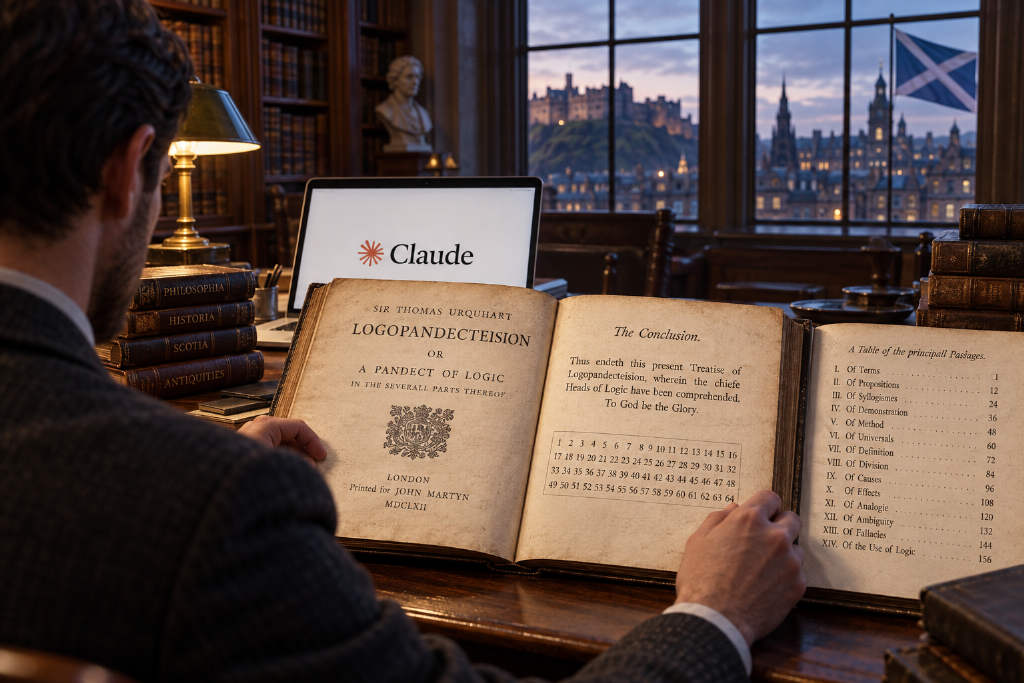
Vals AI researcher Geby Jaff wrote in an experiment log published on Aug. 31 that he gave a 370-year-old unsolved cipher to Claude Fable 5.1, and the model cracked it in 44 minutes. The post later hit Hacker News’ front page on Sept. 13 and picked up more than 600 points.
A 64-number puzzle that had circulated since 1899
The cipher is known as Cyphral Distich. It shows up at the end of Scottish writer Sir Thomas Urquhart’s Logopandecteision. Bare bones stuff: 64 numbers set in two lines of 32, and the task is to recover the hidden message.
In 1899, Notes and Queries ran it as an open problem. Later it came back in 20th-century cryptography writing, and cipher historian Klaus Schmeh added it to his list of 50 unsolved encrypted messages. Earlier attempts tried frequency analysis, substitution methods, and homophonic substitution. None of them landed. Jaff said those efforts overlooked a very simple clue.
The key was not outside the text
Anthropic released Fable 5.1 on Sept. 1 and called it its most advanced model for coding and knowledge work. Jaff’s log says this run lasted 44 minutes and used 176,000 tokens, with no help from him. The model tried a few routes before settling on two judgments.
The first was positional. The cipher is printed directly after Urquhart’s 32 Proquiritations, and Urquhart had plainly stressed that number, writing that “No number can be chosen like thirty-two.”
The second came from the promise in the poem printed beside the cipher. It says an honest reader will find “his own heart’s desire, and the author’s intention” there, while the 32 Proquiritations keep ending with wording about desire, wishes, and hope.
That pairing was the whole thing: 32 Proquiritations, 32 numbers in the first line, 32 in the second, plus all that repeated language of wishes. Jaff said many earlier solvers assumed the key had to come from somewhere outside the text, either a reconstructed cipher alphabet or some number-to-letter mapping. Fable 5.1 went the other way. It treated the book itself as the key. The i-th number maps to the i-th Proquiritation; that number is then read as a word-position index, and the first letter of the chosen word is taken.
The decoded lines point to Charles II
Using that method, the two lines decode to: “O GOD UPHOLD KING CHARLS THE SECOND AND / MAKE HIM THE SUPREME RULER OF THIS LAND”. Jaff glossed the message as a prayer asking God to uphold Charles II and make him the supreme ruler of the land.
He said the result strongly validates itself. Each line has exactly 32 letters. The final words, and and land, rhyme in a way that matches the promised distich form. And Urquhart was a committed royalist. So hiding a prayer for Charles II in the book fits his politics too.
A larger 285-number cipher was also tackled with the same idea
Urquhart left behind another, larger cipher of the same kind in his 1652 work The Jewel. That one, Cyphral Octastich, contains 285 numbers and had also stayed unsolved. Jaff said Fable 5.1 pushed the same basic idea further, except it switched from “paragraph” to “page.” The Jewel has 284 numbered pages, so the k-th number is treated as the word-position index on page k, and the first letter of that word is taken.
In Jaff’s telling, 231 of 275 readable positions were exact first-occurrence hits. The other 44 were off by one to three words, for reasons he could identify: hyphenation at the top of a page, hyphenated compounds, the “ ” symbol, paragraph numbering, and a stretch of Greek text that had not been transcribed.
Nine letters still need confirmation
Jaff was direct about what remains unresolved. In line 4, the output reads I-R-S-H, which could be a typo or an intentional abbreviation. In line 5, nine letters decode as C-O-N-E-R-T-H-T-O, which does not produce a readable phrase. He said he tested ideas involving page shifts, missing words, misprinted numbers, and dictionary-style grid searches, but none of them gave usable English.
He also said that from position 159 onward, each number has to map to page k−1. But there is still no free page-image source for the 1652 edition of The Jewel. Checking those nine letters would require either a physical copy or the 1983 edition by Jack Lyall.
Jaff said the model kept searching rather than performing exotic cryptanalysis
Jaff wrote that the model did not depend on especially sophisticated cryptanalytic tricks. For the past several months, he had been trying to steer models toward unsolved ciphers, but none of the other frontier systems he tested produced a verifiable answer.
His prompt to Fable 5.1 was simple: give it a goal, offer some encouragement, tell it to look at math problems Fable had solved before, and ask it to think creatively while analyzing the problem seriously. He set only two constraints. One was to avoid ciphers that were already solved or that allow multiple plausible answers. The other was to avoid the hardest problems, including Kryptos K4, which he said is still too difficult for current models.
He did not claim the result as his alone. Jaff wrote that he does not think other frontier models would necessarily fail on this cipher, because the clue looks extremely simple in hindsight. What Fable did well, he said, was notice that the problem was “unusually solvable,” and know when to stop and when a line of attack had gone nowhere.
His conclusion: the bottleneck may have been attention
Jaff’s view was that models can do more than math. They can also work through historical mysteries, forgotten conjectures, and archival puzzles. Problems like these often stayed stuck because they demanded human attention. Someone had to spend hours or days reading obscure material, testing ideas that looked hopeless, and chasing notes and references.
That bottleneck, in his view, may be starting to fade. As he put it, Claude did something almost opposite to what people usually praise in intelligence work: the answer looks simple after the fact, and the model just kept looking until it found it.