
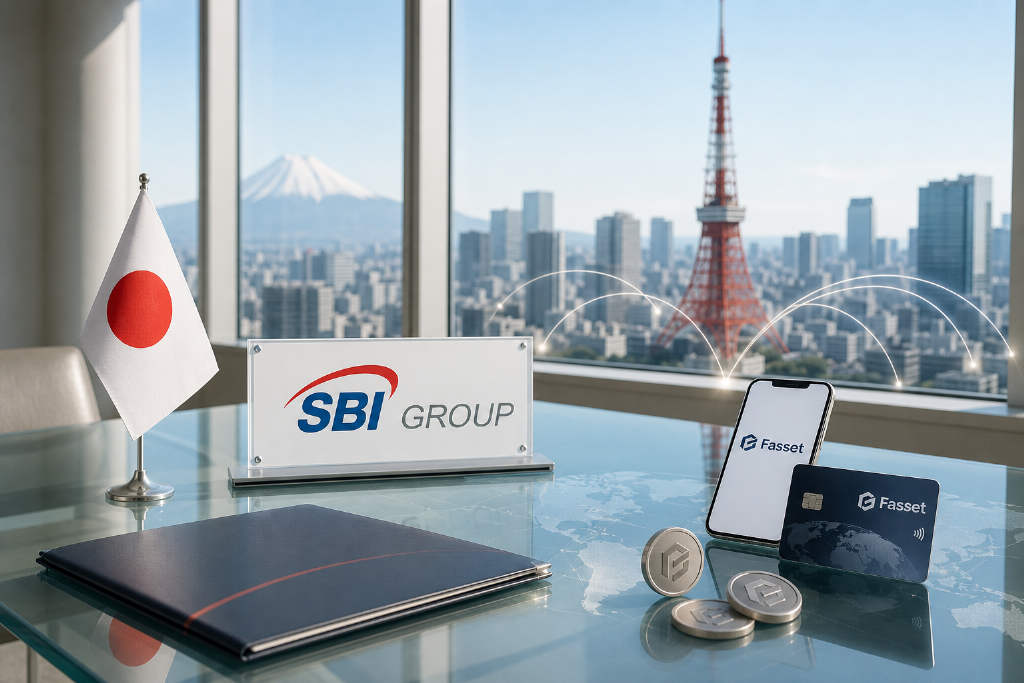
Fasset said Monday that it has secured $68 million in a funding round led by Japan’s SBI Group, lifting the stablecoin banking platform to a valuation above $1 billion. The raise came only three months after its previous round and takes the company’s total funding this year to $119 million.
Based in Los Angeles, Fasset describes itself as a financial platform that uses stablecoins as settlement infrastructure in the background, letting retail users and businesses hold, send, spend, and invest across multiple currencies and assets. The company said it now processes more than $40 billion in annualized transaction volume and has a footprint in 125 countries and territories.
Second raise in three months
This is Fasset’s second funding round of the year. In May, the company closed a $51 million raise that included early angel investor Speedinvest and other strategic investors. Combined with the new SBI-led deal, that brings total capital raised in 2026 to $119 million.
The pace stands out. Fasset returned to the market just three months after its last financing, a rapid turnaround at a time when fundraising conditions have been difficult across the sector.
Revenue growth and profitability
CEO Mohammad Raafi Hossain shared several operating metrics for the business. He said revenue has grown nearly sixfold over the past year and that Fasset has remained profitable for 12 consecutive months. He also said card and bank account products have only recently started to generate additional income.
- Revenue is up nearly 6x year over year
- The company has been profitable for 12 straight months
- Card and bank account products are beginning to add new revenue streams
According to Hossain, revenue is driven mainly by institutional and retail activity, with stablecoin payments and settlement making up the core growth engine. Fasset has not disclosed exact revenue or profit figures.
OWN Network built on Arbitrum
Under the hood, Fasset runs on OWN Network, an internally developed AI-enabled Ethereum Layer 2 system based on Arbitrum. The network is designed to connect banks, telecom operators, payment providers, liquidity providers, and other financial institutions across more than 100 banking corridors.
Fasset said stablecoins can serve as the settlement layer even when end users do not explicitly know they are using them.
Hossain said, 「Customers will interact with stablecoins at many levels on the platform. They may be moving between a bank account, a payment product, a currency, or an asset, and the stablecoin sits underneath as the settlement rail.」
SBI’s network and expansion into Japan and Asia
SBI is one of Japan’s most active traditional financial groups in digital assets. The report said its investments span Ripple, Circle (CRCL), and DeFi lender Morpho. It also owns crypto liquidity firm B2C2 and has built exposure to blockchain infrastructure and stablecoin projects.
Fasset said SBI’s backing gives it access to that broader financial network and will help extend OWN Network’s corridors into Japan, Asia, and emerging markets.
Fasset is already working with SBI Remit, a remittance network that covers about 470,000 service points. Its bank account transfer capabilities reach roughly 200 countries, according to the report. Hossain said the goal is 「to connect more corridors and financial rails into Japan, Asia, and other emerging markets.」
Neither side has identified specific products or newly targeted corridors so far. What has been outlined is a plan to combine Fasset’s infrastructure with SBI’s regulatory capabilities and wider portfolio of financial companies.
Stablecoins move beyond exchange transfers
The funding round also points to a broader shift in how stablecoins are being used. The report said they are no longer limited to moving assets between exchanges and are increasingly being applied to cross-border remittances, corporate treasury flows, and international payments. In emerging markets especially, transfers often pass through multiple correspondent banks, adding both time and cost.
Fasset’s model is built around using stablecoins as invisible settlement rails inside a more familiar financial product experience.
The report also noted that the U.S. Securities and Exchange Commission has just put forward its 「Reg Crypto」 proposal and that stablecoin supply in multiple jurisdictions has continued to climb. Against that backdrop, traditional financial groups are moving faster to position themselves in digital asset infrastructure. For Fasset, the next question is whether OWN Network can open new cross-border corridors and whether SBI’s other financial businesses can help it scale quickly.