
A more hawkish-than-expected message from the Federal Reserve’s September meeting has given the U.S. dollar its strongest short-term support, according to Citi Research. The bank said the market reaction was stronger than expected, even as geopolitical tensions and political pressure ahead of the U.S. midterm elections continue to keep conviction in foreign-exchange direction relatively low.
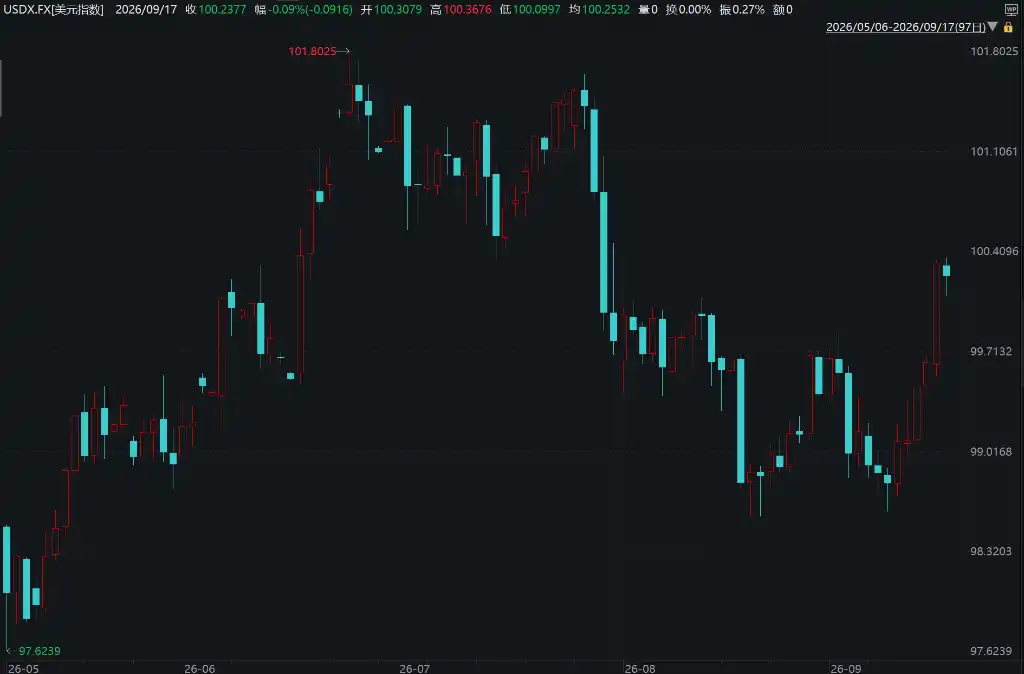
Citi said the September outcome has turned the October meeting into a live meeting, with markets now pricing in roughly 13 basis points of additional tightening. On the technical side, the U.S. Dollar Index, or DXY, has confirmed a double-bottom pattern, with 101.15 as the target.
October rate expectations moved higher after the Fed meeting
Citi said its prior base case had been that the Fed would struggle to out-hawk market pricing on the policy path and could end up disappointing investors. That view, the bank wrote, was overturned by this meeting under Warsh’s lead.
The meeting not only confirmed a rate increase, but also delivered guidance strong enough to force a reassessment of the path ahead. Citi said there is a risk that market pricing has moved ahead of reality, but added that, before geopolitical tensions become clearer, those tightening expectations could keep supporting Treasury yields and the dollar.
Citi says the current macro mix has been historically favorable for the dollar
Citi argued that the dollar is now trading in a macro setup defined by high yields and pressure on stocks, a combination it described as historically one of the most supportive environments for the U.S. currency. The bank added that the euro, Swiss franc, Swedish krona and New Zealand dollar are all facing downside pressure, and that EUR/USD could retest the 1.13 low.
Geopolitics and the midterm elections remain central variables
Geopolitical developments remain another core driver for the FX market. Reuters reported on Sept. 9 that Trump said the Iran war could end after the U.S. midterm elections. Citi said that aligns with its earlier view that the November midterms could become a flashpoint, and that Iran’s leadership may have an incentive to push energy prices higher before the vote.
Citi said signals from the energy market support that view. The bank pointed to a renewed widening in the spread between spot Brent crude and Brent futures, or spot backwardation, as a sign of tight physical supply. With the conflict extending toward the Strait of Mandeb and east-west oil pipelines, Citi said the strain is unlikely to ease in the short term. Analysts added that a clear de-escalation could narrow that backwardation quickly, but said the odds of that happening before the midterm elections appear relatively low.
DXY double bottom points to 101.15, with resistance at 102.20 to 102.50
From a technical perspective, Citi said DXY has now confirmed a double-bottom structure with a target of 101.15. The bank compared the setup with the double-bottom pattern seen from April to May, when DXY overshot to 101.80 after the formation was completed. If the current move follows a similar path, Citi said EUR/USD would fall back toward the 1.13 low area.
Still, Citi said the upside path is not clear of obstacles. The bank marked the 102.20 to 102.50 range as a key resistance zone, noting that it lines up with the 200-week moving average and a long-term trendline that has carried historical significance. Analysts said this is not a target level, but a warning that the dollar could run into a resistance wall after an overextended move.
Pressure on equities and a cooler AI narrative add support
Citi also said the equity market is giving the dollar extra support. The bank noted that stock-market turbulence in the early phase of a rate-hiking cycle has been common historically, and said U.S. equities are already starting to show that pattern.
Over a longer stretch, Citi said social and political resistance around artificial intelligence, along with uncertainty over the pace of model development, could keep weighing on market sentiment before the midterm elections. Citi’s U.S. equity strategy team still expects earnings to drive gains by year-end, but it also acknowledged that, before earnings season begins, a mix of negative AI narratives, high rates and geopolitical risk could keep markets volatile.
Citi said the combination of rising yields and falling stocks has historically been the most favorable macro state for the dollar, and argued that the market is now in that state, leaving room for follow-through over the next several days.
Citi warns that the setup could reverse quickly
Even with a constructive short-term dollar view, Citi repeatedly warned that the broader call could reverse. First, the market had already priced in a large part of the FOMC outcome, reducing the marginal bullish effect. Second, changes in PCE statistical methodology remain a variable the market still needs to absorb. Third, price action on Fed decision days has historically been volatile, making it risky to overread a single session.
Citi concluded that, in the absence of new information, the dollar lacks an obvious short-term downside driver and the path for EUR/USD to retest the 1.13 low remains open. At the same time, the bank said the market can change in a fundamental way over a very short period, and investors should avoid overcommitting to a single direction.