
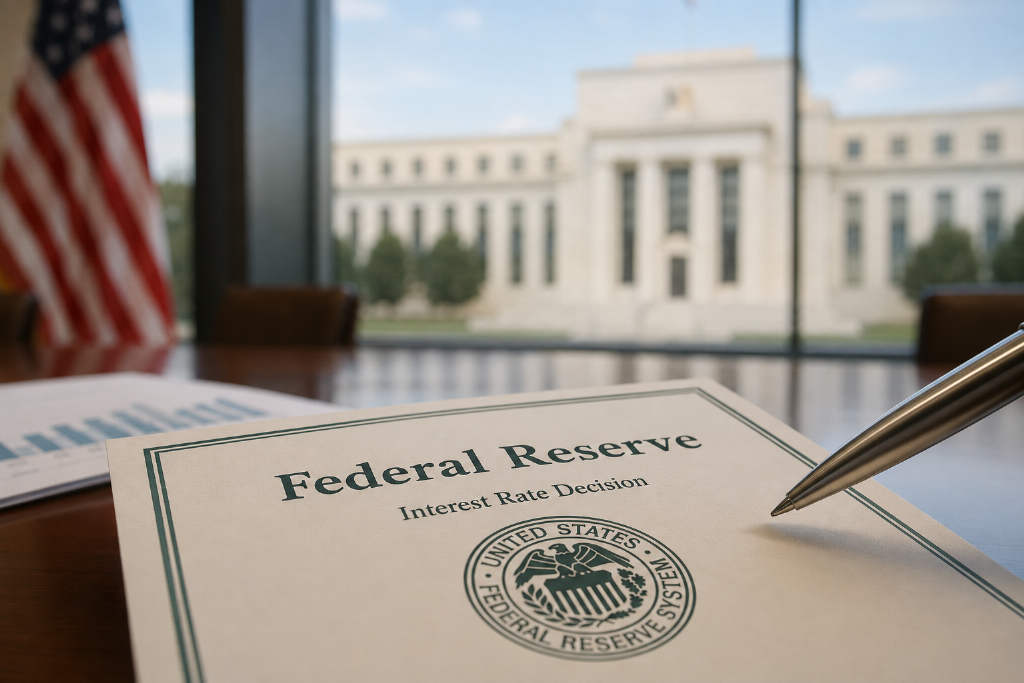
Federal Reserve Governor Christopher Waller said he would support leaving interest rates unchanged at the Fed’s mid-September meeting if the August Consumer Price Index keeps slowing toward the central bank’s 2% long-term goal. He also said he would back renewed rate hikes if inflation unexpectedly rebounds.
August CPI now sits at the center of the September decision
Waller’s comments turned next week’s August inflation report into the key data release ahead of the Federal Open Market Committee meeting scheduled for Sept. 15-16.
He said the federal funds rate is currently in a 3.50% to 3.75% range and is only “modestly restrictive” for the overall economy. If the disinflation trend stalls or reverses, he said, that could push him back toward a tighter stance.
Waller also invoked John Lennon’s line about giving something a chance, saying policymakers should “give cooling inflation a chance.” In his view, a single 25-basis-point hike at the turn of the year would not by itself solve the price problem, and the Fed has room to wait and watch incoming data.
A contrast with Warsh’s earlier hawkish tone
Waller’s more cautious and dovish message stood in clear contrast to the tougher hawkish stance previously associated with Fed Chair Kevin Warsh at the Jackson Hole global central banking conference.
Warsh had warned that central banks still had “more work to do” to bring inflation under control, a message that had earlier driven up market expectations for a September rate increase.
Even so, Waller did not dismiss inflation risks. While he said he was encouraged by the cooling in annualized core PCE growth over recent months, he also pointed to energy-related geopolitical risks, trade tariffs and the heavy funding needs tied to AI computing infrastructure as factors that could push up the neutral rate and keep price pressures in place for longer.
Treasury yields fall and risk assets rebound
Markets responded quickly to Waller’s pause signal and the pullback in Treasury yields. Global risk assets rallied, and the three major U.S. stock indexes all moved sharply higher.
The yield on the rate-sensitive 2-year Treasury fell by about 5 basis points to 4.33%, while the benchmark 10-year Treasury yield retreated from recent highs to around 4.76%. That eased some of the pressure on equity valuations and corporate financing conditions.
Bitcoin tops $82,000 as crypto shorts are squeezed
Crypto markets also moved higher. Bitcoin surged more than 5% on the day, briefly broke above $82,000 and then held around the $80,000 level. ETH recovered the $2,500 level as well.
As expectations for rate cuts or at least a pause in hikes picked up, short covering accelerated the move. Across crypto derivatives markets, liquidations over 24 hours reached about $415 million to more than $510 million, with more than 80% of forced liquidations coming from short positions.
Rate futures reprice after Waller’s remarks
Waller’s statement quickly shifted rate futures pricing. Traders cut back bets on a September hike, bringing the implied probability down from a level above 60% to roughly even odds.
Attention now turns to the upcoming CPI report, which markets will use to test whether the disinflation path is still intact.