
With less than two weeks left before the Federal Reserve’s Sept. 16 policy meeting, the market focus is shifting from macro data to the likely vote count inside the Federal Open Market Committee.
Jim Bianco, founder of Bianco Research, wrote on social media that he has long believed the way to read the Fed right now is simple: count the votes.
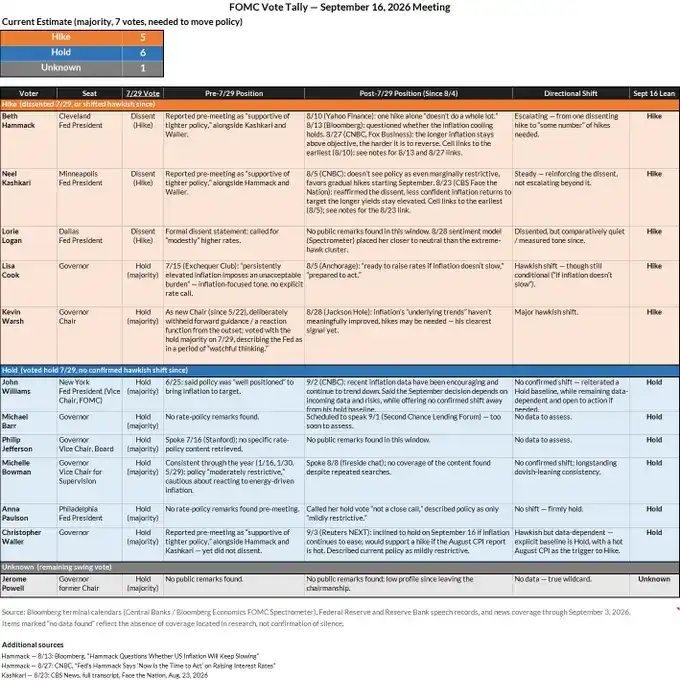
Bianco updates the tally to 6 for hold, 5 for hike
After Federal Reserve Governor Christopher Waller recently indicated support for leaving rates unchanged, Bianco updated the current lineup to six votes for holding rates steady and five for a hike, with one vote still unassigned.
In his view, that unknown vote belongs to Jerome Powell. The article notes that Powell’s term as Fed chair expired on May 15 this year, and that he remains on the Board of Governors.
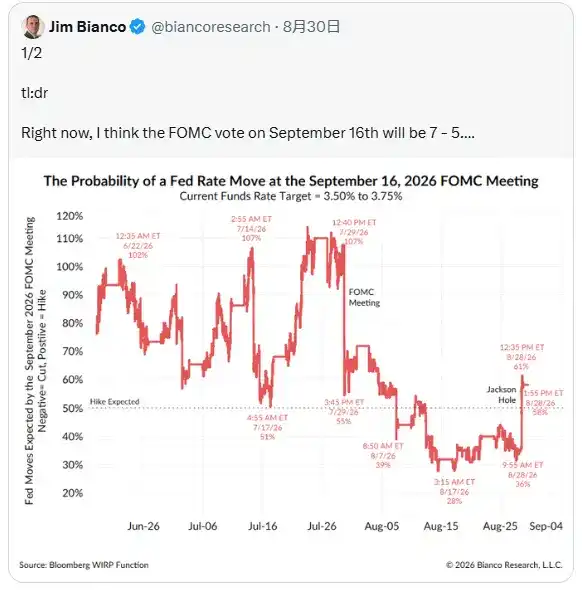
Bianco also said that on Aug. 30 he had projected a 7-5 outcome for the Sept. 16 meeting, but at the time could not tell whether that would mean 7-5 for a hike or 7-5 for no change.
Powell’s silence leaves one pivotal vote unclear
According to Bianco, Powell has not spoken publicly since the May press conference and 「he hopes to fade from public view」.
Bianco said that approach has a backdrop. Donald Trump has continued to criticize the Federal Reserve, which has raised concerns within the committee about its independence. As a result, FOMC voting members have become more deliberate in using public remarks to anchor their own positions.
That has also made Powell’s silence more consequential. Bianco wrote: 「If everyone votes according to their public statements, Powell’s vote becomes crucial.」
Bianco says September hike odds are effectively 50/50
Based on that vote-counting framework, Bianco’s conclusion was direct. He said that this is why, with less than two weeks to go before the meeting, the probability of a rate hike is effectively 50/50.
For now, after Waller moved into the hold camp, officials favoring no change lead 6-5. Even so, Powell’s unresolved vote keeps the final outcome open.
Trump pressure and Fed independence form the backdrop
Bianco said Trump’s continued pressure on the Fed is an important part of understanding the current split.
He argued that concern over the institution’s independence has pushed FOMC members to define their positions more clearly in public instead of relying on internal discussion to produce consensus. In turn, that has made it possible for outside observers to track the policy path by counting those public signals.
No 6-6 tie has appeared since 1936, Bianco says
Bianco also said there has never been a 6-6 vote since 1936. The closest cases came in 1963, 1964 and 1973, when the outcome was 6-5.
He wrote that the Federal Reserve Act does not provide for a tie. His interpretation is that a deadlock would mean the status quo remains in place, because without an agreement the Fed would keep the federal funds rate unchanged.
He added that officials could, in theory, hold a second or even third vote until the tie is broken.