
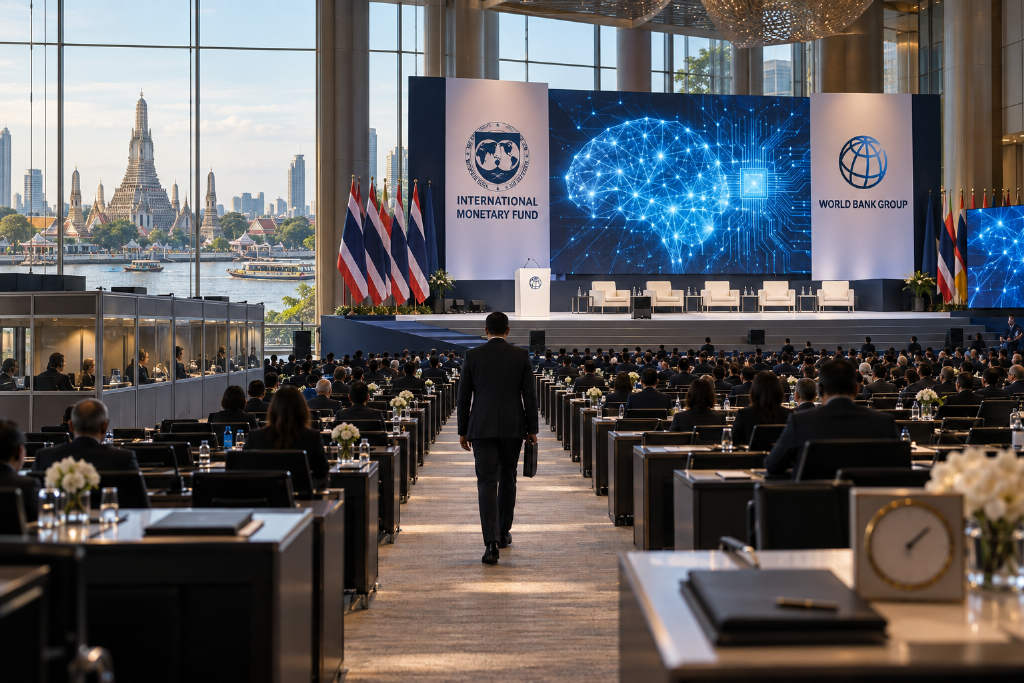
Federal Reserve Chair Kevin Warsh said artificial intelligence is the most far-reaching economic transformation of his lifetime and identified the Fed’s two remaining rate meetings this year, in October and December, as the key points for reaching a clearer policy judgment.
Speaking in a fireside chat with International Monetary Fund Managing Director Kristalina Georgieva at the IMF and World Bank annual meetings in Bangkok, Thailand, Warsh said global economic developments since the September rate increase had been broadly in line with the Fed’s expectations. Markets read that as a signal that the Oct. 28 meeting is more likely to result in no change. After his comments, the dollar fell 0.1% against a basket of currencies, S&P 500 futures rose 0.3%, and market pricing for an October rate hike dropped quickly from about 27% to about 15%.
October hold seen as more likely, while December hike expectations remain
Charu Chanana, chief investment strategist at Saxo Markets, said Warsh’s refusal to commit to another rate increase prompted some traders to unwind Fed hiking bets. After stronger inflation data, Warsh said he would not prejudge the outcome of the meeting, wording that Chanana said weighed on the dollar.
The dominant market view now is that the Fed will keep rates unchanged in October and raise them again by 25 basis points in December. Warsh said the central bank remains clearly committed to restoring price stability, but he does not support pre-judging policy meeting outcomes or signaling in advance what action the Fed may take at the remaining meetings this year.
Warsh also said economic performance since the September hike had been broadly in line with expectations, reinforcing the market view that October could bring a pause. In September, the Fed raised the target range for the federal funds rate to 3.75% to 4%, the first increase since July 2023.
Fed officials had already signaled in September that only one more rate increase was planned for this year. Several voting members indicated they would rather wait until the final meeting in December. Earlier this week, San Francisco Fed President Mary Daly, who is not a voting member, told Reuters that while another hike is "likely," the timing is not "urgent" and that "I think we have enough time."
New York Fed President and Vice Chair John Williams, along with Vice Chair for Monetary Policy Philip Jefferson, also signaled that policymakers could afford to be patient and wait.
Warsh also said the Fed is abandoning forward guidance. "We don’t do that anymore," he said in Bangkok, adding that the central bank is returning to a data-driven framework and will no longer offer a clear advance signal on the future policy path.
Inflation concerns remain after fresh data
Inflation figures released this week raised concern among some investors that the pace of tightening could accelerate. September CPI rose 3.7% year over year, driven by a surge in energy prices linked to the Iran war. Core CPI rose to 2.6% from 2.4% in August and came in above expectations. After the data release, market odds of an October rate increase briefly climbed to 55%.
Warsh acknowledged that inflation pressure remains troubling. "It is hard, in conversations with central bank governors, not to hear the same thing echoed back — everyone is talking about sharp price increases," he said.
He said inflation is not a problem unique to the United States and that most of the world is tightening monetary policy at the same time, "which means no country gets to free-ride." He also said Fed policy has spillover effects on other economies, while policy moves abroad can feed back into the U.S. Major central banks including the European Central Bank have also raised rates in response to inflation.
Since taking over as Fed chair in May this year, Warsh has kept the 2% inflation target at the center of his policy commitment. The Fed has now gone more than five straight years without meeting that long-run goal.
Warsh sees near-term inflation pressure from AI, longer-term supply gains
Warsh described artificial intelligence as "the most profound economic transformation of my lifetime" and said he is approaching its macroeconomic effects with caution. He added that in the United States, AI has also been referred to as "SI," or superintelligence.
On the transmission path through the economy, Warsh said the impact on the demand side is likely to appear before the supply-side effects come through. In his view, the current wave of AI investment could lift inflation in the short run, but over time it could produce a strong positive supply-side shock and generate "enormous gains" for the global economy.
Still, he said the path will not be smooth. "The road from here to there is very likely to be a very bumpy road — bumpy in our understanding of the technology, and bumpy because we really do not know how the market structure around these new technologies will evolve," Warsh said.
He also said AI could help central banks gain greater confidence in economic data and policy judgments, and that it will reshape the real economy, though its short-term effects on employment remain uncertain.
Fed working groups to study AI and other policy issues
Warsh said the Fed’s productivity and employment working group will hold a field hearing in the San Francisco Bay Area on Nov. 16, with artificial intelligence and its economic impact among the issues under review.
In June, he set up five working groups made up of outside experts to study key areas tied to monetary policymaking. Those groups are expected to submit recommendations to the Fed around year-end. Warsh said their role is to create new intellectual capital and help support decision-making at the Federal Open Market Committee, or FOMC.