

Filecoin said three major developments this month are reshaping its token model and network strategy: a new reward structure, the approaching end of the token vesting period set in the genesis block, and new products meant to give enterprises, AI agents and IPFS users direct paths into the network.
The project said the reward redesign will direct a growing share of block rewards to services that bring paying customers onto Filecoin. It also said the end of the original vesting schedule is expected to reduce daily newly circulating FIL by about 75%, while the latest product rollout is meant to turn enterprise, AI agent and IPFS usage into direct network demand.
Filecoin framed the changes against a broader shift in the storage market. It said global data generation is projected to nearly triple between 2025 and 2029 as AI-driven automation, sensor applications and demand for contextual data expand. It also said memory and storage prices have risen by more than 2x over one year, while the time needed to order and deploy new hardware has lengthened sharply.
The network also pointed to rising demand for data sovereignty. As storage becomes scarcer, more expensive and more sensitive to where data is physically located, Filecoin argued that decentralized storage has a distinct advantage in serving those needs.
Six years after mainnet launch, Filecoin said it has made significant progress on its 2026 priorities. Its pitch is an open market that large hyperscale cloud providers and other traditional vendors cannot easily replicate: independent storage providers build services, win customers and receive network rewards based on the customers they actually serve.
Marta Belcher, president of the Filecoin Foundation, said: 「Filecoin network is already the world’s largest decentralized storage network. This year is an important turning point for the network, with the community shifting its focus from expanding supply to expanding demand. The timing matters: AI is fundamentally changing market demand for sovereign and controllable storage, and that puts Filecoin in position to become essential infrastructure for an AI-native world.」
Solstice changes how block rewards are allocated
Starting this month, Solstice will change how the Filecoin network allocates block rewards, according to the announcement. Filecoin described it as one of the most important reward-system changes since launch.
Under the new design, a larger and larger share of block rewards will go to services that bring paying customers to the network, while rewards tied only to consensus mining will decline. Any part of the service reward share that is not earned will be burned rather than distributed.
Filecoin said the goal is to move the network toward a model centered on serving paying customers and generating revenue. In its view, that should expand commercial opportunities for storage providers across the network and support higher-quality service delivery.
End of the vesting period could cut new circulating FIL by about 75%
The sixth anniversary of the Filecoin network also marks the scheduled completion of the token distribution vesting plan set in 2020 by Protocol Labs and the Filecoin Foundation. Based on a model from FilecoinTLDR, Filecoin said the amount of newly circulating FIL entering the market each day will fall by about 75% once the vesting period is complete.
The project presented that shift as another key change in its token-economics structure this month.
Products aimed at enterprises and AI agent developers
On the product side, Filecoin highlighted new ways for enterprise users and AI agent developers to access the network.
Integral Spacetime
Filecoin said Integral Spacetime is a new storage neocloud company launched this week and built on the Filecoin network. It said the model opens a new commercial path for storage infrastructure.
According to the announcement, the company’s approach has two parts:
- Acquiring enterprises with large storage needs and moving their data workloads onto Filecoin, bringing thousands of paying customers to the network in a single move.
- Using signed customer contracts and recurring revenue from acquired enterprises to finance the next generation of storage capacity, improve competitiveness and make the Filecoin network a more attractive business opportunity for operators globally.
Fil One
Filecoin also said enterprises that are used to S3 object storage are looking for alternatives as storage costs rise and demand grows at the same time. It positioned Fil One as a commercial on-ramp within the broader Filecoin ecosystem, offering high-performance S3-compatible object storage at prices below those quoted by hyperscale cloud providers, with no egress fees on paid plans.
The project said that edge is creating an active pipeline of paid enterprise storage demand, driven by a dedicated GTM sales team and channel partners focused on AI infrastructure, automotive, banking and sovereign government workloads.
Filecoin said Fil One turns enterprise IT budgets into sustainable and repeatable on-chain protocol volume, while also letting Filecoin sit directly alongside GPU compute in an emerging neocloud stack.
It also described a new product form for the AI era: storage for neocloud, where storage is deployed in neocloud facilities close to GPU compute resources so that training and inference data remains easy to access, fast and cost-controlled, with tighter coordination between Fil One and GPU compute.
AI agents as direct storage buyers
Filecoin said AI agents are becoming standalone storage customers. These agents continuously generate outputs that need to be stored or shared, and they need a way to purchase storage programmatically without going through a traditional sales cycle or signing enterprise contracts.
To support that, Filecoin pointed to several tools. Its publish skill can take any file or folder and return a persistent, verifiable public link. Filecoin MCP Server and foc-cli can produce the same result through a terminal or an AI assistant.
In those setups, storage providers prove they hold the underlying data, while payment is settled on-chain. For agents that prefer S3, Filecoin said Fil One documentation explains how to choose and use Filecoin’s high-performance network rather than getting locked into higher-cost traditional providers.
IPFS migration tools are meant to convert users into customers
Filecoin said Filecoin Storage has introduced several features in 2026 to make Filecoin a top destination for IPFS content. New migration tools are meant to give users a more cost-effective option, with services tied to wallets rather than user accounts while keeping content addressing intact.
According to the announcement, multiple teams have already chosen to store their pinned IPFS data on Filecoin. Those users include NFT platforms and institutions that carry legal and compliance obligations around data.
A closed economic loop built around payments, lockups and burn
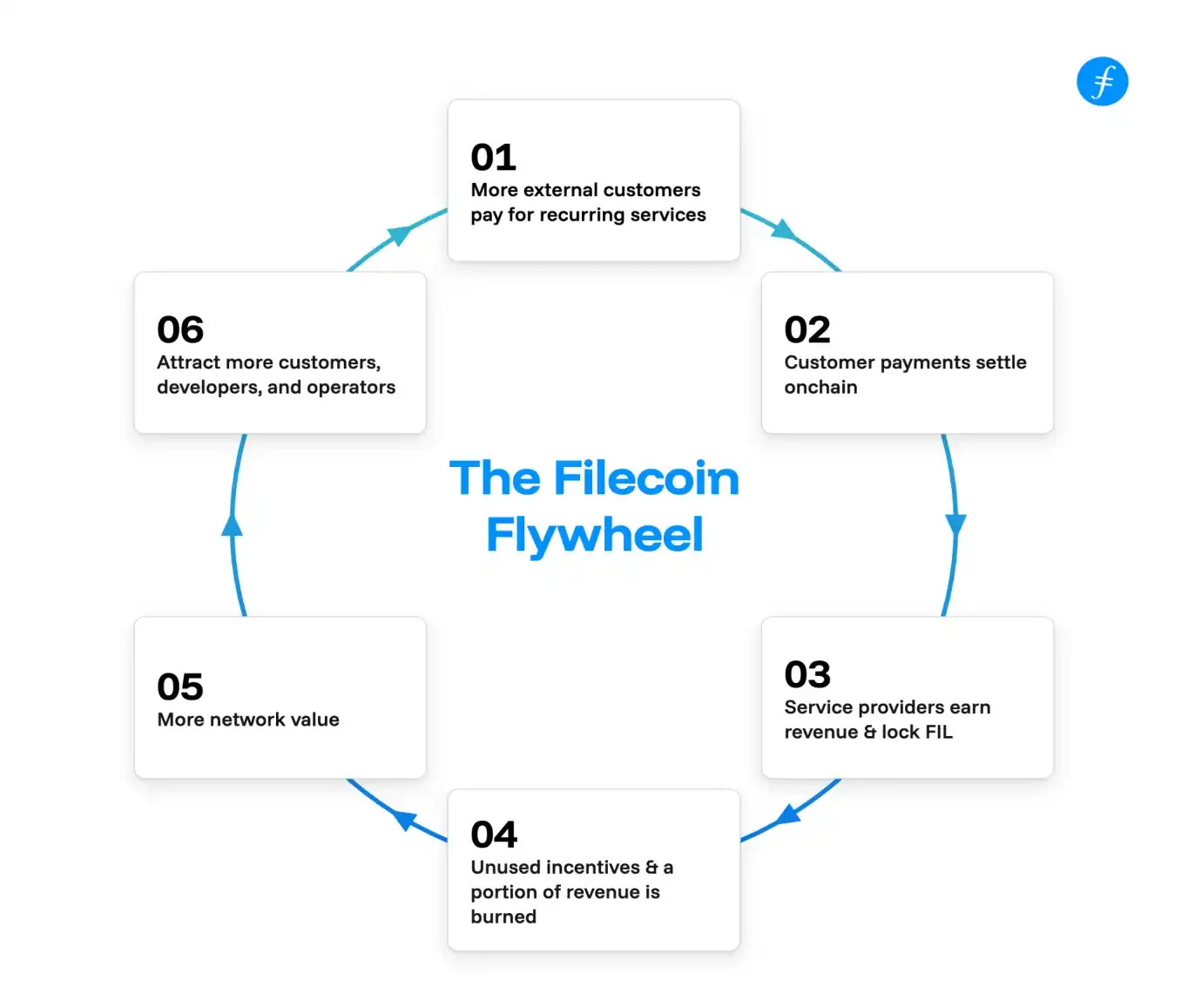
Filecoin summarized the strategy as an integrated approach for a new era, centered on a closed economic loop.
In its description, enterprise customers archiving records and AI agents storing their own outputs both pay for ongoing services and settle on-chain. Storage providers that serve them earn revenue and lock FIL against that service. Rewards flow to services customers keep using, while unearned incentives and part of the fees are burned rather than distributed. Filecoin said that dynamic should make the network more attractive to the next wave of enterprises, developers and operators, restarting the cycle.
Molly Mackinlay, CEO of FilOz, said: 「The Filecoin flywheel is now connected end to end and starting to build momentum. We are still early, but the feedback loop across useful storage, customer revenue, network value and provider rewards is now fully in place. From here, we have a favorable path to keep accelerating on top of the momentum already in the system.」
What Filecoin says comes next
Filecoin said the network has made notable progress so far in 2026. Its view is that data storage is moving from a standardized utility service to a core infrastructure pillar for unlocking AI, and that changes in token economics, product positioning and developer tooling are pushing the network in that direction.