
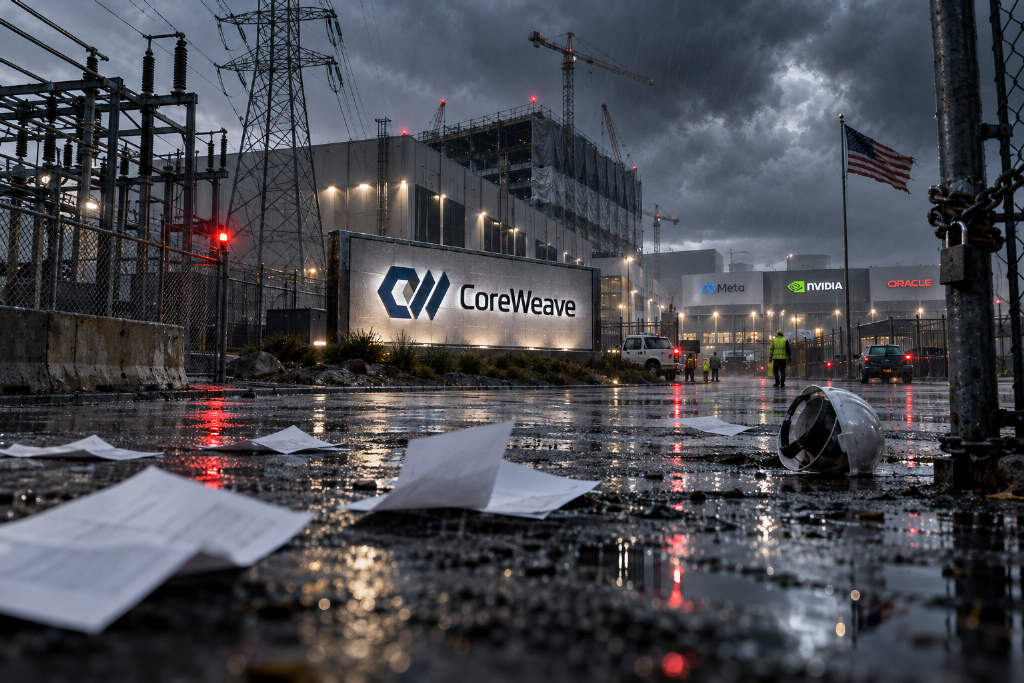
Investor confidence in whether the AI boom can generate enough revenue to support the huge debt piled onto data center projects is fading, the Financial Times reported on Oct. 16. Bonds used to finance some large U.S. data center developments have fallen sharply in recent weeks.
The report said some debt issued to fund data center construction for Meta, NVIDIA and Oracle is now trading below par. Cloud infrastructure suppliers, especially CoreWeave, which has backing from NVIDIA, have come under heavier pressure.
CoreWeave debt falls to distressed levels
CoreWeave bonds have dropped below 80 cents on the dollar, a level markets often treat as distressed. Their yield was close to 15% on Thursday. The company’s stock has fallen 17% this week, while rival Nebius is down 18%. NVIDIA has also lost about $270 billion in market value over the past week.
Investors are repricing execution risk
Ludovic Subran, chief investment officer at Allianz, said data center bonds are facing a “Darwinian moment,” with weaker projects set to undergo a survival test. He said widening credit spreads tied to power supply constraints and construction delays suggest the market had been too optimistic in pricing execution risk in data center debt.
At the center of the concern is a large gap between the scale of AI infrastructure investment and the revenue it may ultimately produce. OpenAI’s decision to delay its IPO until next year, together with slower quarterly sales growth at Anthropic, has added to investor doubts about how durable AI sector growth will be.
Gartner sees a revenue shortfall by 2030
Technology consulting firm Gartner estimates that 80% of new cloud providers may not be able to continue operating independently by 2030. It also estimates that AI data center owners would need to generate $8.5 trillion in revenue by the end of 2030 to cover capital and financing costs and earn reasonable returns. Consumer and enterprise spending on AI services, however, is projected to reach no more than $3.6 trillion by then.
That would leave more than $4 trillion of assets at risk of impairment by 2032.
Permitting and financing structure add pressure
Beyond revenue concerns, some parts of the United States have tightened restrictions on data centers over water use, noise and air pollution. Delays in power supply approvals are also slowing projects. Investors are also watching the sector’s circular financing structures closely, particularly arrangements in which customers and suppliers fund one another.
NVIDIA chief executive Jensen Huang said on Thursday that he does not believe CoreWeave needs backstop support from NVIDIA. He also said the company’s cost of capital is falling and its operating strength continues to improve.