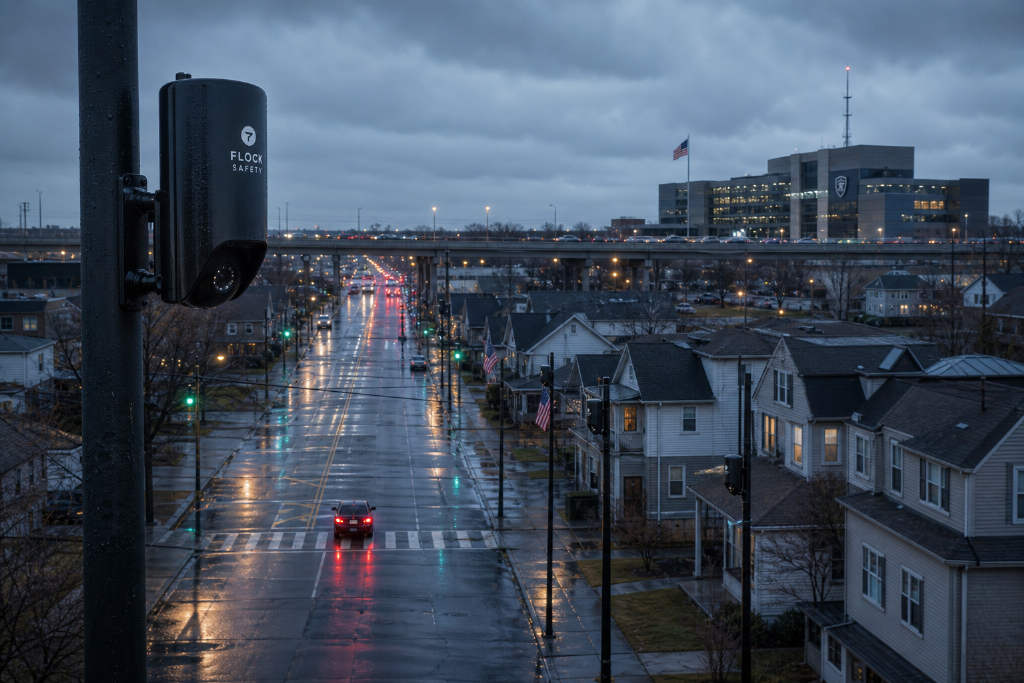
Flock Safety has built an AI investigative tool that can identify and track drivers without a name, license plate, or physical description, according to a Wired report that examined code pulled from files hosted on the company’s own site. Flock’s camera network logs vehicles across more than 6,000 communities in the U.S.
Wired said the system code was available through files served to anyone who loaded Flock’s login pages.
From Nightshift to OS Investigate
The software was first called Nightshift and has since been renamed OS Investigate. Flock said the product is still under development and is being tested with a small group of law enforcement partners.
According to the report, an officer using the system opens a chat box and can choose from 69 canned prompts or type in a custom request. One built-in prompt labels as “witnesses” the vehicles seen most often in a neighborhood over the previous two weeks.
Another prompt identifies people arrested more than twice over two years, excluding drug offenses, and then creates dossiers on the top three. A separate “workup” feature can take a name and birth date and pull in relatives, phone numbers, and online accounts from police records and commercial data brokers.
Queries that need no plate or name
Wired reported that 14 of the 69 prompts require no plate number, name, or description at all. Instead, an officer can enter a place, a time window, and a pattern of behavior. Examples in the report included cars that visited three retail stores in three days, or several banks within a week. The system then returns the people who match.
The code also showed a filter designed to remove buses and delivery vans, leaving ordinary drivers on the list if their movements fit the pattern.
Association logic in the code
The report said the system’s associate-finding logic is explicitly described in the code. It counts how often other plates appear at the same cameras within a two-minute window of a target vehicle, flags any that show up three or more times above a 0.75 confidence score, and returns up to 20 names.

“I don’t know how else to say this, but this sounds completely insane,” Noel Pichardo, a former Pawtucket, Rhode Island, police officer who reviewed the prompts, told Wired. “I don’t know how anyone can argue against the idea that Flock literally tracks people.”
Public claims collide with reported capabilities
Jay Stanley, a senior policy analyst at the American Civil Liberties Union, said the gap between what Flock’s cameras can do and what the company is already doing leaves “very little space... like China.”
Flock has long said publicly that its technology “cannot recognize, identify, or track individuals” and is “not for watching people.” Spokesperson Paris Lewbel said OS Investigate is a separate product from the company’s license-plate readers, built to help investigators work across records their agencies already hold. Lewbel also said the tool’s capabilities could change significantly before any broader release. The company did not dispute Wired’s reporting.
Backlash has moved from criticism to action
The confrontation has already spread beyond policy debate. In June and July, activists spray-painted, taped over, and destroyed Flock cameras across the U.S. The Guardian counted at least 33 incidents across 23 states.
That anger lines up with documented misuse of license-plate reader systems. A report from the Institute for Justice found more than two dozen cases in which officers resigned or were arrested for allegedly using the technology to stalk current or former partners.
The issue has also reached Capitol Hill. The report said Rep. Thomas Massie plans to introduce a bill that would cut off federal funding for agencies that deploy the technology.
Countermeasures and wider industry pressure
Researchers have created AI-generated patterns designed to confuse plate-reading software. Wired also noted that Flock is not alone in extending surveillance capabilities: Meta has patented cameras that can recognize faces and log a person’s actions.