
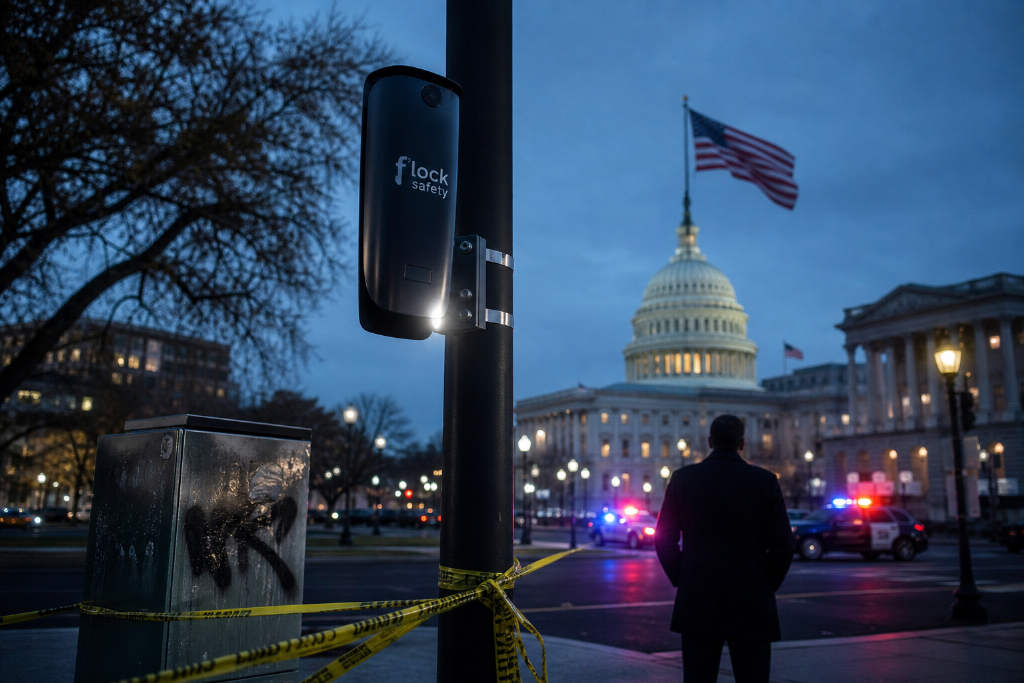
Flock Safety CEO Garrett Langley has called for Americans to accept a “compromise” on privacy as opposition to the company’s AI-powered license plate cameras grows across the country. The systems have been vandalized in multiple locations and are drawing bipartisan criticism in Congress.
In an interview aired Saturday on Fox News, Langley said, “What we have to prioritize as a country is compromise,” arguing that Americans who frame the issue as a choice between privacy and safety are “prioritizing the wrong thing.”
Bipartisan pressure builds in Washington
Flock has become a rare point of agreement for lawmakers who usually line up on opposite sides. Senator Bernie Sanders, the Vermont independent, said this month that he would introduce legislation to stop “AI mass surveillance.” House Republicans led by Representative Tim Burchett have introduced a bill that would bar the federal government from buying Flock cameras. Missouri Republican Senator Josh Hawley has opened a separate Senate inquiry.
Langley argued that an outright ban would be “like banning vehicles.” He said the United States did not respond to traffic risks by eliminating cars, but by adopting drunk driving laws, seatbelts, and airbags.
Langley points to data retention and officer accountability
Instead of banning the technology, Langley said regulators should focus on two areas: how long data is kept and how officers are held accountable when they misuse the system.
He said Flock recently reduced its own recommended retention period to seven days, compared with a 21-day state limit that he described as the strictest in the country. On police misuse, Langley said, “The person who wants a bad cop gone first is a good cop, and 99.9% of cops are good.”
Investigations from The Washington Post and WIRED add to scrutiny
A Washington Post investigation published on August 19 found that at least 69 police officials had been accused, charged, or convicted of misusing Flock or similar license plate readers. In at least 15 of those cases, the first person to spot the problem was outside the department, including a victim, an activist, or a journalist.
Reporters later identified three more officers by reviewing public search logs. One officer in Indianapolis had run 3,759 searches over ten months on vehicles used by his wife and two acquaintances, or about 12 searches a day. All three departments said they did not regularly audit officer search activity, and two of the officers were later disciplined.
Six days before the Post report was published, Flock said all law enforcement customers would be required to turn on Audit Assistance by the end of the year. The feature, which flags abnormal search patterns, had been optional since April. Flock said about one-third of the 7,000 agencies using its system had enabled it.
Questions over AI tracking without a plate or name
Langley was also pressed about a WIRED investigation published the same day as the Post story. That report said Flock had built an AI tool capable of identifying drivers from movement patterns alone, without needing a license plate number or a name to begin a search.
He did not dispute the report. Langley described AI as “incredibly powerful, but also a very dangerous tool,” and said any use in public safety requires third-party attestation. “When you call 911, it has to work. There’s no space for hallucination.”
Flock cites survey-based impact figures
Flock says its technology supported more than 1 million criminal investigations last year and helped locate over 10,000 missing people. The figures come from the company’s own Impact Census, a survey of nearly 700 agencies that Flock says is still an early methodology and open to criticism.
The company said the 1 million figure counts investigations in which its technology played a part. Separately, Flock estimates that it contributed to about 20% of cleared cases in jurisdictions where its cameras are in operation.