
FMS 2026 was held in Santa Clara, California, from Aug. 4 to Aug. 6. At the 21st edition of the storage industry’s largest independent summit, SK hynix, Samsung and Kioxia each laid out a different answer to the AI memory wall, shifting attention away from a single chip and toward the role storage now plays across AI systems.
HBF gets its first standard specification
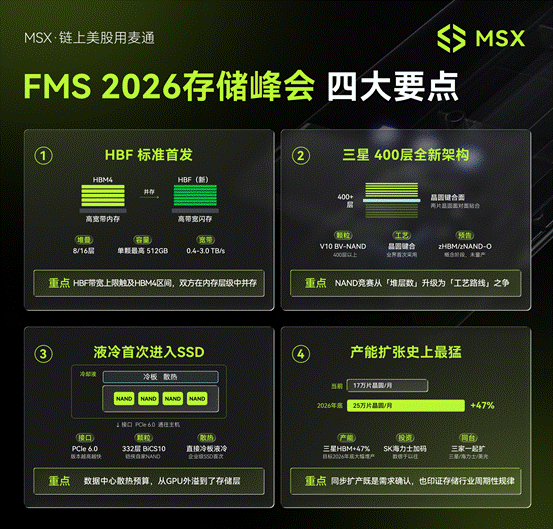
According to MSX Research Institute’s conference note, SK hynix and Sandisk released the first standard specification for High Bandwidth Flash, or HBF, through the Open Compute Project. The specification supports 8-high and 16-high stacking, with capacity of up to 512GB per package.
HBF was listed with read bandwidth ranging from 0.4 TB/s to 3.0 TB/s. The upper end already falls within the bandwidth range associated with HBM4, but the official positioning stops short of framing it as a substitute for HBM. Instead, it was presented as an added tier below HBM.
Samsung shows BV-NAND with more than 400 layers
Samsung unveiled its V10 BV-NAND, built with more than 400 layers. The company described it as the industry’s first use of wafer bonding for this approach.
Samsung also previewed zHBM and zNAND-O at the event. Both remain at the concept stage and have not entered mass production.
A separate report cited in the article said Samsung’s monthly HBM output is expected to rise from about 170,000 wafers to about 250,000 wafers, an increase of roughly 47%, with that target set for the end of 2026.
SK hynix and Kioxia target efficiency and cooling
Beyond HBF, SK hynix introduced its 10th-generation 375-layer 4D NAND, with energy efficiency improving by 2.5 times from the previous generation.
Kioxia introduced the CM10, described as the first enterprise SSD to combine PCIe 6.0, 332-layer BiCS10 and direct cold-plate liquid cooling. The move points to thermal limits spreading from GPUs to SSDs.
MSX view: capacity commitments are arriving before standards converge
MSX Research Institute said the main signal from this year’s summit was not tied to any one product. Its view was that storage has changed position inside AI systems. Whether vendors are adding a new tier below HBM or bringing liquid cooling to SSDs, the common point is that storage has become a constraint on whether compute can run at full utilization.
The note also warned that HBF, despite reaching into HBM4-like bandwidth at the top end, still uses flash as its underlying medium. That leaves it in a different class from DRAM in both latency and write endurance, which is why the official framing remains an incremental layer rather than a replacement.
It also said the three technical routes are not compatible with one another and that industry standards are still far from settled, even as all three companies are already committing capacity. In the short term, MSX described the synchronized expansion as a sign that AI demand has been confirmed by all three players. Over the medium term, it said the real variable for this cycle will be whether supply timing matches demand.
About MSX
The article described MSX as an RWA trading platform focused on access to global financial markets. It said the platform offers spot and derivatives trading across nearly 400 tokenized stocks and Pre-IPO assets, alongside U.S. equities spot and perpetuals, crypto-to-crypto trading, Pre-IPO products and research services.
The piece ended with a risk notice saying that macroeconomic conditions and the U.S. stock market can be highly volatile, and that the material was provided for research and observation only and does not constitute investment advice.