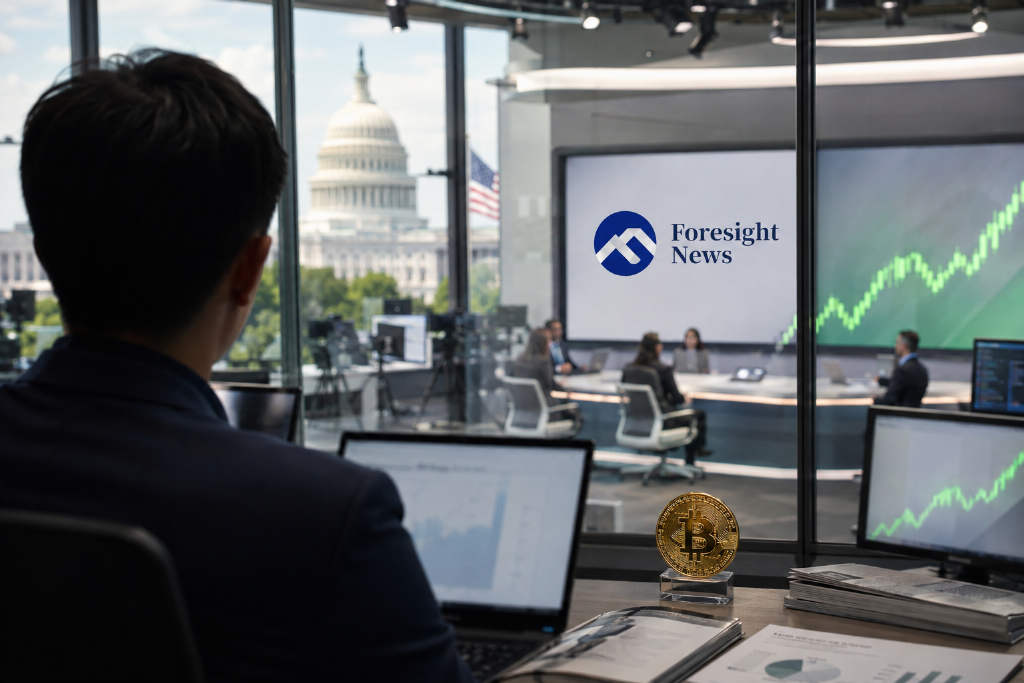
Foresight News used the latest edition of its “Creator Says” series to tackle a question that has quickly moved to the center of the crypto conversation: has a new bull market begun, or is the latest move still just a forceful rebound?
The discussion followed a sharp market recovery since August. Foresight said expectations of added liquidity from the US Treasury’s expanded bond buybacks, along with faster-moving crypto policy efforts in Washington, helped set the backdrop. Bitcoin rebounded about 25% from its mid-year low, briefly rose above $81,000, and saw the move amplified by ETF inflows and short liquidations.
Participants in the discussion included IOSG Ventures’ Mario, XH Research Institute, BlockSec, Zeuspace’s Yaokun, JamesX, Stablehunter and Foresight News deputy editor Joe Zhou. Foresight put five questions to the group: whether the market has entered a bull phase, how macro and regulation constrain the rally, what is driving the shift in sector narratives, how capital is being allocated, and what risks matter most from here.
Is this a bull market, or only a repair rally?
Mario said the rebound is real, but he still sees it as a recovery after a deep drawdown rather than the start of a new cycle. He pointed to altcoins rising from depressed levels, citing ether.fi’s TVL climbing from $2.85 billion in June to $4.26 billion in August, while ARB’s market cap had fallen to a bit above $500 million in mid-August. From those levels, even a small marginal improvement can turn into a 40% move in two weeks, he said. Bitcoin’s near-30% gain in August, its push above $80,000, “that Robinhood line,” and a shift in macro sentiment all contributed to the rally in his view.
Still, Mario argued that the structure of the market does not yet look like a full bull phase. BTC dominance remains at 59%, while the Altcoin Season Index is still below 50. In his reading, capital is rotating, not broadly entering the market. He said he would need three things to call a real bull market: sustained higher highs over three to six months with pullbacks absorbed by buyers, a new channel for incremental capital after spot ETFs, and one leading narrative the market can clearly identify as the cycle’s main driver.
He named two leading candidates. One is on-chain exchanges. Perp DEX trading volume reached $1.8 trillion in the second quarter, he said, taking a meaningful share of the futures market. The other is tokenized equities and brokerage chains. Mario noted that Nasdaq’s rules for tokenized stocks passed in March, the US Securities and Exchange Commission proposed Regulation Crypto Assets in August, and Robinhood launched its own chain. In his view, whichever theme can genuinely bring in users from outside crypto will become the defining narrative. Without that, the move still looks like a well-executed squeeze.
XH Research Institute described the current stage as a confidence reversal in the late-bear, early-bull period, though it said spot demand has not fully validated the trend. It pointed to two signs: the market has been able to extend higher quickly, and the price has not broken down after consolidating near the highs. In that framework, the roughly 25% move in August and Bitcoin’s pullback from $80,000 to around $77,000 fit an early reversal pattern. The group said short covering has clearly been part of the move, but a squeeze can only create speed. Spot buying has to confirm direction.
XH Research Institute highlighted that spot Bitcoin ETFs recorded about $3.5 billion in net inflows during August, but by early September the market had already seen single-day outflows in the hundreds of millions of dollars. It said the next test is whether ETFs and institutions can keep producing real spot demand. Compared with the prior cycle high around $126,000, it still sees $77,000 as relatively low. The institute also said it had been flagging Bitcoin as entering a “high cost-performance zone” since mid-May and repeated that view twice on July 6 and July 13, when Bitcoin was near $60,000. Whale dip-buying on-chain and larger OTC turnover, combined with the squeeze, suggested a shift from panic selling to long-term accumulation, it said.
BlockSec also took a cautious stance. It noted that on Aug. 20, as the market moved sharply higher, about $2.7 billion in crypto shorts were liquidated over 24 hours. Spot Bitcoin ETFs in the US then saw notable inflows. That means the rally cannot be reduced to a short squeeze alone, BlockSec said, but price strength by itself is still not enough to confirm a new long-term bull market. Its framework has three layers: price, capital and usage. Price reacts first. On the capital side, it wants to see sustained ETF and institutional inflows rather than a short burst. Most important, though, is usage: whether stablecoin payments keep growing, whether on-chain trading and finance expand, and whether traditional financial institutions truly fold digital assets into their business systems. Based on what it hears from clients and partners, BlockSec said more institutions are now seriously working through the operational problems that come with using digital assets in real business. If that demand persists, it may matter more than any specific price level.
Zeuspace’s Yaokun placed the market in a “confirmation phase” between the late stage of the bear market and a new upcycle. He agreed the initial rise had a clear short-covering element, especially after a long stretch of declines and low volatility left bearish positioning crowded. A shift in macro expectations or market mood could easily force liquidations and drive prices higher. But he said the rally has not depended entirely on leverage. After the first jump, most major tokens did not immediately lose momentum. ETF and spot inflows kept coming in, and capital also began to pay attention to ETH and SOL beyond BTC. That suggests some real allocation demand is already present. Even so, he said it is too early to declare a new bull market. He wants to see sustained stablecoin growth, cleaner breakouts and hold levels in major assets, a pick-up in trading activity, broader capital spread beyond BTC, and a macro liquidity backdrop that turns more supportive.
JamesX said he hopes the market is in an early bull stage, but he keeps updating that view based on external conditions. He cited the US 10-year Treasury yield rising to 4.79%, Japan’s 10-year yield touching 3%, the highest since 1996, and Polymarket data showing roughly a 59% chance of a 25-basis-point Fed hike in September, against about a 40.5% chance of no change. He also pointed to election expectations shifting, with the probability of Republicans losing control of the House at about 89% and losing the Senate at around 51%. To him, those changes all signal higher capital costs and lower risk appetite. Higher Treasury yields raise Bitcoin’s opportunity cost, while the prospect of tighter Japanese policy could trigger yen carry unwind pressure. A loss of congressional control would also limit the Trump administration’s ability to push crypto-friendly policies.
Stablehunter was more skeptical. He said the current “bull return” looks more like an illusion, with the market still too calm and the new cycle not truly confirmed. A rally can come from short covering, leverage liquidations and a temporary improvement in liquidity, he said, but none of that proves a bull market is here. For that, he wants to see steadier spot demand, broader market participation, and simultaneous improvement in fundamentals such as on-chain users, stablecoin size and protocol revenue. Until then, he sees the move as a rebound and repricing exercise.
Joe Zhou said the force of the four-year cycle should not be dismissed, nor should the persistence of how on-chain participants tend to behave. If Oct. 6, when Bitcoin traded at $126,000, is treated as the top of the last cycle, then a symmetric time-based approach would place the next bottoming window around the end of this year to early next year, he said.
Macro and regulation are setting the ceiling
On macro conditions, Mario said the most unusual feature of this rally is that it happened without rate cuts. He said the market had assigned better than a 60% chance of a 25-basis-point hike for the Sept. 15-16 meeting, with zero probability for a cut. On Kalshi, he added, the probability of “zero cuts in all of 2026” had risen to 40%, while the dominant Wall Street view was for policy to stay unchanged all year. In his reading, the rally was driven not by fresh liquidity but by positioning: shorts got squeezed, helped by several industry-level catalysts. That limits the upside and makes the move more fragile than it may look. If inflation surprises to the upside, rate hikes become reality and US stocks pull back, crypto’s high-beta nature could amplify the drawdown. He said there is no real case for calling this a decoupled crypto market when the correlation with the Nasdaq is still visible.
Mario also argued that compliance is not a headwind in this cycle but the admission ticket. The cost is that the sector cannot stay as “Degen” as it once was. He pointed to the CLARITY Act, which remains stuck in the Senate after a combined text of more than 600 pages emerged on July 22. John Thune has already acknowledged the votes are not there, Mario said, making September the most realistic window. He also flagged the SEC’s Aug. 18 proposal of Regulation Crypto Assets as the heaviest digital-asset rulemaking push of this administration. If those measures advance, brokers, pensions and listed companies could finally get a clearer compliance route into crypto. The trade-off is a sharper narrowing in product design freedom. In his words, the old model in which an anonymous team writes a contract and launches a Fair Launch within three months no longer survives intact. If a design includes yield, shares or buybacks, founders will need to think first about whether it falls under digital commodities or investment contracts in a CLARITY framework. Tokenized-equity projects also have to confront the SEC’s market-structure rules directly. That is why IOSG now asks every project the same question: does this design still work under next year’s regulatory framework?
XH Research Institute said macro and regulation are mainly constraining the short- and medium-term pace of the market rather than reversing the longer-term direction. It noted that total US debt has already moved above $40 trillion, with a high share in short-dated Treasuries, making fiscal conditions highly sensitive to rates. On the policy side, it said the market is close to consensus that the CLARITY Act will not complete the legislative process this year, while the key procedural vote window in the Senate falls around mid-September. Late-August hawkish remarks from the Fed, combined with higher oil prices caused by tensions in the Middle East, helped cool the market after Bitcoin moved above $80,000. For now, the institute said, the main issue is whether buyers step in during the pullback. Even if a hawkish policy path, geopolitical stress and rising local protectionism push the market into another base-building phase, it still sees those shocks as changing the slope, not the long-term trend. Its response would be to cut high-risk leverage while watching how spot demand holds up and whether long-term holders continue to absorb supply.
BlockSec said macro conditions can obviously interrupt the rally, given how tightly crypto now moves with global liquidity, rates and traditional financial markets. But it also drew attention to a recent event that shaped its thinking. This year, BlockSec represented Hong Kong at the Virtual Asset Technical Exchange, or VATE 2026, in San Antonio. The closed-door gathering included Europol, the UK’s NCA, Germany’s BKA, Japan’s NPA, JPMorganChase, Fidelity, FINRA, Coinbase, Binance, OKX, Kraken and Circle. For BlockSec, the key point was not one specific policy proposal. It was that actors from very different systems are now sitting at the same table to discuss digital assets. That reinforced its view that regulation and compliance are shifting from external constraints into part of the market’s own infrastructure. The SEC’s proposed Regulation Crypto Assets and Hong Kong’s implementation of its stablecoin issuer regime both raise compliance costs, it said, but they also reduce uncertainty for institutions. For large financial players, the scariest outcome is not strict regulation. It is not knowing what the rules are.
Yaokun broke the macro issue down more finely. He said August’s rally was helped by a temporary pullback in long-end US yields and the dollar, the Treasury’s expanded long-bond buybacks, and renewed ETF inflows. But he does not see that backdrop as stable. Oil prices and geopolitical risks are pushing inflation pressure back up, the US 10-year yield has returned to roughly 4.8%, and Fed officials have made clear that more hikes are possible if inflation stops falling. For him, the market is rallying in an environment where liquidity has not genuinely turned broad-based and easy. He also drew a distinction between two types of rising rates. If yields rise because of concern over US fiscal sustainability and debt, then BTC could benefit alongside gold as part of a fiat-credit deterioration trade. If yields rise because inflation reaccelerates, forcing tighter Fed policy while the dollar strengthens and US equities fall, that is plainly negative for crypto. On regulation, he said the SEC has already changed its approach this year, clarifying the boundary of securities law in March and proposing Regulation Crypto Assets in August to build clearer issuance and safe-harbor rules. That matters for institutional money, but most of the framework remains in proposal or legislative form. As a result, better regulation lowers long-term risk premia; it does not cancel macro headwinds. If policy progress disappoints, he said, ETH, SOL and higher-beta alts are likely to feel it before BTC does.
Stablehunter put it more simply: crypto is now deeply tied to rates, dollar liquidity, US equity risk appetite and regulatory policy. If rate-cut expectations are pushed back, the dollar strengthens or stocks undergo a meaningful correction, the current rally can be interrupted. His response would be to cut leverage, hold cash and stablecoins, reduce high-volatility positions, and wait for support to be confirmed again.
Joe Zhou said macro conditions, especially US regulation, have become one of the most important forces shaping crypto. Most of the time, his approach is simply to wait and let the cycle run to its peak before the next one begins.
Why new narratives are working and old names are struggling
On sector rotation, several contributors said the market is no longer rewarding stories in the same way it did during the last cycle. Mario said the deepest reason is a change in who is setting prices. With market makers, quantitative traders, listed-company treasuries and ETF channels now involved, the market is moving from “narrative plus liquidity” toward assets that can be valued with harder numbers. A token that only offers governance rights and has no connection to cash flow becomes difficult to price under that system, he said, which is why older tokens are under pressure.
He listed some of the industry’s attempts over the past year to rebuild the link between a protocol and its token. Uniswap turned on a fee switch after UNIfication and burned 100 million tokens. ether.fi wrote buybacks into the protocol contract on Aug. 13, routing a cut from each revenue line on weekly and monthly schedules. Ethena is still debating a fee switch. Hyperliquid launched AQAv2 on Aug. 26 and routed 90% of USDC reserve income to the foundation to buy HYPE. Mario said total protocol buybacks in 2026 are running around $640 million, with Hyperliquid and Pump.fun accounting for nearly 90% of that amount. The concentration itself is a signal, he said: very few projects are generating enough real money to fund buybacks.
His framework for separating durable narratives from short-lived speculation starts with retained revenue. Ethena, he said, offers a clear example. Over the trailing 12 months, gross fees reached $322 million, but 98.2% of that went to sUSDe holders, leaving just $5.85 million to the protocol. Over the past three months, monthly retained revenue was down to only $40,000-$50,000. On gross fees, the multiple looks cheap at 3.7x; on retained income, it runs above 300x. Next, he looks at whether buybacks actually accrue to holders. Jupiter uses 50% of revenue to buy JUP, but the purchased tokens go into Litterbox Trust for three years. About 276 million JUP has been bought, but only 134.5 million has actually been burned, and that happened through a governance vote. Hyperliquid’s Assistance Fund also holds rather than burns tokens, and governance could theoretically redirect it. “Bought” is not the same as “burned,” and neither is the same as “returned to holders,” in his framework.
He then looks at net issuance versus net repurchases. Using Hyperliquid again, Mario said the monthly first difference of the assistance fund balance shows real repurchases falling from around 1 million HYPE per month early in the year to around 600,000 in July, while staking issuance was about 826,000 per month. That means the token turned net inflationary in July. Because the fund spends dollars, not HYPE, a rising token price and falling protocol income squeeze how many tokens can be bought back. On revenue pressure, he also wants to know whether the problem is lower activity or lower fee rates. Hyperliquid’s revenue has dropped roughly 60% from the $300 million level posted in 3Q25, he said. Only about one-third of that can be explained by lower volume. The rest comes from fee compression, with HIP-3 market fees falling from 3.5 basis points to 0.88 basis points while accounting for half of perpetual nominal volume. If the problem is volume, revenue can return with the market. If the fee structure has changed, it may not.
For ZEC, Mario said the logic is entirely different. It is not about cash flow but about scarcity and hedging demand under tighter regulation. That trade can work, he said, but it depends heavily on the regulatory narrative itself and cuts both ways.
XH Research Institute said the deeper driver of this rotation is that incremental money is repricing assets around real use cases and compliant access points. In its view, ZEC reflects a path where privacy assets are being re-institutionalized under a regulatory framework, while HYPE has benefited from real on-chain perpetuals fee income, a buyback mechanism and strong expectations of a compliant route into the US market. Older tokens remain under pressure because the last cycle saddled them with heavy concept premiums, while this cycle’s capital is asking for active users, protocol revenue, buybacks and a credible compliance exit. The institute said it looks at four indicators: real demand, self-sustaining economics, capital channels and value capture. It added that regulation had previously forced many major projects to keep token utility constrained to weak governance functions. As the SEC and others loosen financing and policy boundaries, even older assets like UNI are now moving toward revenue buybacks, tying protocol fundamentals more closely to token performance.
BlockSec said crypto has always been narrative-driven, but this market is asking more from the story. In the previous bull cycle, many projects started with a huge promise and only later looked for users and business models. This time, money is asking whether anyone actually uses the product and where value ultimately settles. HYPE is a clear example, BlockSec said, because Hyperliquid is not just a new token. It sits on top of real trading activity, protocol revenue and value capture through buybacks. According to recent public reports cited by BlockSec, Hyperliquid has bought back and burned about $1.3 billion worth of HYPE since December 2024. ZEC is different: its recent move has put privacy demand back into the market debate, and Grayscale is pushing to convert the Zcash Trust into an ETF. But BlockSec said a price rise alone is not enough to conclude that privacy as a sector is returning. The tests, in its view, are simple: is there real demand, is there ongoing economic activity, and can value be captured by the protocol or the asset?
Yaokun said the so-called preference for the new over the old is really a change in pricing standards. After a full bear market, investors have become more selective and are searching for assets that can offer a new growth path. Many older Layer 1 and DeFi projects have not disappeared; the problem is that the market already knows their business models, their narratives have lost momentum, and they still carry old overhead in the form of trapped holders, unlocks and valuation digestion. That is why a warmer market does not automatically send them back to former highs. HYPE, by contrast, gives the market a cleaner link between users, volume, revenue and token value capture. He said the platform’s disclosed annualized fees have already passed $1 billion and that HYPE buybacks continue under its mechanism. To judge whether a new narrative has staying power, he watches whether the story turns into real demand, whether the token itself captures that growth, and where the money behind the move is coming from. If the price is being driven mainly by perps, high funding and fast leverage build, the move is more fragile. If spot buyers, institutions and long-term holders keep stepping in, then the narrative may be making the transition from theme to asset.
JamesX viewed the issue through market fragmentation. Most altcoins, he said, have lost their narrative property, and the number of users trading alts on centralized exchanges has fallen sharply. Only a small group of tokens with a strong core story, backers and some help from compliance or regulatory developments can still produce a fundamentals-based move. Much of the rest of the alt market is being run by market makers, in his assessment. Meanwhile, more liquidity has moved on-chain, where traders are rotating through newer meme coins, some with DeFi angles and some with none at all. That split is making liquidity in crypto more fractured.
Stablehunter said the market is searching for new growth and scarcity. Older stories carry trapped supply and valuation pressure, while newer assets can generate fresh expectations. But “new” does not automatically mean valuable. He wants to see real users, sustained delivery, verifiable products and revenue, and demand that survives after attention fades and prices pull back. If the move is mostly driven by hype, leverage and short-term liquidity, he sees it as speculation.
Joe Zhou said the strength in ZEC and HYPE shows that crypto users have changed how they vote with capital. They are willing to pay for projects with real users, real trading and sustainable fundamentals, not just narratives. At the same time, meme assets remain resilient, and he sees both trends shaping the market’s new direction.
How participants are allocating capital
Mario said IOSG, founded in 2017, has long focused on early-stage investments in Ethereum and infrastructure. The biggest change in the past two years has been building stronger liquid-market research, because many of the firm’s venture investments are now public tokens. Looking only at private markets misses the full process in which fundamentals are tested or disproved once a token lists. IOSG now produces liquid-market research on each key asset, breaking down revenue streams and making buybacks and unlocks verifiable so the same analytical framework can be used across private and public investing.
He splits the portfolio into three layers. The core book holds BTC, ETH and a very small number of assets with real, verifiable cash flow and distribution mechanisms written directly into contracts rather than announced by teams. That bucket is not actively timed; weakness is used to add. The tactical bucket is for names with dated catalysts, such as a fee-switch vote, the passing of a major unlock cliff or the first real distribution in a quarter. Those positions have explicit checkpoints. If the thesis fails at the checkpoint, the trade exits. He gave ether.fi as an example: IOSG turned negative in July because buybacks had stopped and the support bid disappeared, but once buybacks were written into the contract on Aug. 13, that reason no longer held. The flexible bucket is for small test positions in new narratives, with hard size limits and full acceptance that the position can go to zero. The aim is not only profit but staying in the flow of information. Mario added one hard rule: calculate unlock calendars and supply overhang before entering. Some major sources of sell pressure are not in standard vesting tables. He pointed to a Nasdaq-listed company holding about 20% of Ethena’s supply without a public lockup, and to projects where actual circulating supply does not line up with “unlocked” supply because foundations retain discretion over additional issuance.
XH Research Institute approached the question from the perspective of a regulated group. It said New Huo Group has kept accumulating with proprietary capital since Bitcoin first dropped below $70,000 in February, arguing that the asset had entered a high-value area. It drew a distinction between listed companies and institutions or individuals. A listed company has to prioritize operations and is constrained by strict SFC regulation, so it can only use a smaller pool of proprietary capital for medium- to long-term positions that support the main business. For pure investors, the mix between core holdings and flexible capital depends on style. Long-horizon value investors should lean more heavily into core positions, while trend or high-frequency traders need a larger flexible pool. From New Huo’s perspective, the market is in a confidence-reversal period between the end of a bear market and the start of a bull market, so it suggested beginning with a 20% starter core position and increasing that weight only after a second base is confirmed and right-side signals become clearer.
It also highlighted one of its own products, Alpha BTC, launched under Hong Kong SFC Type 9 licensing. The idea is to address Bitcoin’s lack of native yield compared with staking assets such as ETH and to solve for the absence of internal cash flow in long-term spot holdings. Using quantitative hedging and low-risk market-neutral arbitrage strategies tested on more than 10,000 BTC in live trading, the service aims to earn BTC-denominated returns without taking outright directional risk, allowing holders to increase the absolute amount of BTC they own across bull and bear cycles.
BlockSec declined to give specific personal allocation ratios, saying that would stray too close to investment advice and fall outside its expertise. If forced to use portfolio language, though, it said Security and Compliance are its core holdings. It does not change direction because one token or sector suddenly becomes popular. Its reasoning is straightforward: if blockchain is rebuilding financial infrastructure, then security and compliance are non-negotiable base layers. On the security side, larger on-chain asset pools mean larger economic incentives for attackers, so the industry needs more real-time monitoring, attack warnings and active risk control rather than post-incident investigation alone. On the compliance side, BlockSec continues to invest in Phalcon Compliance and MetaSleuth for AML/KYT, address-risk analytics, continuous monitoring, and fund tracing and investigation. It is also focusing closely on the intersection of AI and crypto. AI can improve efficiency in on-chain investigation, risk analysis and security operations, but AI agents with wallets will create entirely new questions around authorization, security and compliance. In its own analogy, Security and Compliance are the core book, while AI, agentic finance and new on-chain financial forms sit in the flexible research-and-build bucket.
Yaokun said Zeuspace’s adjustments are happening mostly at the level of trading models and risk control rather than in discretionary bets on specific tokens or narratives. As an AI quant team, it studies macro factors, fund flows and market structure, but those inputs are used to understand the environment, not to override the model. The market now has higher volatility, wider cross-asset dispersion and faster rotation, which is a favorable setup for systematic strategies, he said. The goal is not to predict whether BTC, ETH or some new theme will win next. The goal is to keep the model reading changes in trend, volatility, turnover, liquidity, capital behavior and cross-asset correlation, then raise risk exposure when the opportunity set improves and cut it when the market structure deteriorates.
JamesX said his core holdings should still be built around gold and Bitcoin. He added that centralized exchanges and on-chain perp DEXs such as Hyperliquid now offer many commodity and US equity markets as well, which makes it easier to adjust quickly from a single trading account.
Stablehunter said he divides funds into three pools: core holdings, flexible trading capital, and cash or stablecoins. The core bucket stays exposed to the long-term trend, the flexible bucket hunts stage-specific opportunities, and the cash bucket preserves optionality for drawdowns and sudden events. The key, he said, is not to maximize every gain but to make sure a wrong call does not force an exit from the market altogether.
Joe Zhou’s allocation was the most concentrated answer of the group: more than 90% still goes into regular BTC and ETH buying.
The biggest risks and the easiest mistakes to make
Mario listed the main variables in order. First comes rates rising rather than falling, which he called the one factor capable of breaking every narrative at once. Second is another failed September window for the CLARITY Act, which would leave compliance capital waiting outside the door. Third is the reflexivity around DATs and listed companies holding tokens: they are natural buyers when they expand, but if their own shares move to a discount versus NAV, they can flip into natural sellers, and their holdings are now large enough to influence individual token prices. Fourth is the ongoing fee war among perp DEXs, which is hitting what is currently the largest revenue pool in crypto.
He also laid out several cognitive traps. One is treating buybacks as dividends. They are not the same thing, and the only question that matters is where the tokens end up. Another is annualizing one-day or one-month data. Using Ethena as an example, Mario said DefiLlama records fees around distribution events, which means most days show less than $100 and occasional days show $3 million to $4 million. Depending on which 30-day window is selected, annualized figures can differ by a factor of 10. A third trap is assuming a dashboard reading of zero means no revenue. Mario said that same zero can mean different things: ether.fi’s holders revenue still shows zero after buybacks went live because the adapter only tracks one sub-protocol; Aave’s daily zero readings after June 25 come from an adapter following an old treasury address rather than the new buyback contract; Morpho’s zero is a genuine zero because the protocol is not designed to retain revenue. A fourth trap is looking only at vesting calendars to estimate sell pressure. Mario said Morpho’s circulating supply rose 25% in six months, but contract unlocks explain only about 40% of that increase, with the rest coming from discretionary governance and reserve-pool issuance. Jupiter’s unlock calendar is empty, yet 56% of supply sits in three multisigs with no schedule at all. The final trap is assuming this cycle will rhyme too closely with the last one. Strategies that worked before, like buying the highest beta and the newest narrative, may not work the same way in a market dealing with fee compression, tighter regulation and compliance-gated capital. He ended with a familiar warning: in a rebound, it is easy to mistake survivor bias for skill. Plenty of tokens are up 40% to 100% off the lows, but the link between price performance and fundamentals remains weak. Beta is not alpha.
XH Research Institute said the biggest variable ahead is policy uncertainty after the US midterm elections. As Trump’s term moves into its later stage, a tighter balance of power in Congress could strengthen the “lame duck” effect. The major risk, in its view, is the continued pressure that a high-rate environment puts on global liquidity, compounded by lofty equity valuations in the US. If traditional markets undergo a broad valuation reset because of tighter liquidity or weaker earnings, the spillover through both liquidity channels and risk aversion could weigh heavily on crypto. It sees two common mistakes. The first is mechanically applying old-cycle templates, from halving timing to capital rotation, while ignoring how ETFs, stablecoin legislation, DAT participation and the rise of RWA have reshaped the capital base and investor mix. The second is liquidity mismatch: deploying all available capital in an emotional market, then using up flexible funds and taking on too much leverage as soon as a rebound begins, leaving no room to smooth costs or buy into a deeper second dip.
BlockSec framed the main risk as a mismatch between the speed of asset and business growth and the slower pace of risk-infrastructure development. That issue becomes especially visible in a bull market. A flaw that might once have led to a $1 million loss can suddenly become a nine-figure attack opportunity when token prices and TVL rise. A modest compliance problem can also scale quickly as payments and institutions expand. New forms of risk are appearing at the same time. Once AI agents start trading on-chain, questions emerge that did not exist in the traditional wallet era: who has the authority to approve a transaction, who is responsible if an agent is manipulated by prompt injection or something similar, and how much value an agent should be allowed to move. BlockSec said two mistakes are especially dangerous: assuming risk falls when markets rise, and assuming compliance matters less when regulation turns friendlier. In practice, it said, rising prices strengthen attacker incentives, while clearer rules invite more institutions in, which raises rather than lowers requirements around AML, KYT, sanctions screening, source-of-funds checks and risk management. Its main concern is not Bitcoin’s eventual price but whether the market can build security, compliance and risk infrastructure that matches the scale of value that may end up on-chain.
Yaokun said the key issue for a quant firm is whether the current market regime can last. Crypto has become highly financialized and is now shaped jointly by global liquidity, institutional money and regulatory systems, so the biggest threat is a sudden shift in market state. Externally, that still means a liquidity reversal. This rally has taken place while long-end US rates remain high and inflation and geopolitical risks have not disappeared, so the base is not especially loose. If inflation turns back up, the Fed tightens again, and the dollar and real yields rise together while equity risk appetite weakens, ETF inflows could become ETF outflows. Internally, he sees the largest risk in prices running ahead of fundamentals and real liquidity. Early in a rally, money clusters in a small number of strong assets and hot narratives, creating a wealth effect that pulls in leverage and momentum capital. If prices rise quickly while stablecoin supply, spot turnover, real users and long-term holders do not expand in step, the market may look stronger than it really is. He then repeated three mistakes he sees often: confusing beta for alpha, reading price gains as proof of stronger fundamentals, and mechanically replaying the script of the last bull market such as “BTC first, then ETH, then alts.” That kind of fixed playbook, he said, is exactly why his team leans on AI-driven quantitative systems: models can reread data and accept that old relationships have stopped working.
JamesX also returned to macro and regulation as the biggest risks. He said uncertainty around the Trump administration and the broader fiscal and monetary backdrop can easily trigger sharp swings or black swan events, which is why traders should avoid using too much leverage for one-way bets. In his view, one of the biggest mental traps in this market is still expecting a broad altseason like the old ones. He argued that the previous cycle’s altseason was already much less pronounced and often expressed through on-chain meme trading instead. At this stage, without a strong narrative base, the odds of a broad altseason across most projects are getting lower. Active money is more likely to choose newer on-chain projects or meme assets, especially now that on-chain trading infrastructure has improved enough that users do not need centralized venues for many of those trades.
Stablehunter said the biggest variable ahead is whether the market can move from being driven mainly by liquidity to being driven jointly by capital, fundamentals and real usage. The easiest mistake, in his view, is to treat price gains as full bull confirmation, turn every new narrative into new value, and think only about entry points while ignoring exits. His stance is straightforward: stay constructive if the evidence supports it, but do not give up risk management just because the market is talking about a “bull return.” A healthy bull market should show resonance between price, capital, users, products and macro conditions.
Joe Zhou said the main external variable remains the path of the Trump administration and US policy. Internally, the most dangerous mistake is to treat new narratives and new assets as the final destination while letting go of the sector’s real foundation and core assets, which he still sees as the ballast that carries portfolios through full cycles.
Disclaimer
Foresight News ended the piece with a standard disclaimer, stating that markets carry risk, the article does not constitute investment advice, and readers should decide for themselves whether the opinions and conclusions discussed are suitable for their own circumstances.