
French lawmakers back stablecoin tax amendment as exit tax and self-custody reporting proposals stay in play

French lawmakers back stablecoin tax amendment as exit tax and self-custody reporting proposals stay in play

N
News Editor
2026-10-19 10:22:30
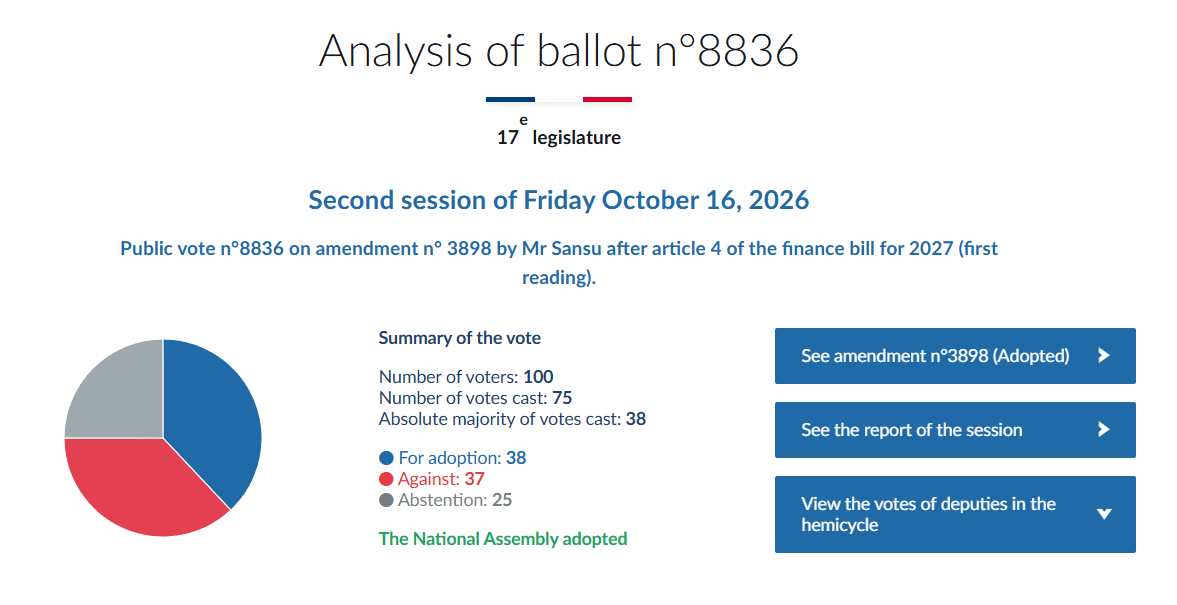
France’s National Assembly has adopted Amendment I-3898, a crypto tax measure that could make certain crypto-to-stablecoin swaps taxable starting in 2027 if it becomes law. The amendment passed Friday by a razor-thin margin of 38 votes to 37, with 25 abstentions. Under the proposal, investors swapping Bitcoin or other cryptocurrencies into stablecoins could face tax on gains even if they do not convert those gains into fiat currency. The measure would also change how France calculates crypto capital gains, using the acquisition cost of the asset sold and a weighted average purchase price. The vote comes as lawmakers continue reviewing other crypto-related tax proposals tied to the 2027 Finance Bill. One rejected measure would have allowed realized crypto losses to be carried forward for 10 years; it failed with 18 votes in favor and 75 against. Two other proposals remain under consideration: Amendment I-CF1822 would extend France’s exit tax regime to unrealized crypto gains for taxpayers moving abroad with aggregate crypto holdings above €800,000, while Amendment I-2701 would require individuals to declare self-custodial wallet holdings if their total value exceeds €100,000 during the relevant tax year.

France’s National Assembly has adopted a crypto tax amendment that could make certain crypto-to-stablecoin swaps taxable events from 2027, if the measure is enacted.
French lawmakers back stablecoin tax amendment as exit tax and self-custody reporting proposals stay in play 2

According to Cointelegraph, lawmakers approved Amendment I-3898 on Friday by 38 votes to 37, with 25 abstentions. The measure was first introduced as committee amendment I-CF1826 by French lawmaker Nicolas Sansu and was adopted on Oct. 7.

Crypto-to-stablecoin swaps could trigger tax

Under the proposal, investors who convert Bitcoin (BTC) or other cryptocurrencies into stablecoins would trigger tax on gains even if those gains are not converted into fiat.

The amendment would also change the way France calculates crypto capital gains tax. The calculation would rely on the acquisition cost of the crypto asset sold and the weighted average purchase price.

The Assembly is scheduled to vote on the first part of the 2027 Finance Bill on Tuesday, according to its official agenda. Other crypto-related proposals are still under consideration, though it remains unclear whether each one will be debated or voted on that day.
French lawmakers back stablecoin tax amendment as exit tax and self-custody reporting proposals stay in play 3

Exit tax and self-custodial wallet reporting proposals remain under review

Separately, the Assembly rejected a proposal on Friday that would have allowed realized crypto losses to be carried forward for 10 years. That measure received 18 votes in favor, 75 against and 3 abstentions.

Lawmakers are also preparing to discuss other crypto-related proposals as part of next year’s budget process. Amendment I-CF1822 would extend France’s exit tax regime to unrealized crypto gains when taxpayers with aggregate crypto portfolio values above €800,000, or about $895,000, move their residence abroad.

Another proposal, Amendment I-2701, would require individuals to declare holdings in self-custodial wallets if the total value of those wallets exceeded €100,000, or about $112,000, during the relevant tax year.

As of Monday, both proposals remained under consideration for the 2027 Finance Bill.

This article was originally published by Bit.Fan. For more cryptocurrency news and market insights, visit www.bit.fan.
700

Disclaimer:

The market information, project data, and third-party content displayed on this platform are for industry information sharing only and do not constitute any form of investment advice or return commitment.

Cryptocurrency trading carries high risks. Users should fully assess their risk tolerance and make independent decisions. All profits, losses, and legal responsibilities are borne by the users themselves.