
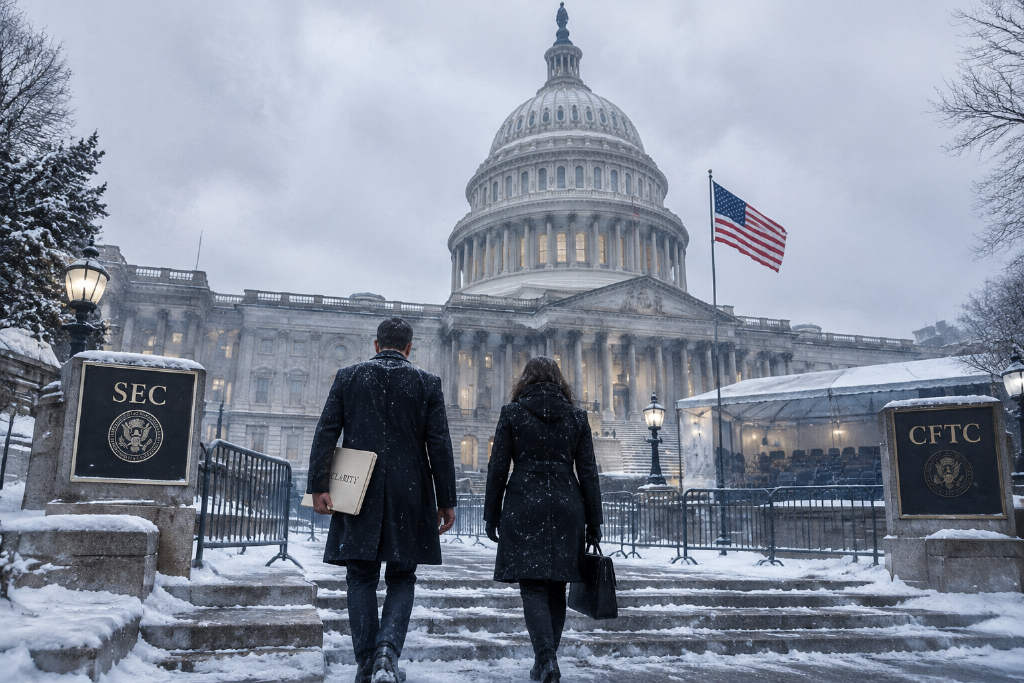
U.S. House Financial Services Committee Chairman French Hill said recent crypto rulemaking by the Securities and Exchange Commission and the Commodity Futures Trading Commission is not enough to replace congressional legislation. In an interview with Fox Business on Wednesday, Hill said the digital asset market needs a long-term and predictable legal framework, not one built around agency discretion.
Hill says agency action falls short of legislation
Hill said the SEC and CFTC have started rolling out new proposals for digital assets, but those administrative steps are still “not enough” to match the stability that legislation can provide. He argued that agency rules do not carry the same legal standing and can shift with changes in government, which leaves crypto companies and investors without the certainty needed for long-term planning.
Last month, the Senate failed to pass the Digital Asset Market Clarity Act, or the CLARITY Act, a bill that had been seen as a key step toward a clearer U.S. regulatory path for crypto. After the bill stalled, SEC Chair Paul Atkins and CFTC Chair Michael Selig each put forward their own crypto regulatory drafts under instructions from President Donald Trump. Those proposals covered spot market classification, stablecoin compliance and derivatives oversight.
Hill said in the interview that the two agencies’ response does not keep pace with a legislative solution. His position was clear: Congress still needs to write the rules.
A 22-day lame-duck window
Hill said he still sees a path for the CLARITY Act during the lame-duck session after the midterm elections. Under the current schedule, the Senate will have only 22 working days between the November midterms and the start of the new Congress in 2027.
That narrow window could make the vote highly sensitive to the election outcome. Lawmakers who know whether they will remain in office next year may change how they vote.
Hill also pointed to precedent. At the end of 2020, Congress moved quickly on the framework for the CHIPS and Science Act, which included semiconductor subsidies and infrastructure investment. For the crypto sector, passing the CLARITY Act before the next Congress is seated would help avoid another two years of regulatory uncertainty.
Vacancies are limiting both agencies
Hill also highlighted a structural problem at the SEC and CFTC: leadership vacancies. As of Wednesday, the two agencies had seven vacant seats combined.
After SEC Commissioner Hester Peirce announced her resignation last week, the SEC was left with only Chair Atkins and Commissioner Mark Uyeda. At the CFTC, Michael Selig is the only sitting commissioner.
That thin roster limits decision-making. At the SEC, crypto-related rule proposals require votes from at least three commissioners to take effect, but the agency now has only two. The CFTC faces a similar constraint, with Selig trying to move new rules forward without support from other commissioners.
Compliance pressure remains while the bill is delayed
For the crypto industry, a delay in passing the CLARITY Act means firms will still have to rely on SEC and CFTC administrative rules in the near term. Those rules can move faster, but they do not offer the same long-term stability and could still be challenged in court.
That leaves exchanges, custodians and project teams continuing to spend on compliance as they respond to different standards set by different regulators.
Hill’s remarks also sent another message to the market: Congress still wants a role in shaping crypto law and does not intend to leave the field entirely to executive agencies. The lame-duck session offers only a 22-day opening, but Hill made clear he does not see that as impossible.