



P2P is a neutral term, really. Strip it down and it points to one of finance’s oldest arrangements: one person needs cash, another has cash to spare, and lending connects the two.
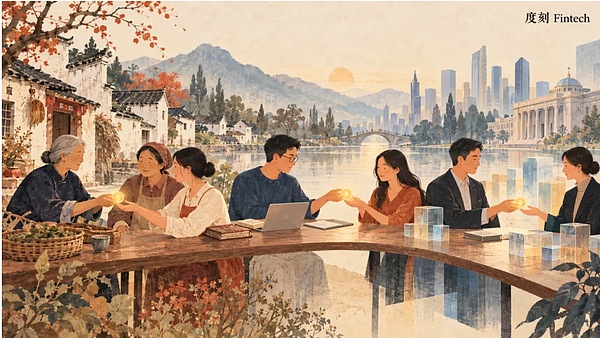
But the tension is there from day one. In a small circle, trust comes from knowing people. Once the circle expands, an intermediary shows up. And after that, the relationship stops being truly direct.
The PANews article puts rotating credit circles, Wenzhou-style raised-interest associations, CreditEase, DeFi, and RWA on one timeline. Different eras, different labels. Same question underneath: why would anyone feel safe giving money to a stranger?
Wenzhou credit circles and the limits of familiar trust
The piece opens in Yueqing, Wenzhou, Zhejiang, with a local practice called “cheng hui.” A respected organizer brought together relatives, friends, and neighbors. Everyone paid in a fixed amount each round, and the pooled sum went to one member in turn. Families used the money to build homes or cover wedding costs.
Wenzhou’s local gazetteer put it bluntly: “When money is urgently needed and there is nowhere to borrow, one asks relatives, neighbors, and friends to form a hui.” The trust behind the arrangement came from repeated contact and long memory. Finance here was not some abstract balance sheet. It was familiar faces. That’s it.
According to the article, things changed around 1985 as Wenzhou’s private economy grew. Family workshops spread fast, but bank credit failed to reach many sole proprietors and small factories. Demand for capital pushed past what tight social circles could provide, and “tai hui” appeared.
Here, the word “tai” had two meanings: higher interest and bigger pools. What started as a “single ten-thousand yuan hui” expanded into pools of 100,000 yuan, 500,000 yuan, and 1 million yuan. By then, the article says, people were no longer counting cash bill by bill. They would “measure it with a ruler, or weigh it on a scale.”
A mutual-aid setup built on familiar trust ballooned within months into a money pool nobody could fully see. Then, in the spring and summer of 1986, the funding chain snapped and organizers fled, the article says.
The author’s point is sharp: these systems functioned for centuries because they depended on credit among acquaintances. But once more money poured in and participants became less familiar to one another, “I know him” gradually turned into “I trust the organizer.” Questions about who borrowed, who could repay, and who would take responsibility all ended up on that organizer. Reputation could pull money in. It could not always cover the hole after a collapse.
The article also turns personal, saying the mechanism sat close to everyday life and that the author’s own family was affected after an organizer ran off. Many households, it says, went through the same thing.
CreditEase and the platform era
The second section shifts to modern P2P platforms.
In 1997, Tang Ning went to Bangladesh and saw the Grameen Bank model tied to Muhammad Yunus: women in villages borrowed small amounts to buy raw materials, repaid through work, and then borrowed again.
Nine years later, Tang founded CreditEase in Beijing. The article says the early structure was simple enough: loans were first issued in an individual’s name as the original lender, and then the claims were split and transferred. Investors were not so much trusting a system as “Tang Ning himself.” His Peking University mathematics background and Wall Street resume acted as the credit backing for the model.
The author describes Tang as the intermediary of that era, not so different from the organizer in a traditional hui. The difference lay in training and experience. He turned lending that had once stayed inside familiar circles into a business offered to many more strangers.
And around the same period, similar tests were emerging elsewhere. In 2005, four young founders in London launched Zopa, which the article calls the world’s first online P2P lending platform. In 2006, Lending Club was founded in the United States. Their sales pitch was also about extending credit to people banks had left out.
But platforms had interests of their own. The article points to Lending Club’s 2016 scandal, when an internal review found that $22 million in loans had been sold in violation of rules, triggering the resignation of the founder and CEO. That episode showed something plain: a platform does not just match borrowers and investors. It also decides which loans get sold to whom. So investors have to trust not only borrowers, but the platform picking loans for them.
In 2015, Yirendai listed on the New York Stock Exchange and became what the article calls “China’s first P2P stock.” For investors, Tang’s personal credentials were now paired with the stamp of a listed company. Over the next decade, the article says, CreditEase expanded beyond P2P, and its products and transaction structures grew more complicated. Looking back, that bell at the exchange sounded like the start of an era and its ending note at the same time.
The article then quotes an apology letter sent on the evening of Oct. 11, 2026 through a CreditEase app to investors in quasi-fixed-income products. The letter said multiple businesses in the group were losing money, the value of assets disposed of through market-based methods was low, effective funding sources were lacking, and the products had effectively defaulted. It added that the group “may already be balance-sheet insolvent.”
That came four months after the company announced a full halt to redemptions on May 22. Investors waited four months without getting a repayment plan, the article says, and received just one message in return: the money might not be repayable.
It also singles out another line from the letter. A legal due-diligence institution said it could not independently investigate the compliance of the quasi-fixed-income products based on the materials the group had provided on transaction channels and structures. The author’s takeaway is blunt: after 20 years, the path led from one person, to a listed company, to a structure outsiders could no longer see through.
Blockchain and DeFi: removing the platform itself
The third section turns to blockchain.
The article quotes HashKey’s Xiao Feng from a 2014 speech: “The internet will not overturn demand for financial services; it will overturn the institutions that provide financial services.” It also cites an earlier line he used: “Human financial needs remain unchanged through the ages, but the models of financial service keep changing.”
Look at it that way, and rotating credit circles, raised-interest associations, CreditEase, Zopa, and Lending Club are all doing the same basic job. They convert savings into investment and move value from one person to another across time and distance. What changes is who carries the risk, who keeps the records, and who explains the rules.
Then the article asks the obvious question: if platforms can turn into black boxes, can the platform itself be removed?
Bitcoin gave a radical answer in 2009. Trust would be written into code instead of being lodged inside an institution. DeFi came after, and the article describes the next decade as a shift from a chaotic early stage toward institutionalization.
Its main example is Luna/UST in 2022. The system tried to hold a dollar peg through an algorithm. Anchor offered yields close to 20% annually, and LUNA’s market capitalization at one point hit $41 billion. Then came the death spiral. UST lost its peg, LUNA supply exploded, prices fell again, and the loop kept feeding itself. LUNA dropped from nearly $90 to $0.00017 within days, erasing tens of billions of dollars.
The article argues that the algorithm laid out how to respond when prices drifted away from target, but it could not stop everyone from losing confidence at the same moment. Rules built to preserve stability ended up speeding up the collapse. And that, the author says, echoes the old hui failures: on normal days, everyone believes the next round will go on. Then one day, everyone wants the money back at once.
After Luna, DeFi contracted. But the article says the real turn did not come from technical iteration inside DeFi. It came when traditional financial institutions started entering on their own.
RWA and the return of institutions on-chain
The names now showing up on-chain, the article says, include BlackRock, JPMorgan, and Franklin Templeton. What they bring with them are U.S. Treasuries, money market funds, and custody and management arrangements that have been running for years.
Bernstein estimates that the RWA market reached about $51 billion in 2026.
The article frames the change like this: DeFi 1.0 carried the wild story of bypassing banks. RWA carries a different story — putting banks themselves on-chain. Technology that once aimed to go around financial institutions is now being used by those same institutions.
Even so, intermediaries have not vanished. Managers, custodians, and technology platforms still sit in separate roles behind these products. The division of labor is different. The intermediaries are still there. This time, the institutions coming on-chain are ones the market already recognizes. The names are more familiar, the rules are more numerous, but trust still has to rest somewhere.
Technology changes form, not the core risk
The article closes by invoking Jevons and his counterintuitive observation that more efficient steam engines led to higher total coal consumption because efficiency opened up more uses.
The author says financial technology works much the same way. As organizing a transaction gets easier, money can travel to more people and across greater distances. Funds in a local hui moved among relatives and neighbors. Platforms connected people who had never met. On-chain protocols let capital cross borders.
And when participation widens, trouble in one place can spread much farther.
Risk, though, does not vanish. It changes shape. And when the scale is bigger and the chain is longer, the force of a single shock can travel farther than before. Technology can make money move faster and transactions reach farther. It does not answer the old questions: can borrowers repay, do the people managing other people’s money have different incentives, and can lost funds be recovered after a failure?
The article ends with a simple line: each generation gets its own version of P2P. From the face of a local organizer, to the brand of a platform, to code on a blockchain, people keep looking for a way to feel safe handing money to strangers. The methods keep multiplying. Confidence stays hard to secure.