Foresight News, citing Kate Irwin, reports that GalaChain has suffered another attack with losses of more than $3 million. The issue was not access control, but a code-level flaw in the way GalaChain handled EIP-712 structured signatures. An attacker did not need to break a private key; by reusing a valid signature and adding undeclared fields, the attacker could make a transfer execute on-chain.
The report says the flaw sits in the getPayloadToSign function. Under EIP-712, the type declaration should tell users what they are signing, but only the fields listed in the types definition are hashed. GalaChain’s implementation allowed the caller to submit types together with the DTO. If the payload contained fields not declared in types, those fields were left outside the signature.
According to the article, the attack could start from an ordinary interaction on GalaSwap, such as Swap, AddLiquidity, or CollectPositionFees. A signature collected there could then be reused in a GalaChainToken TransferToken flow, with extra to, quantity, and tokenInstance fields inserted into the DTO. The on-chain check would still recover the victim’s address and treat the transfer as authorized.
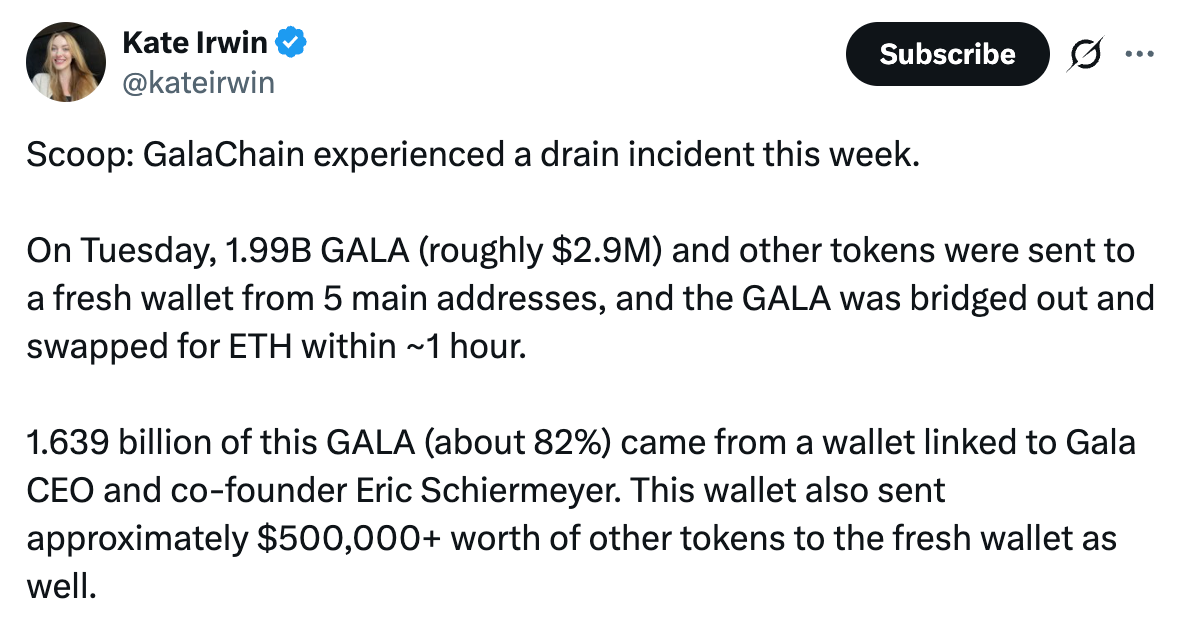
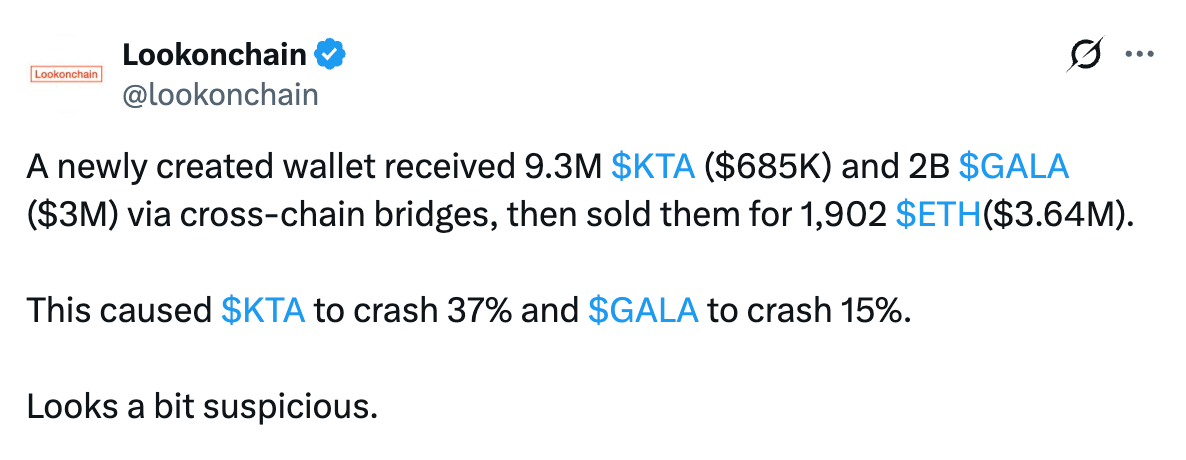
Lookonchain tracked a newly created address receiving bridged GALA and KTA and then selling them for ETH. Kate Irwin said more than 1.6 billion stolen GALA came from addresses linked to Gala Games co-founder and CEO Eric Schiermeyer. The team reportedly merged a fix on Aug. 18, about 14 minutes after the PR was created, but neither Gala nor Schiermeyer had publicly commented at the time of reporting.
Foresight News says GalaChain has suffered another attack, this time with losses of more than $3 million, and the problem was not permissions.
Kate Irwin, a former Decrypt and Blockworks reporter, disclosed the incident on Aug. 21 Beijing time. The victim was Gala Games. The report ties the exploit to GalaChain’s handling of EIP-712 structured signatures, specifically the getPayloadToSign function.
Under EIP-712, the type declaration is supposed to tell users exactly what they are signing. In GalaChain’s implementation, however, the caller could submit types together with the DTO. If the actual payload included fields that were not declared in types, those fields would not be covered by the signature hash. The chain would verify only the signed part, while extra recipient and amount fields inserted by the attacker could still be executed.
That makes the attack flow hard to spot. A user may have only signed a routine GalaSwap action such as Swap, AddLiquidity, or CollectPositionFees. Once the attacker obtains that valid signature, there is no need to break a private key. The same signature can be reused in a GalaChainToken TransferToken transaction, while undeclared to, quantity, and tokenInstance fields are added into the DTO. Because those fields were never part of the original hash, verification still recovers the victim’s address and the system treats the transfer as legitimate.
The article gives a plain-language example: a user signs a paper that appears harmless, such as consent to make a normal trade or add liquidity. The attacker then writes new text on the same paper, including a clause that sends all the user’s coins to the attacker. Since the added content was not in the original declaration, the system treats it as unsigned and executes it anyway.
On the day of the attack, Lookonchain tracked a newly created address receiving bridged GALA and KTA and then selling them for ETH. Kate Irwin said more than 1.6 billion of the stolen GALA came from addresses linked to Gala Games co-founder and CEO Eric Schiermeyer.
Neither Gala nor Schiermeyer had publicly commented on the incident at the time of reporting, and neither responded to Kate Irwin’s request for comment. The article says the impact appeared limited and users were not affected.
The team did move quickly to patch the flaw. The fix was simple in logic: before a signature payload is generated or verified, the code recursively checks whether every actual field is declared by the matching type. If an unsigned field is found, the transaction is rejected; legitimate requests with complete declarations still pass. The PR was created on Aug. 18 and merged about 14 minutes later.
The piece also argues that Web3 security is often reduced to private keys, multisig, and audits, but a structured signature shown in a wallet does not mean the entire request is protected. Correct contract logic also does not guarantee that the SDK, gateway, and chain code interpret the same data in the same way. An attacker does not always need to break through defenses; finding a gap between two modules’ understanding of what the user agreed to can be enough to drain funds.
The article says similar attacks do happen in DeFi, but attacks at the chain logic layer are rare. It calls the flaw a serious and low-level mistake for a chain’s message-verification logic, and a warning to self-built chains that want to improve efficiency: security should come first.

This article was originally published by Bit.Fan. For more cryptocurrency news and market insights, visit www.bit.fan. Disclaimer:
The market information, project data, and third-party content displayed on this platform are for industry information sharing only and do not constitute any form of investment advice or return commitment.
Cryptocurrency trading carries high risks. Users should fully assess their risk tolerance and make independent decisions. All profits, losses, and legal responsibilities are borne by the users themselves.