
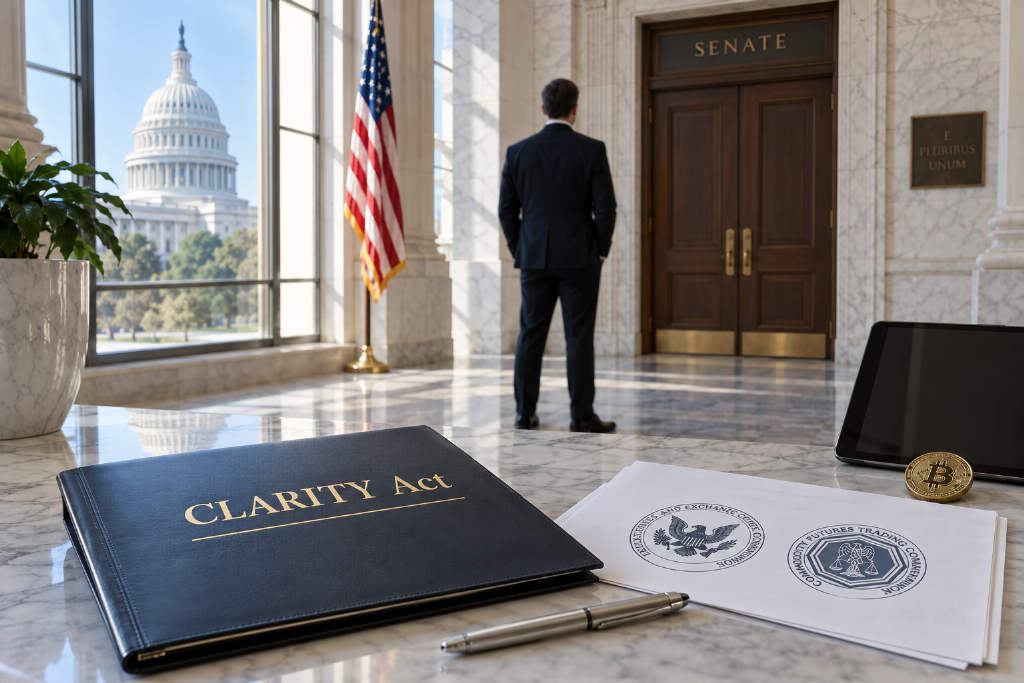
Alex Thorn, head of research at Galaxy, said the US Senate’s failure on Tuesday to move the CLARITY Act forward was a heavy blow for people who have spent years working on crypto market structure legislation.
He said North Carolina Republican Senator Thom Tillis still has a chance to revisit the cloture motion before the current Congress ends, and that some people are trying to restart the bill behind the scenes. Even so, Thorn said he does not expect meaningful progress this year. The cloture motion is the step needed to end debate and move the bill toward a vote.
Thorn described the CLARITY Act as a strong bipartisan legislative product. In his view, it could have delivered stronger investor protections, helped curb illicit finance, supported innovation, and reinforced the global leadership of US capital markets. He also said many people across Congress, regulatory agencies, and the crypto industry had put substantial work into the bill over several years.
Crypto’s near-term path does not depend on the bill
Even with the legislation now likely to fail, Thorn said the focus should shift to what comes next.
He argued that bitcoin, crypto, and blockchain do not need the CLARITY Act in order to keep developing in the short term, at least for now. Blockchain activity is still expanding, global adoption is accelerating, and market regulators are taking action. For the rest of the current administration, he said, the US regulatory environment is not only favorable to crypto but broadly supportive of its development.
Thorn added that a future administration hostile to crypto could reverse some of these measures. Still, he said the current setting gives the industry breathing room to keep pushing toward future legislation.
SEC and CFTC are filling in the rule gaps
According to Thorn, the Securities and Exchange Commission has dismantled the anti-crypto regulatory structure that took shape under the previous administration.
He said that during Gary Gensler’s tenure as chair, the SEC was not only hostile to the crypto industry but also failed to seriously address how existing rules should apply to crypto assets. Thorn wrote that the prior SEC leadership claimed that nearly all crypto assets were securities while avoiding the harder task of figuring out how those assets fit within securities law.
He said the current SEC is backing financial innovation while continuing to explain how crypto assets fit into the existing regulatory framework and where that framework needs to be adjusted for the technology.
Thorn wrote that the SEC now has dozens of staff members reviewing current rules and regulations, gathering input, and drafting guidance and proposed rules. He contrasted that with the prior chair’s reliance on litigation, refusal to seriously answer calls for clearer rules, and pressure that pushed lawful business offshore. By comparison, he said Chair Paul Atkins and Commissioners Hester Peirce and Mark Uyeda are promoting a regulatory culture that respects professional judgment, encourages innovation, and values investor protection.
He said the Commodity Futures Trading Commission is moving in a similar direction. Under Chair Mike Selig, Thorn wrote, the CFTC is working with the SEC more closely than ever before and is gradually ending the turf fight between the two agencies over crypto oversight.
Thorn said Selig has advanced rulemaking tied to prediction markets, expanded the use of stablecoins as collateral in derivatives trading, approved the first bitcoin perpetual futures contracts in the United States, and clarified how the CFTC will handle similar approvals going forward. Bitcoin perpetual futures are derivatives contracts with no fixed expiration date.
In Thorn’s account, the SEC and CFTC are jointly providing clearer explanations for how different types of digital assets should be classified and traded. He said this is not special treatment for crypto. Rather, the two commissions are doing the difficult work of explaining how securities law and commodities law apply to a new technology and adjusting the framework where needed.
Other federal agencies have also changed course
Thorn said other federal agencies have taken action as well.
In March 2025, the Office of the Comptroller of the Currency rescinded the prior “supervisory non-objection” process. Under that system, national banks had to obtain a regulator’s non-objection before engaging with crypto assets or using blockchain.
The Federal Deposit Insurance Corporation also removed a similar requirement for non-Federal Reserve member banks. Thorn said those two moves dismantled much of the regulatory machinery behind “Operation Chokepoint 2.0,” a term commonly used to describe efforts to restrict crypto firms’ access to accounts, payments, and financial services through the banking system.
After that, the OCC began issuing conditional national trust bank charters to crypto firms, and the Federal Reserve ended its “novel activities supervision program,” which had previously imposed enhanced supervision on companies involved in crypto business.
Thorn also pointed to an April 2025 Department of Justice memo titled “Ending Regulation by Prosecution,” the Labor Department’s withdrawal of its 2022 strict guidance on crypto assets in 401(k) retirement savings plans, and an Internal Revenue Service safe harbor for staking activity in grantor trust structures used by commodity ETFs. A grantor trust is a trust structure in which the related income is treated for tax purposes as if it were held directly by the grantor.
He said federal agencies are now more active and more willing to devote resources to responsible innovation than they were over the past several decades. In his view, blockchain is being treated as a powerful technology that can serve both individuals and institutions.
Thorn cited Galaxy Research data showing that all of the world’s top 30 banks are developing digital asset products, while two-thirds of the top 30 asset managers are also active in the area. He added that the number of announcements tied to digital asset products from the world’s top 150 traditional financial institutions hit a record last year and could exceed that record in 2026.
Legislation still cannot be replaced
Even with the regulatory shift, Thorn said the likely end of the CLARITY Act chapter also marks the close of an era.
He noted that SEC Commissioner Hester Peirce will leave in November, Tyler Williams left the Treasury Department in July, and Patrick Witt plans to leave the White House at the end of September for officer training.
He also said Thom Tillis and Cynthia Lummis, both key Senate Banking Committee members who played important roles in digital asset legislation, are set to retire from Congress. Many key policy staffers on Capitol Hill may also leave for other jobs.
Thorn said the existing legislative text, research, and policy groundwork remain in place, but when these issues come back for debate, the balance of power, the market setting, and the people involved may all be different.
He wrote that the CLARITY Act was never meant to be the endpoint of this work. It was always the starting point. “We may have lost this vote, but we have not lost the argument.”
The next two years are a window to prove the case
Thorn said there are limits to what regulators can do on their own. The CFTC cannot grant itself spot-market authority. No interpretive document can automatically displace the separate regulatory regimes of all 50 US states or replace state law. And any regulatory relief for non-custodial developers, meaning developers who do not hold user assets, remains temporary unless it is written into federal law.
Regulators can interpret the law, he said, but only Congress can change it.
Still, Thorn argued that the next two years should not be spent waiting in place. He said the industry has a chance to build practical evidence showing that spot markets can be monitored effectively, tokenized securities can clear, settle, and trade safely around the clock, and stablecoins can move funds at scale quickly and at low cost without creating systemic problems.
If that evidence is built, he said, the industry will be larger and the practical case for market structure legislation will be stronger when Congress eventually returns to the issue.
Thorn ended by saying that for the past decade, the industry asked for clear rules and got lawsuits instead. Now the situation has flipped, and in his view that is a much better place to be: the government is willing to put real effort into building rules, and the industry has a limited window to prove that the work is worth continuing.