

Galaxy’s Q2 loss narrowed, but its own portfolio still weighed on results
Galaxy Digital reported a net loss of $85 million for the second quarter of 2026 on Aug. 5, down from a $216 million loss in the first quarter. Adjusted gross profit came in at $43 million, after an $88 million adjusted gross loss in Q1. Adjusted EBITDA was a loss of $77 million, compared with a $188 million loss in the prior quarter.
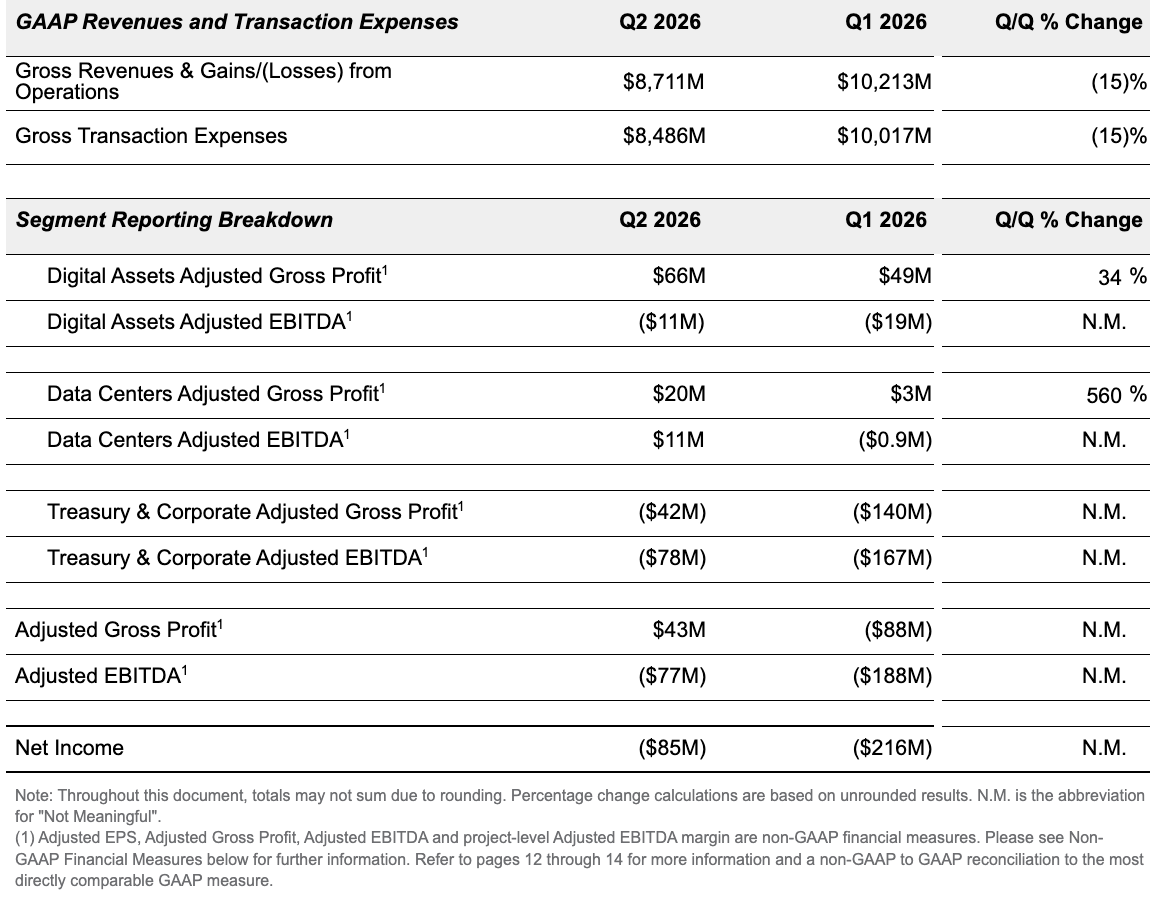
On the operating side, the company’s digital assets and data center businesses together produced $86 million of adjusted gross profit and $1 million of adjusted EBITDA. Digital assets generated $66 million of adjusted gross profit, up 34% quarter over quarter, while adjusted EBITDA was a $11 million loss. The data center unit delivered $20 million of adjusted gross profit and $11 million of adjusted EBITDA.
The main drag on the company-level EBITDA result was Galaxy’s treasury and corporate portfolio. That bucket includes spot digital assets, derivatives and ETFs, as well as public equities, venture capital, private equity and fund investments. In the second quarter, it posted a $42 million adjusted gross loss and a $78 million adjusted EBITDA loss, which Galaxy said was driven mainly by unrealized losses on digital assets and investment positions.
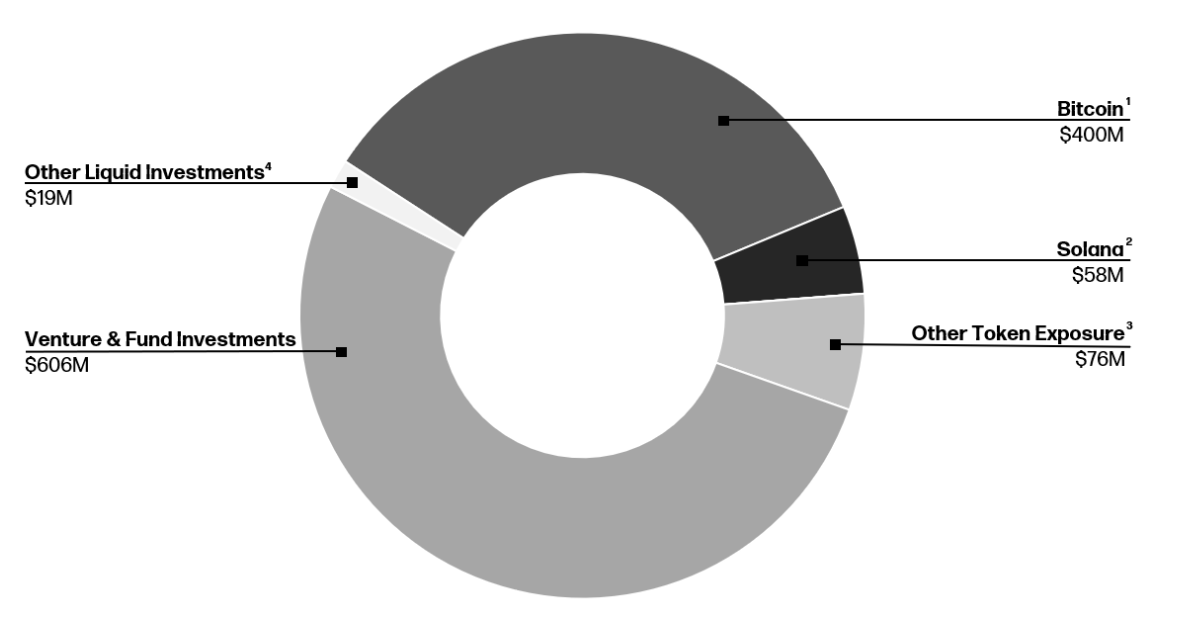
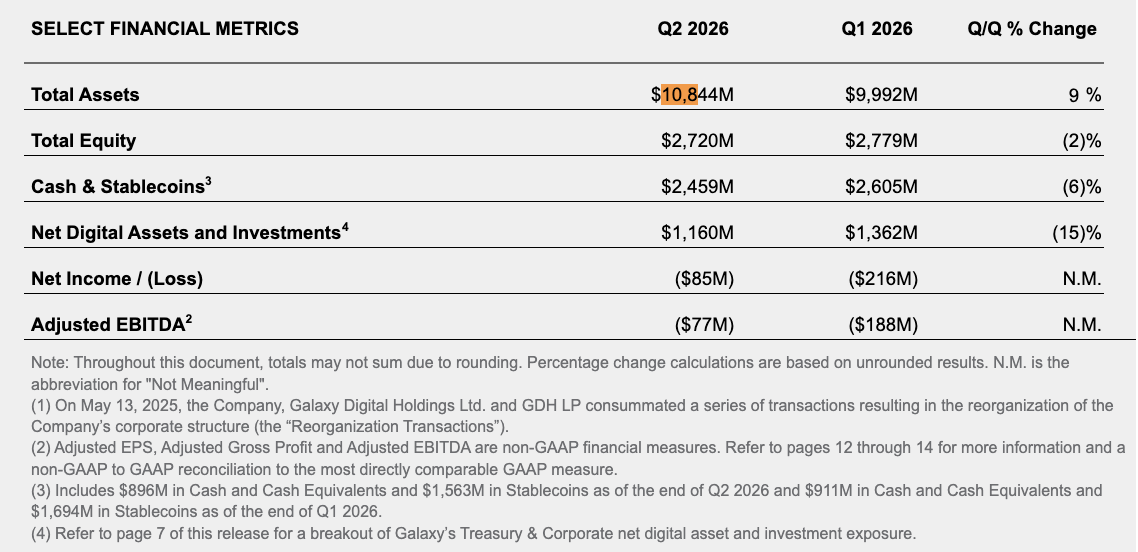
As of June 30, the portfolio carried a net exposure of $1.16 billion, down from $1.362 billion at the end of Q1. The largest piece was venture capital and fund investments at $606 million. Bitcoin exposure stood at $400 million, other token exposure at $76 million, Solana exposure at $58 million and other liquid investments at $19 million. Galaxy said the Bitcoin and Solana figures include more than spot holdings, such as derivatives, short and other hedging positions, wrapped tokens and related investment instruments.
Trading volumes fell, but Galaxy’s market business still lifted profit
Within digital assets, Galaxy’s global markets business posted adjusted gross profit of $49 million, up from $31 million in the first quarter, a 58% increase. Counterparties rose from 1,691 to 1,741, while average loan size held at about $1.4 billion.
The company said trading volume fell 7% quarter over quarter and added that industry volume declined by more than double digits during the same period. That suggests Galaxy held share in a weaker market, but the quarter does not prove the business has settled into stable profitability.
Its asset management and infrastructure solutions segment was hit more directly by crypto prices. At the end of June, assets under management plus staking assets totaled about $7.1 billion, down 12% from the previous quarter. Galaxy attributed the drop mainly to lower digital asset prices. ETF-related assets came to $1.805 billion, alternative assets to $2.553 billion and staking assets to $2.79 billion.
Helios Phase 1 delivered 133 MW and started producing rent
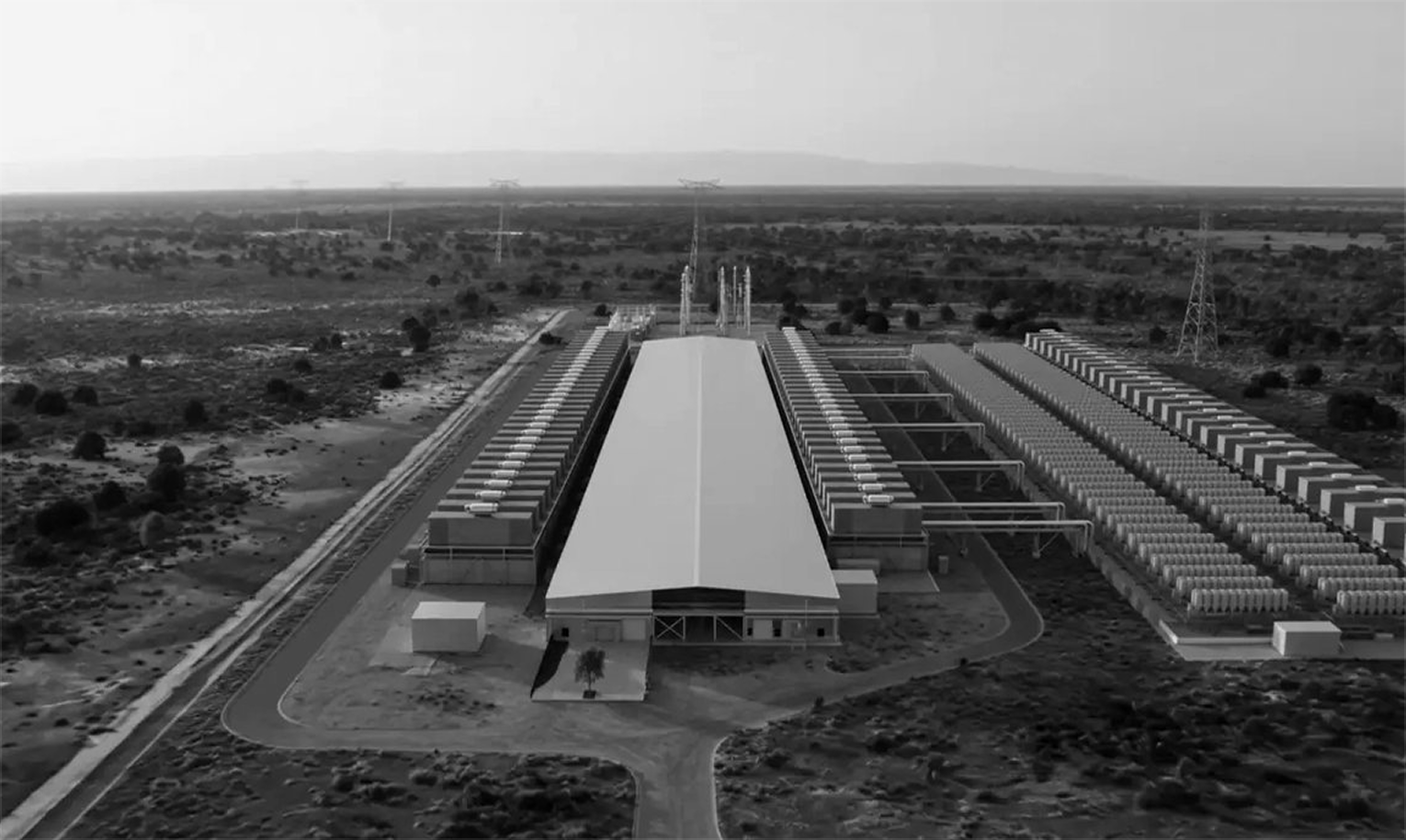
The clearest operational shift came in West Texas. Galaxy said it delivered 200 MW of power for Helios Phase 1 to CoreWeave, corresponding to 133 MW of critical IT load, and completed the phase on schedule. Rent began to be recognized in the second quarter as capacity was delivered, making the data center division a revenue-generating operating business for the first time.
Galaxy expects Helios Phase 1 to contribute about $80 million in quarterly lease revenue starting in the third quarter of 2026, with project-level adjusted EBITDA margins above 90%. The initial lease term with CoreWeave runs for 15 years. Across all three phases, signed critical IT load now totals 526 MW.
Over the full lease life, Galaxy expects average annual revenue from the contract to exceed $1.2 billion, with average lease-level adjusted EBITDA margins also above 90%.
The business is capital intensive. Data center capital expenditures reached $448 million in Q2, up from $354 million in Q1. Total liabilities classified under the data center business rose to $1.548 billion at quarter-end, from $1.33 billion previously.
On July 28, Galaxy’s project company completed a $3.5 billion private placement of senior secured notes due 2031, with proceeds earmarked for Helios Phase 2. That phase is expected to add 260 MW of critical IT capacity, with deliveries slated to begin in the second quarter of 2027.
The headline 5.7 GW figure refers to potential pipeline, not contracted capacity
Galaxy’s headline “more than 5.7 GW” figure refers to potential power pipeline in Texas, not capacity that is already energized or leased. Helios currently has more than 1.6 GW of approved power capacity, and two additional 1 GW load applications are in ERCOT interconnection processing.
The newly acquired Merlin, Caspian and Selene campuses have potential capacities of roughly 500 MW, 700 MW and 900 MW, respectively. Merlin’s initial agreement supports about 74 MW.
Galaxy is turning institutional products into reusable services
Galaxy also spent the quarter and post-quarter period expanding its digital asset product set for institutions. It launched institutional OTC prediction market trading, GOFR, an on-chain financing rate product, and Galaxy Curator.
GOFR packages floating lending rates from Aave, Morpho, Spark and Kamino into a dynamically rebalanced financing rate. Clients face Galaxy directly, while Galaxy handles the wallet, smart contract execution and collateral monitoring. The company said it may commit up to $100 million of its own capital as first-loss protection, subject to the terms of each arrangement.
Galaxy Curator uses Morpho to build institutional treasury strategies and is distributed through Fireblocks Earn, giving institutions access to on-chain yield products through existing approval, signing and policy-control workflows. Galaxy did not separately disclose revenue for these products this quarter, so the more accurate description is capability expansion rather than proven growth.
Regulatory access also moved forward. In May, the New York State Department of Financial Services granted GalaxyOne Prime NY a BitLicense and a money transmission license, allowing it to provide regulated digital asset trading and custody services to institutions in New York State.
In August, Galaxy announced a multi-year partnership with Bank of New York Mellon (BNY), planning to provide staking support for BNY’s digital asset custody platform and to work as a design partner on platform infrastructure.
Management sees two long-term trends: on-chain finance and power demand
In the same CEO letter, Mike Novogratz described Galaxy’s strategy as the convergence of two forces: financial activity moving on-chain and artificial intelligence driving continued demand for power, land and data centers. That is management’s explanation of the company’s direction, not a financial result.
The quarter’s reported numbers were more straightforward. Crypto prices still had a meaningful impact on earnings, the digital assets operating businesses showed better resilience, and the data center unit posted positive adjusted EBITDA for the first time.
Galaxy’s next test is practical. Its on-chain products need to turn institutional partnerships into recurring revenue, while the Texas campuses need to convert potential gigawatts into billable megawatts on schedule. One side of the business will keep moving with token prices. The other is already moving with the meter.