
Gate Research Institute said crypto-based IPO Access is emerging as a new point of overlap between traditional finance and digital-asset markets, as platforms bring stablecoin accounts, global user networks, and tokenization infrastructure into securities distribution. The report argues that this does not automatically let investors replicate the returns traditionally associated with primary-market IPO allocations. Legal rights, underlying assets, fee structures, and risk-sharing arrangements vary sharply across products, making product design central to any real return comparison.
The study starts with a basic point: headline IPO performance and actual investor returns are not the same thing. For years, the gains tied to offering-price access in sought-after IPOs have largely gone to underwriters, professional investors, high-net-worth clients, and investors with close ties to the issuer. Retail investors may be free to buy once trading starts, but that does not mean they participated in the allocation stage.
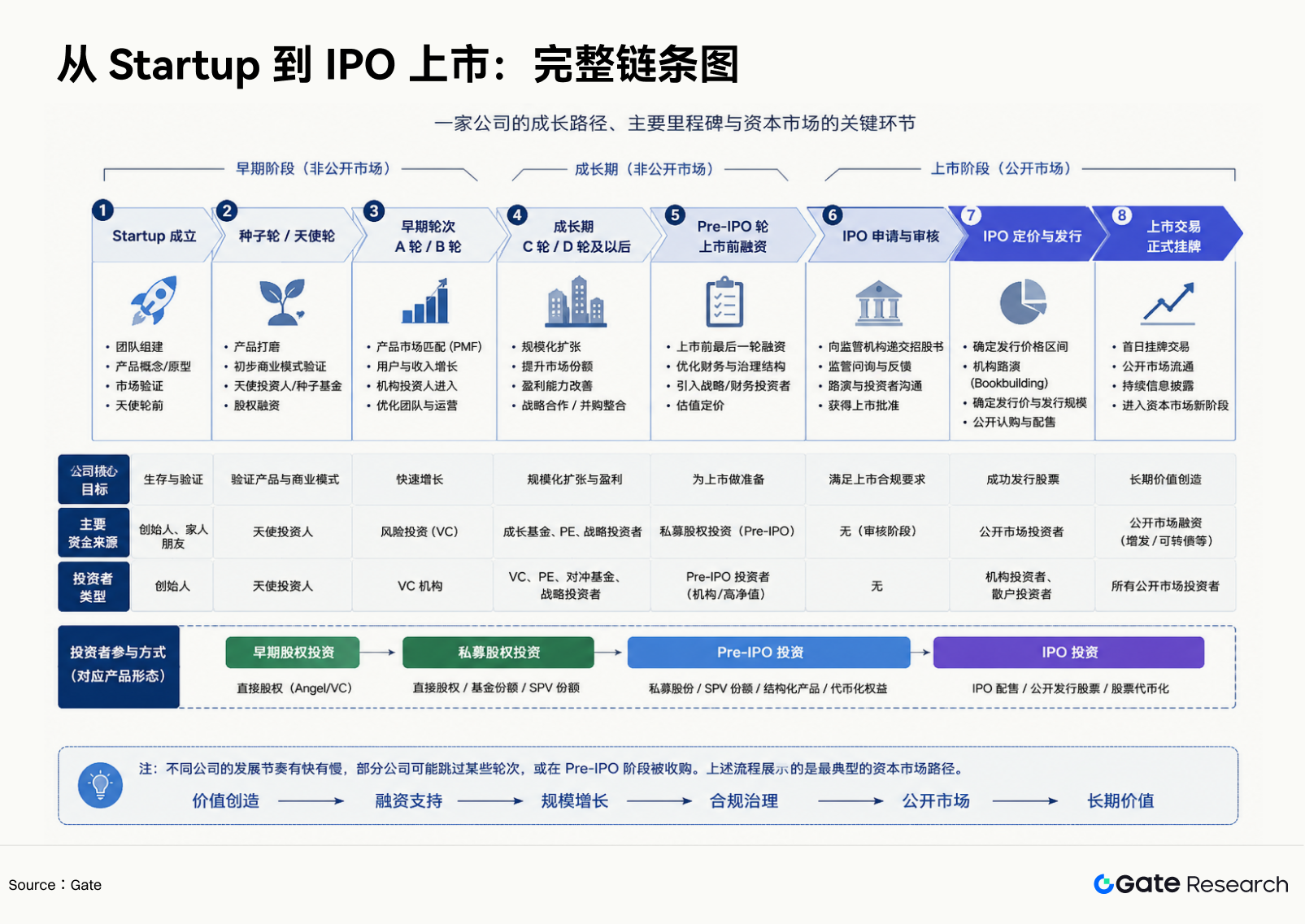
The financing-to-exit chain behind a public listing
The report frames a company’s path to IPO as a sequence of capital handoffs rather than a single financing event. Founders and angel backers provide the first capital. Venture capital follows once product and business model validation begins to appear. Growth capital enters when the business becomes more mature, while Pre-IPO rounds, private secondary deals, IPO allocations, and post-listing exits each carry their own sources of capital, return expectations, and risk profiles.
At the seed stage, investors are effectively wagering on whether the company survives at all. Returns, if any, come from later valuation repricing. In venture rounds, valuation starts to reflect revenue, users, and growth. By the growth-capital stage, the report says the risk focus shifts away from product or technology failure and toward valuation and exit timing. As financing size rises and deal terms become more complex, returns depend more heavily on IPO pricing and the eventual liquidity event.
The report adds that Pre-IPO and private secondary transactions should not be treated as low-risk simply because they occur closer to listing. Returns can still be shaped by valuation, listing progress, transfer restrictions, and liquidity conditions. Even the IPO stage itself is not just about price appreciation. In oversubscribed deals, the number of shares actually allocated often matters more to end-account returns than the first-day move alone. And after the IPO, early holders are commonly subject to lockups, leaving realized returns exposed to later price swings, unlocking pressure, and broader market conditions.
How crypto IPO Access fits into the traditional issuance system
According to the report, crypto IPO Access does not replace the conventional structure of issuer, underwriter, broker, custodian, and securities registration system. It sits on top of that structure and changes how exposure is distributed. A platform first obtains underlying rights from an underwriter, broker, shareholding entity, or structured-product issuer, then accepts subscriptions from users in stablecoins such as USDT and USDC.
The report separates the possible structures. If the underlying is an actual share, the stock normally remains in the traditional custody framework, while the on-chain asset represents the user’s claim on that custodial holding. If an SPV, or special purpose vehicle, is used, investors hold an interest in the SPV rather than direct equity in the target company. If the product is cash-settled and structured, the platform may not need to hold the stock at all, as long as it has pricing, settlement, and hedging arrangements in place.
That means token issuance, smart contracts, oracles, and stablecoin settlement can simplify the user-facing workflow without reducing legal complexity in the background. In some cases, the structure becomes more complicated, not less.
Where crypto platforms do make a difference, the report says, is in organizing demand. Traditional brokers usually serve clients through local accounts, licensing regimes, and national market frameworks. Large crypto platforms already have global stablecoin user bases and can aggregate subscription demand across regions in a short period of time. Users do not need to convert into fiat, open offshore securities accounts, or switch platforms to access IPOs alongside spot trading, derivatives, lending, or yield products.
Three main forms of crypto IPO Access
The report says products commonly grouped under the labels IPO Access or Pre-IPO are not interchangeable. It breaks the market into three broad categories.
1. Real IPO allocation
This is the structure closest to the traditional primary market. A platform or partner broker obtains an allocation in the issuer’s IPO, and users subscribe at the offering price. They ultimately receive actual shares or regulated securities representing those shares. The report says the relevant test is not whether blockchain is involved, but whether user funds participate in that IPO issuance, whether newly issued shares are being acquired, and whether the end entitlement is recognized by the securities registration system.
Its biggest limitation is supply. Hot IPO allocations are scarce, and a larger user base does not automatically produce a larger underwriting allotment. Platforms also still need to meet suitability rules, regional restrictions, KYC requirements, securities regulation standards, custody arrangements, and share-transfer rules.
2. Pre-IPO private shares or SPV interests
This model involves shares that already exist before a listing. Platforms may purchase stock from employees, early investors, or private secondary markets, then place those shares into an SPV and sell interests in that vehicle. Investors receive beneficial rights in the SPV rather than direct shareholder status in the target company, and their names generally do not appear on the company’s shareholder register.
The report sketches the structure as real Pre-IPO shares in the target company, held by an SPV, with corresponding on-chain tokens issued to represent tokenized SPV interests. It also stresses that these transactions, though they happen before an IPO, are not always primary financing. If the shares are bought from an existing holder, the funds go to that seller rather than to the company itself. Fees, performance allocations, rights of first refusal, transfer restrictions, and lockup arrangements may all be part of the package.
3. Structured Pre-IPO tokens
The third category is described as the fastest-growing segment in crypto. These products are linked to a future IPO, a company valuation, or another specified event, but they do not give investors equity ownership in the target company. Instead, the issuer agrees to settle according to a formula, using cash, stablecoins, or other assets at a later date.
Returns depend on the settlement terms in the contract. The reference point may be the valuation in the last private round, the IPO offering price, the first-day closing price, or the average market price over a period after listing. Investors in these products face issuer credit risk, interpretation risk around settlement terms, and event risk if the IPO is delayed, the company is acquired or restructured, or listing never happens. The report cites Gate Mirror Note-related products as an example of this category.
How Gate’s products are structured
The report says Gate’s currently disclosed IPO offerings cover two different structures from the categories above.
Gate IPO Access
Gate IPO Access connects users to the public offering stage. Users submit an IPO subscription intention in USDT. If an allocation is successful, the shares are distributed after listing into a Gate Stock account and can move directly into stock trading. Using SpaceX as the example, the report says the minimum subscription amount is 100 USDT and the maximum is 500,000 USDT. There is no lockup period, and successfully allocated stock goes into the user’s Gate Stock account.
Legally, the report describes the arrangement as closer to a beneficial interest in stock held through Gate or a partner broker’s custody framework. Returns in that case come mainly from price appreciation after the IPO.
Gate Pre-IPOs
Gate Pre-IPOs use a different structure and focus on the pre-listing phase of global unicorn companies. The report says exits can happen in two ways. Before the lockup ends, users can trade freely in a 24/7 pre-market. After the lockup, usually 6 months after listing, users can convert through a dedicated page into stock tokens or into USDT at market value.
Using OpenAI as the example, the report says the OPENAI Asset Certificate is essentially a Mirror Note or a Contingent Payment Note. It is not OpenAI stock or shares, does not confer shareholder status, and OpenAI itself does not receive the investors’ subscription funds. Pre-market trading is available 24/7, and pricing is determined entirely by supply and demand.
Under Gate’s published product rules, if OpenAI completes an IPO in the future and any lockup conditions in the contract are satisfied, the platform would convert the Mirror Note into stock, tokenized stock, or equivalent USDT according to the rules in force at that time. The report says the return drivers are twofold: price changes in the Mirror Note during pre-market trading, and the gap between OpenAI’s future IPO valuation and the current valuation anchor.
Historical US IPO return data
For its broader return analysis, the report uses the long-running IPO database maintained by University of Florida finance professor Jay Ritter. It notes that the database excludes SPACs, ADRs, REITs, low-priced stocks, and some smaller offerings, making it a standard benchmark for operating-company IPO performance in the US.
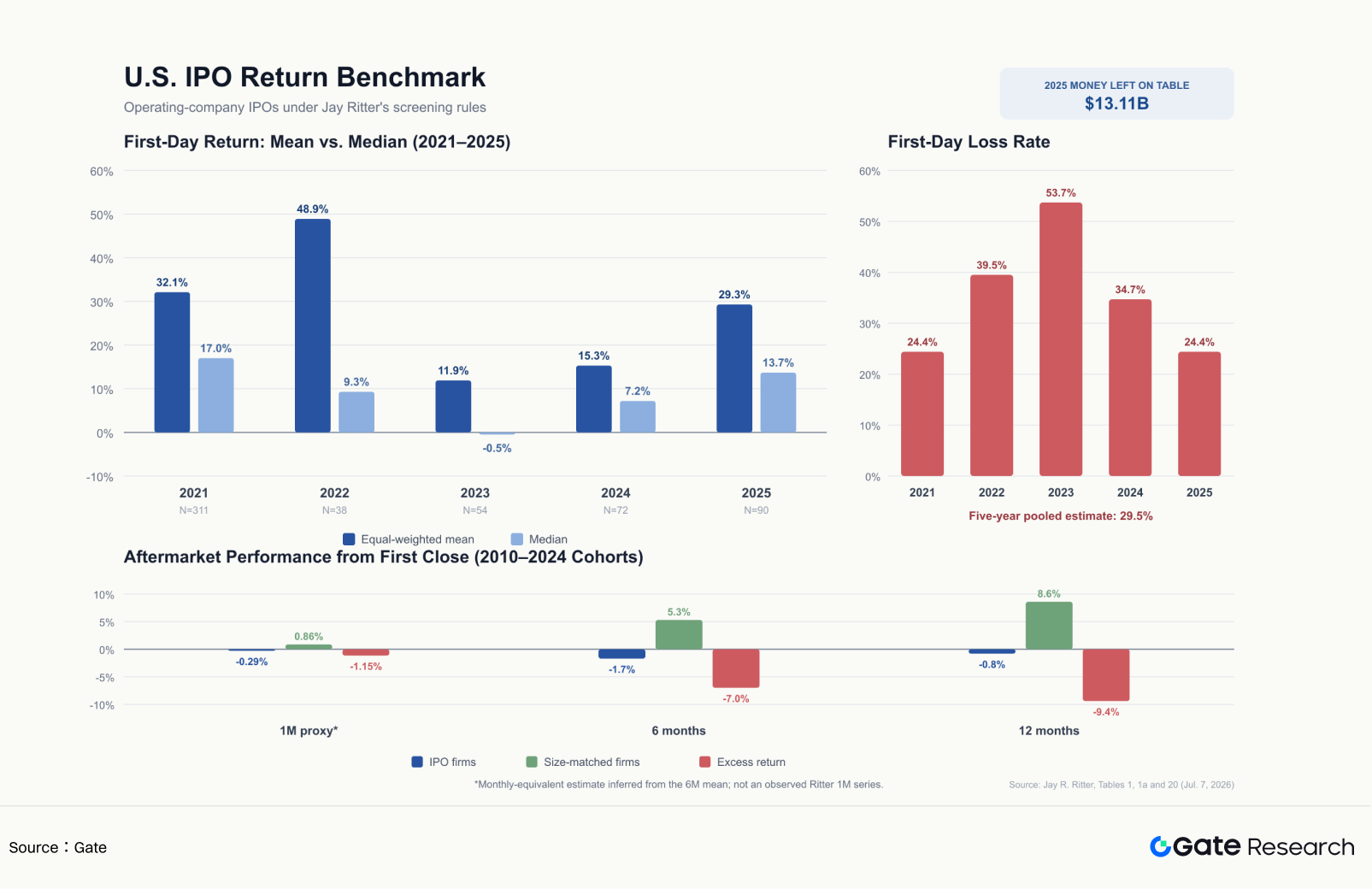
The report lists 311 IPOs in 2021, 38 in 2022, 54 in 2023, 72 in 2024, and 90 in 2025. Average first-day returns for those years were 32.1%, 48.9%, 11.9%, 15.3%, and 29.3%. Weighted by sample size, the five-year average first-day return comes to about 28.7%.
Medians were much lower: 17.0%, 9.3%, -0.5%, 7.2%, and 13.7%. The report says this shows a strongly right-skewed distribution, where a small number of outsized winners pull up the mean while most IPOs perform well below that average. The pattern appears again in break-issue rates. The share of IPOs closing below the offer price on day one was 24.4%, 39.5%, 53.7%, 34.7%, and 24.4% from 2021 through 2025, for a five-year overall figure of about 29.5%. If flat first-day closes are also treated as non-profitable outcomes, roughly one-third of IPOs failed to produce positive first-day returns.
The report uses 2022 as an example. Average first-day performance was 48.9%, but the median was only 9.3%, and nearly 40% of new listings closed below their offer price on day one. In other words, the average result was driven by a limited set of extreme cases rather than by a broad pattern across all deals.
Short-term trading strength did not necessarily lead to stronger later performance. Citing Ritter’s long-term tracking, the report says that for buyers entering at the first-day close, IPOs from 2010 to 2024 produced average returns of -1.7% after 6 months and -0.8% after 12 months. Over the same periods, size-matched listed companies returned 5.3% and 8.6%, leaving IPO underperformance of 7.0 and 9.4 percentage points.
Another metric highlighted in the study is "money left on the table," defined as first-day price appreciation multiplied by the number of shares offered. It measures the value transferred to the market through IPO underpricing. In 2025, the report says, 90 US IPOs raised a combined about $38.97 billion. Using the 29.3% average first-day gain, that implies about $13.11 billion of value left with primary-market investors. Retail investors, however, do not capture that amount automatically. Their realized returns still depend on allocation, fees, and the cost of tying up cash.
Traditional broker scenario using SpaceX
The report writes the traditional IPO cost stack as Freeze + Trading + FX + Qualification + Liquidity. Freeze is the opportunity cost of capital during the subscription lockup. Trading covers commissions, regulatory charges, and other trading fees. FX covers foreign-exchange spreads and remittance costs. Qualification reflects the extra opportunity cost of maintaining assets to meet account thresholds. Liquidity refers to the cost of restrictions on quick sales or flipping.
For its SpaceX scenario, the report assumes an offering price of $135, a first-day close of $160.95, a fifth trading day close of $185, and a 20th trading day close of $139.14. Subscription capital is set at $13,500, the allocation rate at 3%, the allocated principal at $405, the number of allocated shares at 3, the freeze period at 3 days, the substitute yield on capital at 4% annualized, and stock trading commission at $0.
The report notes that a sale could still involve Section 31 Fee and FINRA Trading Activity Fee charges, but with only 3 shares allocated in this example, those amounts are so small that the effect on the final result is less than $0.01 and can be ignored for the return calculation.
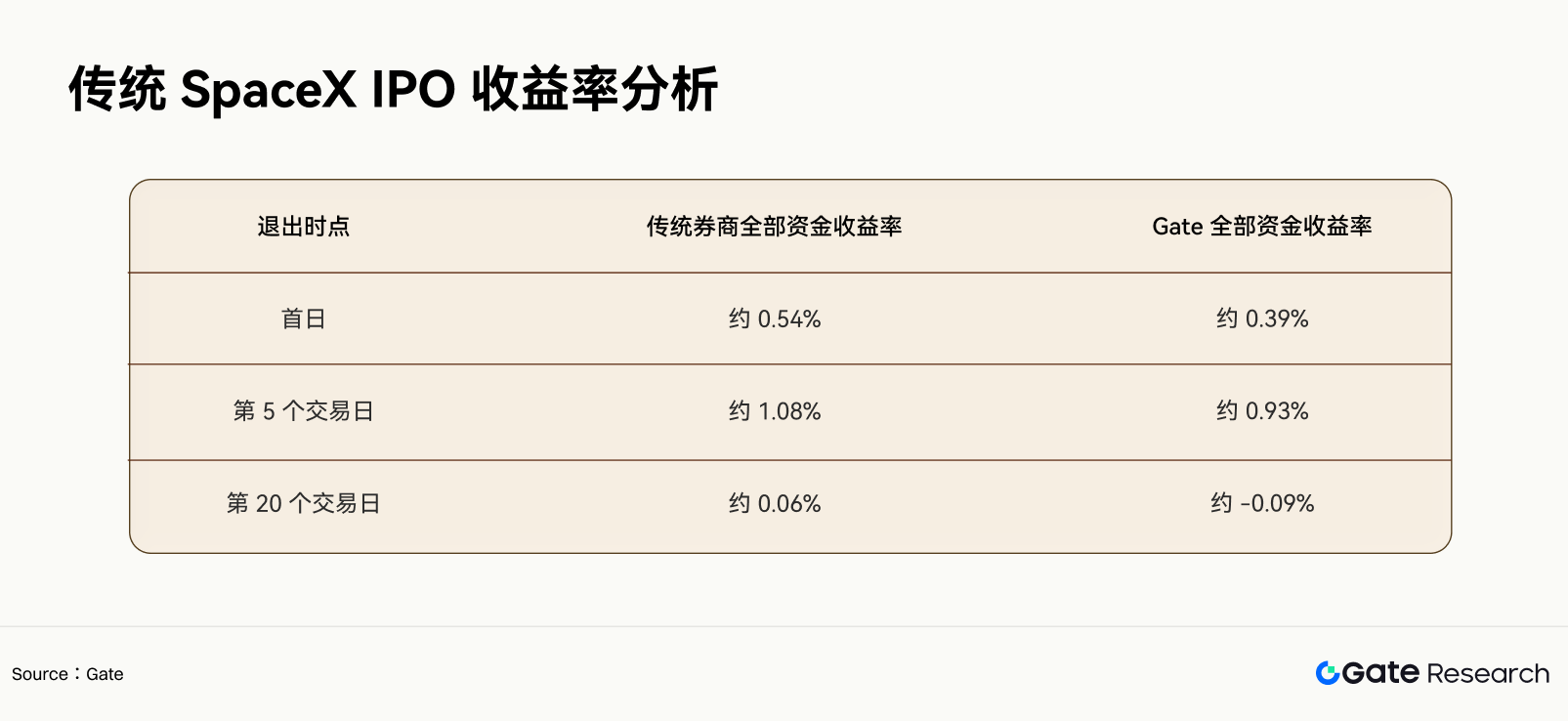
If the investor exits on day one, the gross gain from offer price to close is (160.95 - 135) / 135 = 19.22%. The 3 allocated shares would be worth 3 × 160.95 = $482.85. Gross profit on the allocated stock would be $482.85 - $405 = $77.85. The capital freeze cost would be 13,500 × 4% × 3 / 365 = $4.44. After deducting that funding cost, net profit would be about $73.41.
That produces a net return of 73.41 / 13,500 = 0.54% on total subscribed capital. The point in the report is straightforward: the high percentage gains often associated with IPO investing occur on the small amount that was actually allocated. Once the return is spread across the full subscription capital, the headline stock move tells only part of the story.
The report also says some traditional brokers impose IPO participation requirements. In examples cited from certain US broker practices, access to some offerings may require a relatively high level of retail account assets. Meeting the threshold still does not guarantee allocation, and for investors who otherwise would not qualify, that additional capital requirement can create a larger opportunity cost than commissions or regulatory fees.
Gate IPO Access cost and return calculation
For crypto IPO Access, the report lays out a different total cost formula: Subscription Fee + Management Fee + Spread + Funding + Gas + Premium.
Subscription Fee refers to the charge applied after a successful allocation. In the Gate SpaceX IPO Access example, the offer price is $135 and the successful subscription fee is 5%, making the effective cash cost per share 135 × (1 + 5%) = $141.75. That raises the investor’s breakeven level from $135 to $141.75.
Management Fee includes management charges and carried-interest style performance splits. The report says products tied directly to actual IPO stock allocations typically do not impose ongoing management or performance fees, while structured Pre-IPO products such as Mirror Notes have to be reviewed case by case.
Spread refers to bid-ask pricing differences. A directly allocated IPO share bought at the offer price does not face order-book spread at subscription, though the stock still has a spread when sold. Pre-IPO certificates can face liquidity and order-book depth effects both on entry and exit.
Funding includes stablecoin borrowing costs and the opportunity cost of locked capital. In the same base case, the report assumes $13,500 in frozen capital for 3 days and a 4% annualized substitute yield, again producing a cost of about $4.44. Gas applies only to deposits, withdrawals, or on-chain settlement. The report says using USDT inside the Gate account and settling through a Gate Stock or spot account generally does not create on-chain gas in the basic workflow.
Premium refers to the gap between the traded product price and the underlying stock, the latest private valuation, or another settlement anchor. For products allocated at the IPO price and delivered as actual shares, the report says there should theoretically be no persistent structured premium. In Mirror Notes, Pre-IPO certificates, or valuation-linked instruments, prices may diverge from the latest private round, reference valuation, or expected settlement value.
To keep the comparison aligned with the traditional broker case, the report assumes the following for Gate IPO Access: 13,500 USDT of subscribed capital, a 135 USDT offer price, a 3% allocation rate, 405 USDT of allocated offer-price principal, 3 allocated shares, a 5% successful subscription fee equal to 20.25 USDT, a 3-day freeze period, a 4% annualized substitute yield, a funding cost of about 4.44 USDT, share delivery into the Gate Stock account, no extra lockup, and no taxes or sale slippage in the model.
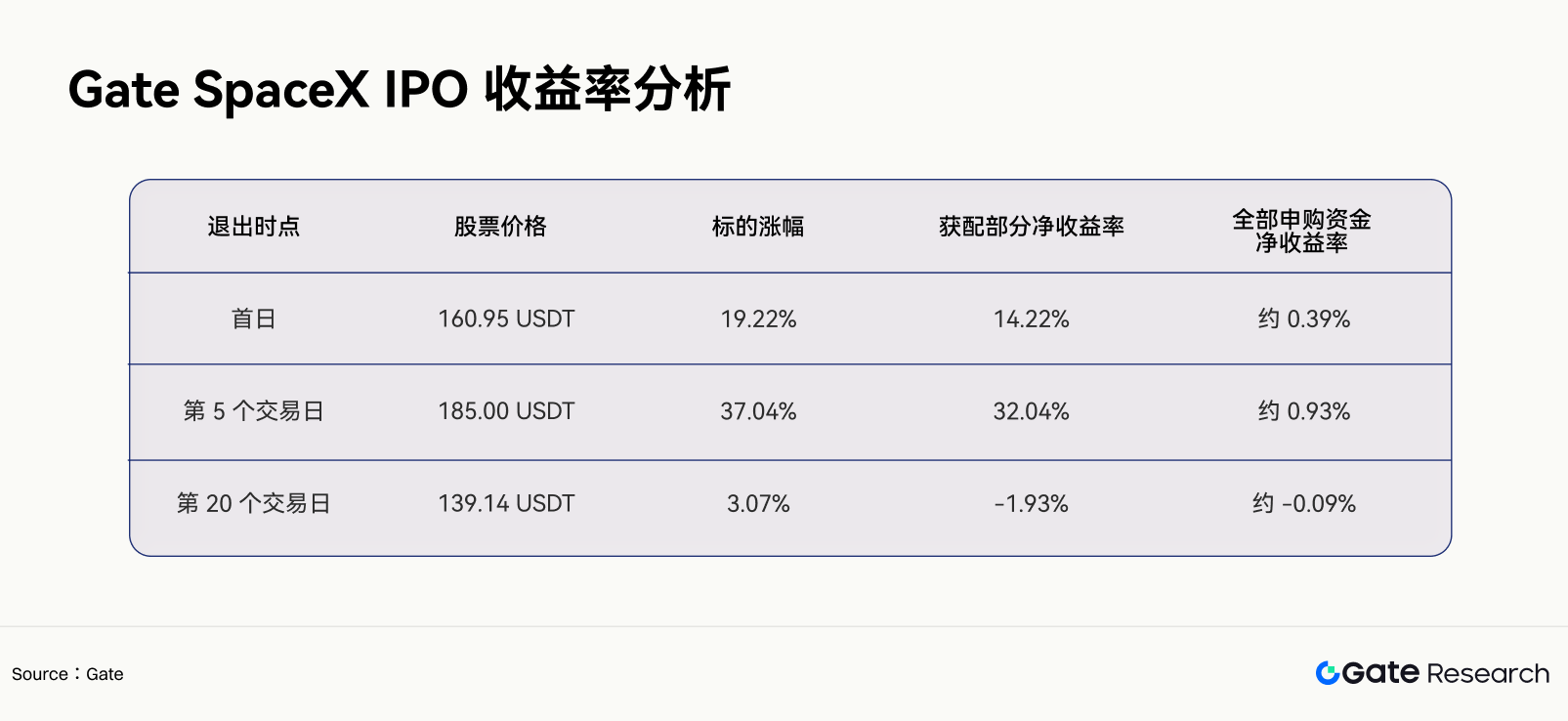
If the investor exits on the first day, the value of the 3 SpaceX shares would again be 3 × 160.95 = 482.85 USDT. Deducting the 405 USDT principal and the 20.25 USDT subscription fee leaves 57.60 USDT of profit on the allocated portion. After subtracting the 4.44 USDT cost of freezing the full 13,500 USDT subscription amount, net profit falls to 53.16 USDT.
That leads to an after-fee return of 19.22% - 5% = 14.22% on the allocated portion, and a net return of 53.16 / 13,500 = 0.39% on the full subscribed capital. The report points out that the 5% subscription fee changes the economics asymmetrically. The investor’s breakeven is no longer the $135 offer price but at least $141.75. If post-listing appreciation is strong enough, the position can still generate a positive return. The report gives the fifth trading day as an example: with the stock up 37.04% from the offer price, the allocated shares would still produce a 32.04% return after the 5% fee.
Same-basis comparison: allocation is the real battleground
With subscription size, allocation rate, freeze period, and exit price held constant, the report says the main difference between a traditional broker and crypto IPO Access comes from the subscription fee charged on the shares that were actually allocated. Because the 5% fee applies only to the 3% allocation slice, its impact on the return over the entire subscription amount is 0.15%.
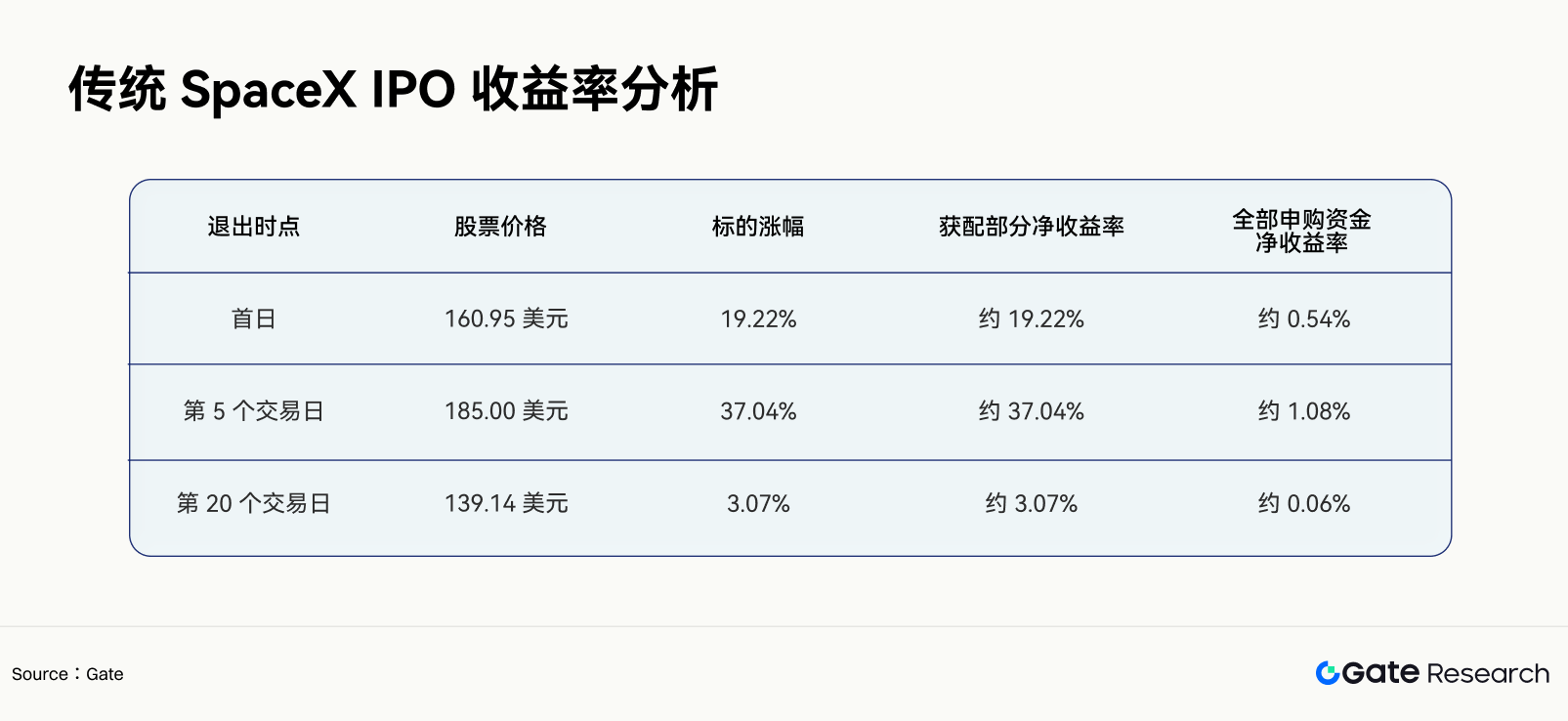
On a per-share basis, the traditional broker is clearly better in the report’s framework. Under otherwise identical conditions, Gate’s 5% subscription fee cuts the return on the allocated portion by 5 percentage points. But the report argues the two channels are not always realistic substitutes. Traditional brokers may have lower explicit fees, yet investors may still face high account-asset requirements, priority allocation for wealthy or highly active clients, no guarantee of any allocation even after qualifying, account-opening and remittance friction across jurisdictions, and possible restrictions on rapid resale.
Gate’s potential advantage, in the report’s view, is not necessarily higher return per allocated share. It is the 100 USDT minimum subscription, the stablecoin funding rail, and the breadth of account coverage. The product’s economic role is to convert scarce, tiered, and geographically constrained IPO allocations inside the traditional brokerage system into a more accessible standardized offering. In practice, the investor is paying a subscription fee in exchange for access.
Whether that tradeoff makes sense depends on the investor’s alternatives. If an investor can obtain the same allocation rate through a traditional broker without extra asset thresholds, foreign-exchange costs, or lockup limits, the traditional channel produces a higher net return. If access through a traditional broker is unavailable, or the realized allocation rate there is close to zero, a crypto platform may still offer real economic value despite the fee. If the crypto platform can deliver a higher allocation rate than the traditional alternative, part of the fee disadvantage may be offset.
Conclusion of the report
The report concludes that traditional brokers and crypto platforms are exposed to the same underlying stock performance, but investor outcomes are driven by allocation rate, fee structure, capital lockup, and exit conditions. Looking only at the move from offer price to trading price can materially overstate the contribution of IPO participation to total account returns.
In the unified SpaceX scenario used throughout the study, the stock rose 19.22% on its first day. With a 3% allocation rate, however, the return on total subscribed capital works out to about 0.54% through a traditional broker and 0.39% through Gate. Most of that difference comes from the subscription fee on the allocated shares.
From a pure return perspective, the report says the lower-fee traditional broker wins when subscription amount, allocation rate, and freeze period are the same. But that only matters if the investor can actually enter the allocation system and receive shares. For users without overseas brokerage accounts, without the asset base needed to qualify, or without realistic access to scarce high-demand IPO allotments, low theoretical cost does not translate into a practical investment opportunity.
The report argues that the core competitive strength of crypto IPO Access is not higher stock returns. It is lower friction across accounts, geography, currency, and minimum capital, allowing IPO allocations that were once concentrated among specific client groups to reach a wider user base.
As a result, the report says it is too simplistic to declare that a product is worse because its fee is higher, or better because its entry threshold is lower. A more useful framework should ask four questions: whether the investor receives actual stock or a right recognized by the securities registration system, how high and how stable the platform’s allocation rate is, how much explicit and implicit cost is paid to obtain that allocation, and whether the investor has access to a lower-cost traditional alternative.
The closing point is that IPO Access products are not selling stock exposure alone. They are also selling entry into a scarce allocation channel. Traditional brokers have the advantage on cost per allocated share. Crypto platforms have the advantage in distribution efficiency and global reach. The report says competition between the two models is likely to shift toward which platform can consistently secure real allocation and deliver it with clearer legal structure, lower cost, and greater transparency.
The data sources cited in the report are Gate, Warrington, and Stockanalysis. The report also includes a risk notice stating that crypto market investing involves high risk and does not constitute investment advice, and that users should independently research the nature of the assets and products involved before making investment decisions.