
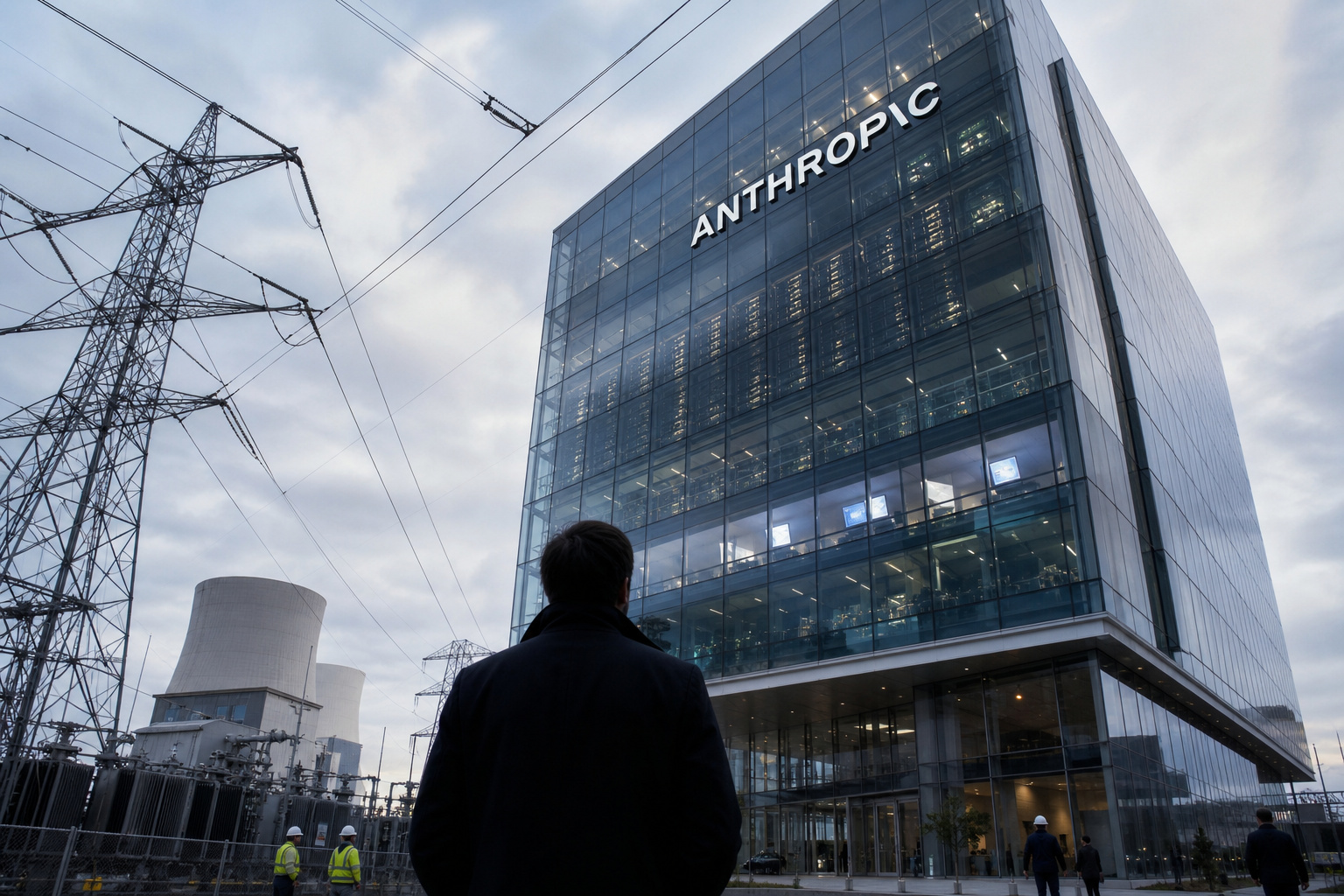
Anthropic’s reported IPO plans and the talk of a roughly $2 trillion valuation drove the latest All-In Podcast discussion, but the bigger issue was not just price. The panel focused on whether Anthropic can secure enough compute and energy to handle another wave of growth if demand for Claude keeps rising at its current pace.
Baker says the $2 trillion figure should not be treated as final
The episode referenced market chatter that Anthropic could go public at about a $2 trillion valuation. Investor Gavin Baker pushed back on taking that number at face value. He said valuation stories that surface before an IPO often reflect competition among underwriting banks, and that the market should not read the reported figure as final pricing before a formal S-1 filing is public.
Baker also said he had heard from multiple people he trusts that Anthropic CEO Dario Amodei had said internally that Anthropic might one day become “the only private company in the world.” Baker described that idea as an “Anthropic maximalist” worldview, one in which the most extreme end state leaves only Anthropic and governments.
He quickly added a note of caution. If Amodei did say that, Baker said, the statement carries a high degree of arrogance, and he suggested Amodei should stop saying it to anyone.
Strong demand may not be the limiting factor
Despite his skepticism toward the valuation rumor, Baker spoke highly of Anthropic’s operating results. He said the company’s absolute revenue is still expanding at a rapid pace even if OpenAI, Grok, and open-source models are eating into share in parts of the market. In his framing, that says less about one company beating another and more about the AI token market getting much larger overall.
Put differently, Anthropic may still post surging revenue even if its slice of the pie shrinks, as long as the pie itself grows faster.
David Sacks introduced an extreme scenario in the episode: if Anthropic reaches roughly $100 billion in annual recurring revenue by the end of this year and keeps its previous growth rate, it could, in theory, move toward $1 trillion in ARR by the end of next year.
Sacks said the real question may no longer be whether demand can support numbers that large. AI agents, coding, and enterprise use are all still expanding quickly, and it is not hard to imagine token demand rising with them. The harder cap may come from physical supply: compute, data centers, and energy.
Baker added that, based on what he heard from multiple credible people, Anthropic is highly confident internally about future growth. He said he had heard that when the company was at about $60 billion in ARR, people inside had assessed the possibility of reaching $600 billion within a year, and that the reported ARR has now moved above $80 billion.
Even so, Baker said a move to $400 billion to $500 billion in ARR next year would already be enough to place Anthropic among the world’s largest software companies, with a scale that starts to approach historic software and internet businesses such as Microsoft Office or Google Search.
Later in the episode, both Baker and Sacks placed what they saw as a reasonable exit ARR range for the end of next year at around $400 billion to $500 billion. They did not go higher largely because compute and energy could become hard physical constraints.
Claude’s pricing power rests on a lead of about six months
The conversation also turned to open-source competition. According to the show, one core reason Anthropic can charge a high premium for Claude tokens is that its frontier model still leads most open-source models by about six months in capability.
If that gap closes, pricing power at the high end could compress quickly. Sacks said that does not automatically mean Anthropic ends up in a price war.
He compared the setup to Apple and Android. Much of the market may choose cheaper open-source models, but if a group of enterprises is still willing to pay a large premium for what he called “true frontier intelligence,” Anthropic could keep very high revenue and gross margins even if that group represents only part of the market.
There is a condition attached to that model. As Sacks put it, if a company wants to keep charging that premium, it has to stay out in front. In practical terms, that leaves frontier AI companies in a research race they cannot afford to pause.
Open-source models may also increase the value of the top tier
Baker offered a less intuitive view on open-source AI. He argued that open-source models do not necessarily reduce the value of frontier models and may, in some cases, make the strongest models more valuable.
His reasoning is that the most expensive and capable frontier models of the future may not need to do every task themselves. They could act as coordinators, sending a large volume of simpler work to much cheaper open-source models.
In that type of market structure, open-source models might account for most token usage, while Anthropic, OpenAI, and other top-end models still capture most of the economic value. That makes the competitive logic more complicated: open source is both a pricing rival and a possible low-cost execution layer for frontier AI.
The argument is also about who should hold AI power
The final part of the discussion placed Anthropic inside a broader ideological split over AI. Baker reduced the divide to one sharp contrast: Anthropic and the effective altruist camp believe AI is “too dangerous to be widely distributed,” while another camp associated with Mark Zuckerberg, Elon Musk, and Jensen Huang believes AI is “too dangerous to be centralized.”
Both sides accept that AI could carry enormous power, but they disagree on what the primary risk is. In Baker’s telling, Anthropic worries that broad distribution of powerful models could produce a race to the bottom on safety standards, which leads it toward frontier models, stricter access, and concentrated governance.
The open-source side worries about something else. If the most powerful intelligence in the world ends up in the hands of two or three companies or governments, the danger lies in concentrated power itself.
Baker said he would rather see every person have an AI that works on their behalf than have Dario Amodei, Anthropic, or any other company decide for everyone what serves humanity’s interests.
What the market may watch next
The discussion suggested that the next phase of attention will center on more than whether Claude is still the strongest model. The larger questions are how fast enterprise AI demand can grow, whether global compute supply can keep up, and whether Anthropic can preserve enough technical lead to support premium token pricing.
If the reported IPO eventually happens, Anthropic’s public quarterly revenue, spending on compute, and gross margin could also give the market a clearer look at how much of the current hundreds of billions of dollars in AI infrastructure investment is backed by actual end demand.