
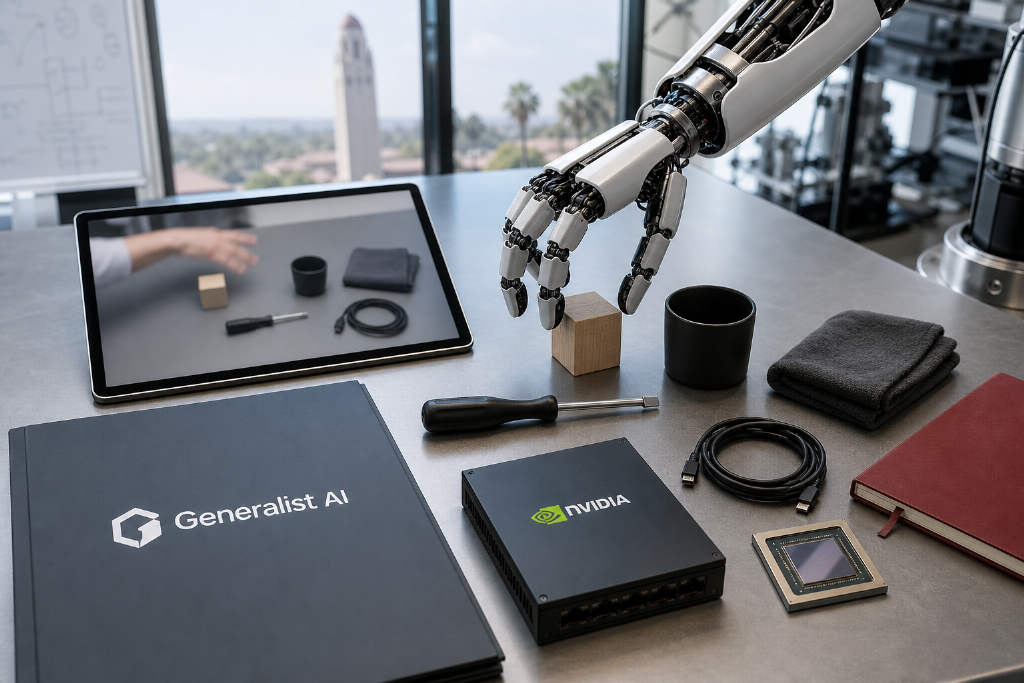
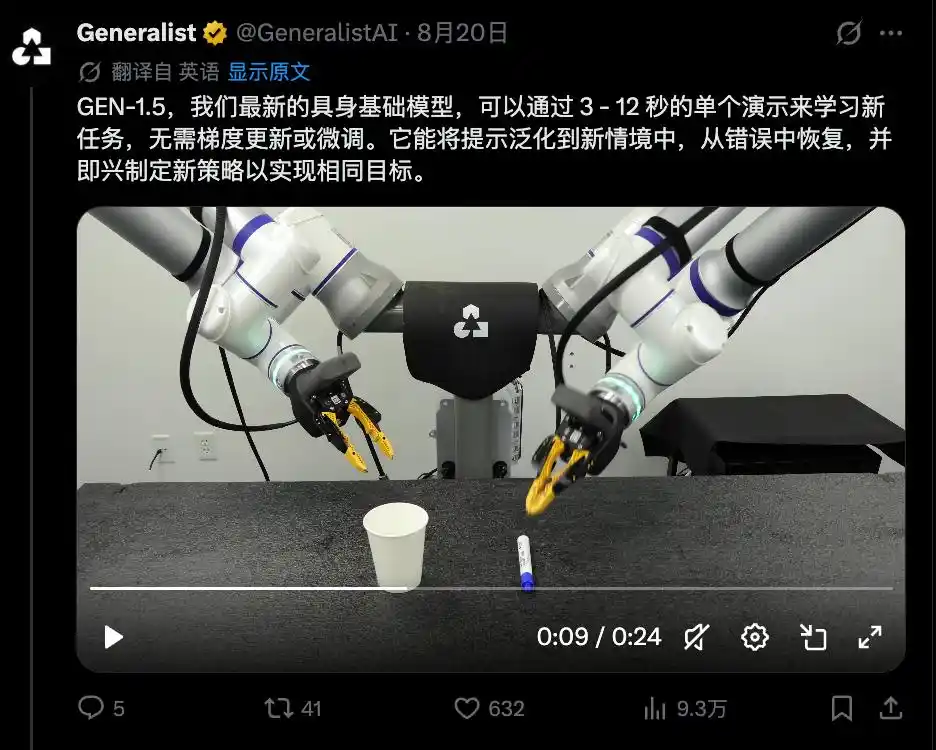
Generalist AI unveiled GEN-1.5 in the early hours of Aug. 20 Beijing time, presenting a robotics foundation model that it says can carry out new tasks after watching a short human demonstration, with no training step and no fine-tuning required at execution time.
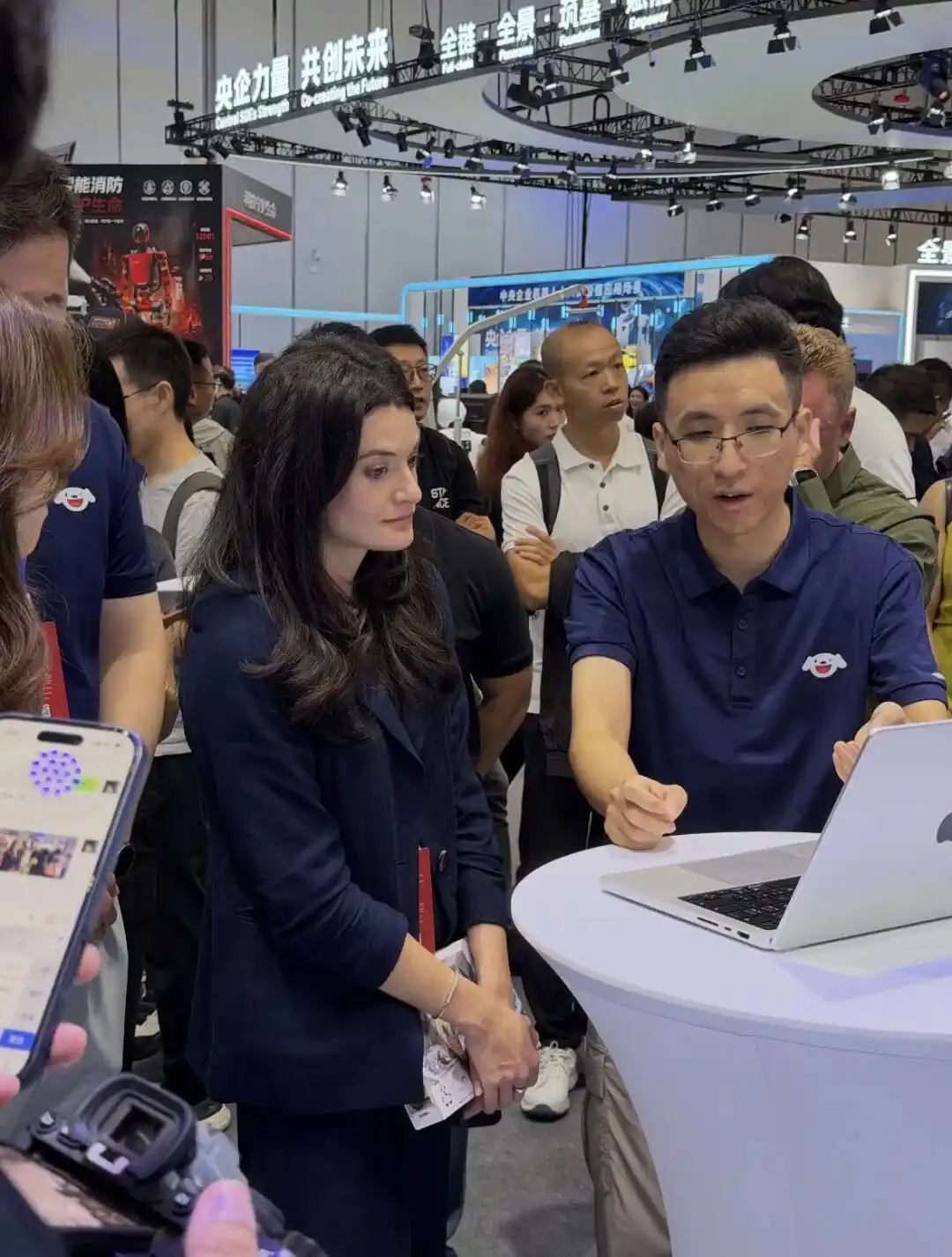
The release came a day after Unitree rang the opening bell on Shanghai’s STAR Market, where it opened at 1,100 yuan per share for a market value of about 444.9 billion yuan. On the same day, Kathy Huang, daughter of Nvidia CEO Jensen Huang, arrived in Beijing for the World Robot Conference.
Two months earlier, Stanford professor Fei-Fei Li had joined Generalist AI’s $400 million financing in a personal capacity. The same angel round also included Xiaomi co-founder Lin Bin and Zoom founder Eric Yuan, while Nvidia is also a shareholder.
Generalist AI says GEN-1.5 shows why that money came in. According to the company, a robot can watch a 3- to 12-second demonstration and then act immediately, without retraining or parameter updates. Across 10 manipulation tasks, the company reported an average success rate of 59% in its one-shot setting.
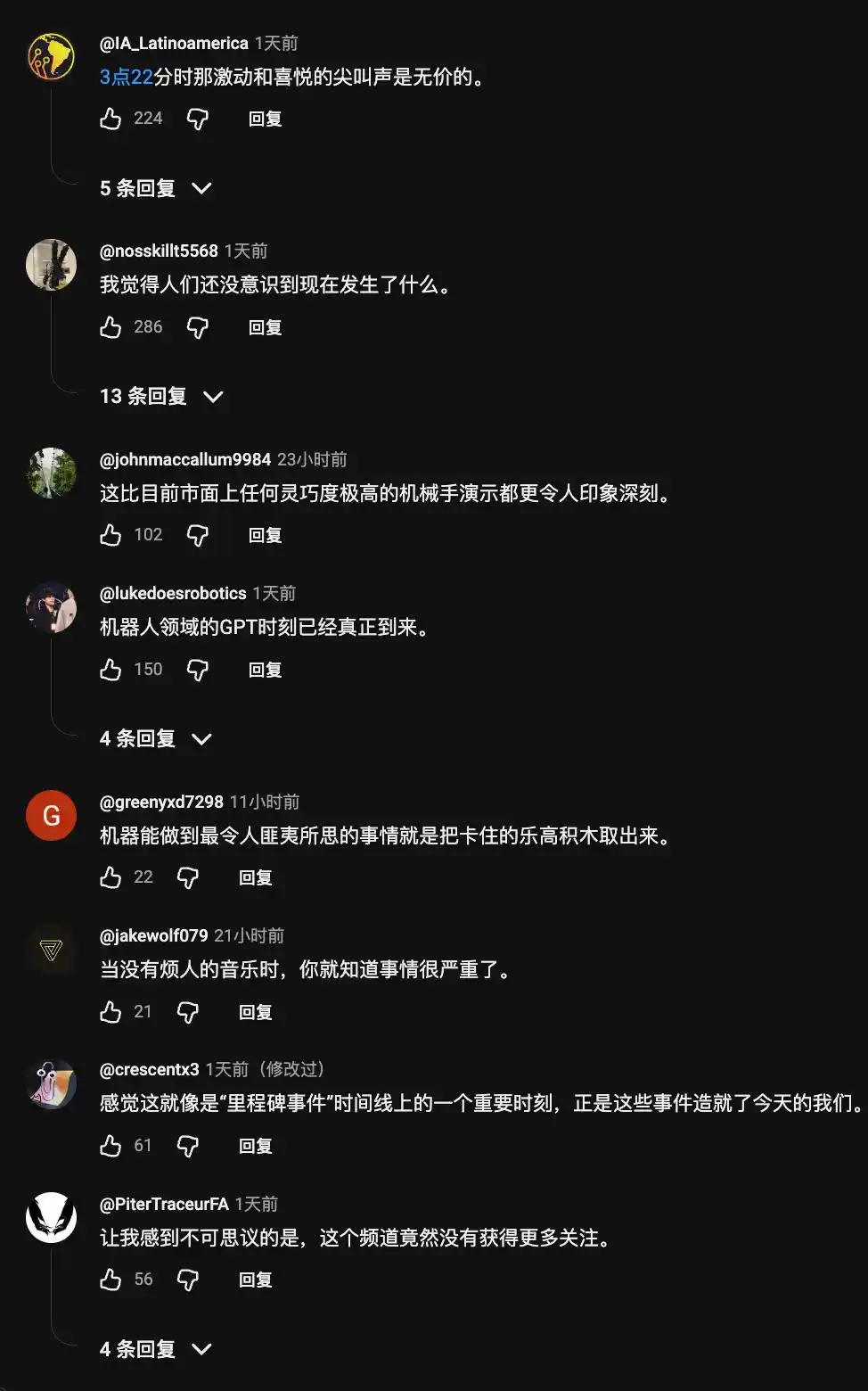
The article frames that as a large reduction in the cost of teaching robots. In the earlier workflow, getting a robot to unscrew a bottle cap could take an engineer three months of programming. Now, the stated input is a three-second demonstration and zero lines of code. Several researchers compared this point to the release of GPT-3 in 2020 and argued that embodied intelligence may be reaching its own GPT-3 moment.
Behavior not explicitly taught during training
What drew the strongest reaction was not imitation alone. The focus was on improvisation.
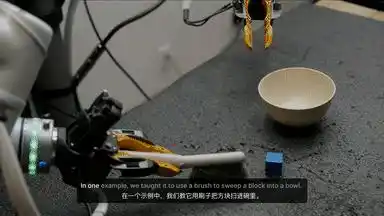
Generalist AI described one experiment in which a robot was taught, using five minutes of human demonstration data and only one gradient step of fine-tuning, to sweep blocks into a bowl with a brush. The tool was then swapped out.
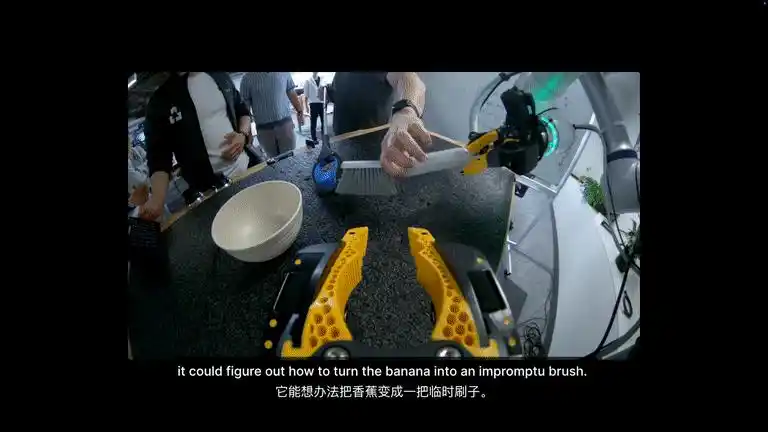
When given a banana, the robot used it like a brush and swept the blocks into the bowl. The company said that result was not surprising because the banana’s shape and contact strategy resemble those of a brush.
When handed a dustpan, the model did something else. It abandoned the sweeping strategy, used the other hand to push the blocks onto the dustpan, lifted it, and dumped the blocks into the bowl.
Those are different contact sequences. Generalist AI said the latter behavior was not taught in the training data. The company also reported running nearest-neighbor language search across roughly 1.89 million pretraining scenes and said it did not find a similar dustpan use case.
In the company’s account, nobody instructed the model at any stage to solve the problem that way.
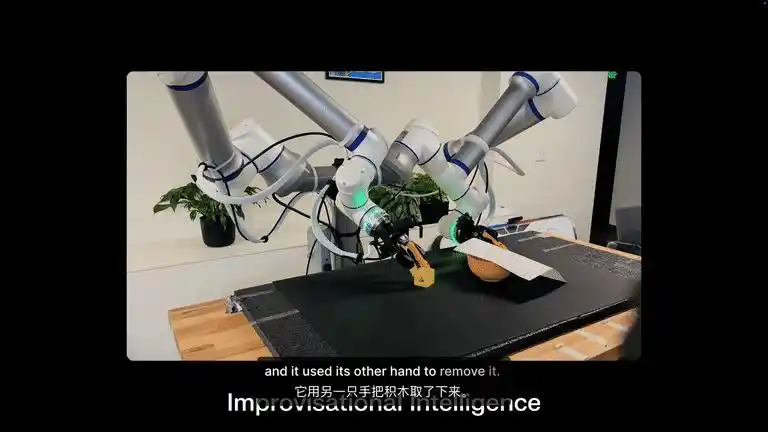
The same pattern appeared elsewhere in testing. If a bowl was covered by a sheet of paper, the model lifted the paper before placing blocks inside, and in some cases put the paper back afterward, despite that scene not appearing in training. If a Lego piece stuck to the robot’s fingertip, the model used the other hand to knock it off. In another case, training only demonstrated one-handed lid rotation, but the model sometimes switched on its own to a two-handed strategy with a different grasp and turning pattern. A model trained only to place one block into one bowl also began sorting multiple blocks by color.
Generalist AI attributed those behaviors to large-scale pretraining.
More than eight months of pretraining and no visible convergence yet
GEN-1.5 has been pretrained continuously for more than eight months, according to the disclosed material, across three training stages.
The company said its validation curves show a continued drop in next-action prediction error, with no sign of convergence so far. Using language common in large model research, the article describes this as a scaling law for embodied intelligence: as physical interaction data grows and training runs longer, generalization continues to improve.
One claim stood out because it runs against the usual intuition. Generalist AI said fewer fine-tuning gradient steps produced stronger improvisation.
Its explanation is that light fine-tuning keeps the model closer to the broad behavior library accumulated during pretraining and preserves more reusable “physical experience.” Ten gradient steps changed only 0.15% of model parameters, the company said. In its phrasing, that is close to “reminding the model of something it almost already knows.”
GEN-1.5 also reportedly crossed two long-standing gaps in robotics. First, a demonstration recorded in simulation could be placed into the context window and then transferred directly to a real robot, even though the pretraining data contained no simulation data, while still generalizing across different grippers and new object positions. Second, in some tests, a person demonstrated an action directly with their own hands in front of the robot’s camera, and the robot later reproduced the task using its gripper.
Generalist AI said none of those abilities came from architecture changes designed specifically for in-context learning, from a meta-learning loop, or from an auxiliary objective that rewarded improvisation. The company’s position is that they emerged from large-scale pretraining on physical data.
What 59% and 83% mean in practice
The article compares GEN-1.5 with the turning point introduced by GPT-3 in June 2020. GPT-3 showed that a model could handle a new language task without retraining if a few examples were placed in the prompt. That capability became known as in-context learning.
Generalist AI says GEN-1.5 brings the same idea into the physical world. The company calls it Physical Prompting.
The setup is straightforward. A real demonstration, including sensor data and action trajectories, is placed into the model’s 30-second context memory window. The remaining space is used for live observations from the environment. The model then attempts the task immediately, with no training step in between.
The article pauses here to explain gradient steps because they matter for reading the results. In a conventional robotics pipeline, learning a new task often requires tens of thousands of gradient descent steps, each one slightly updating internal parameters. That process tends to demand both a lot of data and a lot of compute. In GEN-1.5’s one-shot mode, all of that is skipped and the model parameters stay fixed.
Generalist AI tested GEN-1.5 on 10 manipulation tasks:
- unscrewing a glass jar lid
- opening a pencil case zipper
- taking cash out of a wallet
- folding paper
- stacking cups
- flipping a phone
- sweeping blocks with a brush
- opening a book cover
- tearing open a vacuum pad
- cleaning up trash
It reported two result groups:
- one-shot: a single demonstration, zero gradient steps, 59% average success across 10 tasks, with a standard deviation of ±10%
- few-shot: five minutes of data, about 50 demonstrations, 10 gradient steps, 83% average success, with a standard deviation of ±9%
The article places those figures beside GPT-3’s reported language-task numbers from 2020: about 45% in one-shot and about 65% in few-shot with roughly 100 examples. Its point is not that the domains are identical, but that the shape of the improvement looks similar.
That structure matters because before large language models, getting AI to do a new language task often meant collecting task-specific data and training a new model over months. After GPT-3, in some cases that turned into writing a few examples in a prompt box, shrinking the time cost from months to seconds. The article argues that GEN-1.5 compresses the robotics workflow in a related way: what once required months of programming or tens of thousands of training samples can now, according to the company, begin with a 3- to 12-second demonstration.
Generalist AI wrote in its blog that this changes two things: how fast robots become useful, from months to seconds, and who gets to use them, from experts to anyone.
Released during a crowded week for robotics
The GEN-1.5 announcement landed in one of the busiest weeks on the embodied AI calendar.
The World Robot Conference opened in Beijing Yizhuang on Aug. 19, featuring more than 300 companies, over 2,000 exhibits, and more than 150 global first-launch products.
Three days later, on Aug. 22, the second World Humanoid Robot Games was set to open at the National Speed Skating Oval, known as the Ice Ribbon. A total of 666 teams and 2,056 robots were scheduled to compete in 1,301 matches across 51 events, with team count up 138% from the first edition. For the first time, the event added 21 scenario-based competitions requiring humanoid robots to complete longer tasks in settings such as factories, hotels, and home services.
That same week, newly listed Unitree disclosed that its 2025 humanoid robot shipments exceeded 5,500 units, the highest in the world, with revenue of 1.7 billion yuan and a gross margin of 60%. DeepSeek also took part in the strategic placement.
But the article also points to a sharp contrast inside Unitree’s prospectus. In the first quarter of 2026, revenue growth slowed to 68.49% from 332.64% a year earlier, while net profit after deducting non-recurring items fell 52.55% year over year. The article says the main reason for slower growth was a steep rise in research and development spending.
Its reading is that Unitree is chasing the part it does not yet have: a large embodied intelligence model. Citing an earlier analysis from Xinlichang Pro, the piece says Unitree built the world’s top-shipping robot body, but the “brain” is still missing.
The article adds that 2026 has been described as a major listing year for embodied AI, with more than 20 companies having set listing plans. At the same time, financing pressure is part of what is driving that wave. Many rivals still rely on round after round of fundraising, and their research pace is tied to capital market windows.
At WRC, Unitree founder Wang Xingxing said publicly that the main bottleneck holding back humanoid robots is the embodied intelligence large model. He said a ChatGPT moment for robots could arrive in as little as two to three years, or as long as five to 10 years.
The article treats GEN-1.5 as an early real-world answer to that view. If scaling laws hold in embodied intelligence and large-scale pretraining can push the marginal cost of adapting to a new task close to zero, then for body makers such as Unitree, value will depend on how quickly their hardware can plug into a strong general-purpose brain, not only on hardware specs or shipment volume.
Founders, funding, and a new financing discussion
Generalist AI’s team background matches that path closely. Co-founders Pete Florence and Andy Zeng came from Google DeepMind’s robotics team, while Andrew Barry came from Boston Dynamics.
In June 2026, the company completed a $400 million financing led by Radical Ventures, with Nvidia and Bezos Expeditions participating, at a post-money valuation of $2 billion.
The article says Generalist AI is now in talks for another round at a $3 billion valuation.
Strong reaction from researchers, with caution still present
The release drew a strong response from the robotics research community.
Pete Florence wrote on X: “Ever since I started working on robot foundation models, broad one-shot in-context learning has been the clearest goal in my mind. Now I’m seeing nearly a decade of imagination enter the real world.”
He added that he and Andy Zeng had discussed a “Ctrl-C-Ctrl-V” style capability back in graduate school: a robot sees an action and copies it. The difficulty, he wrote, is that “the world you want to paste into is never the same as the world you copied from.”
Carnegie Mellon robotics researcher Chris Paxton said on X that GEN-1.5 “may be the actual GPT moment” and added: “The holy grail of manipulation learning is, without a doubt, one-shot learning.”
Northeastern University embodied AI researcher Jimmy Yang wrote in a repost: “As an embodied AI researcher, this is a truly special moment for the field.”
Nvidia robotics director Jim Fan offered a more technical view. He pointed to two factors that could help explain the emergent behavior in GEN-1.5.
One is the presence of naturally repeated, symmetric action patterns in the training data. In furniture assembly, for example, repeatedly tightening screws means the second screw effectively becomes an in-context learning example for the first.
The other is the recovery behavior present in human demonstrations. If something drops and the person picks it up and continues, that full arc of failure, recovery, and continuation can give the model a natural basis for error correction at test time.
Jim Fan also said Generalist AI’s UMI data collection method, where a person directly wears and operates the robot gripper, preserves human “physical intuition.” In his view, traditional teleoperation routed through VR hardware loses much of that intuition.
He also urged restraint. In a reply under the same post, Jim Fan wrote: “The demos are still a bit too simple to conclude.”
The article makes a similar point. Other groups have shown related in-context learning abilities before, but only across a small number of task types. The novelty claimed for GEN-1.5 is breadth. At the same time, all of the reported results come from Generalist AI itself and have not been independently verified. The tasks are also still short-horizon manipulations such as unscrewing a lid or opening a zipper, a long way from the more complex, long-horizon work needed in real environments.
The article closes by placing GEN-1.5 where GPT-3 stood in June 2020. It took two and a half years to get from GPT-3 to ChatGPT. GEN-1.5, in this framing, sits at a similar stage: rough around the edges, but headed in a clear direction; limited to simple tasks for now, but showing a visible scaling trend.
Generalist AI wrote in its official blog that once pretraining passes a certain threshold, the cost of adapting to a new task becomes almost negligible. Emergent in-context learning, a few seconds of data, or one gradient step plus a minute of demonstration no longer look like traditional task-specific training. They look more like reminders of something the model nearly already knows.
If the scaling curve for embodied intelligence truly shows no sign of convergence, as Generalist AI says it has not seen so far, then the next key resource in the race may be physical interaction data. The article compares that to the scramble for data that defined the large language model market in 2021.
The original piece was published by the WeChat account Xinzhiyuan and written by ASI Qishilu.