
Genius, an on-chain trading terminal, launched stock-paired meme token platform genius.fun on Sept. 17. The rollout picked up attention quickly after Changpeng Zhao, or CZ, reposted the announcement.
By press time, 38 meme tokens had "graduated" on genius.fun. The largest was Gstock, which at one point reached a $20 million market capitalization and was later quoted at about $16 million. Gstock is paired with BNCB from Binance bStocks. BNCB is the stock token of CEA Industries (BNC), a U.S.-listed company described in the source as a BNB treasury stock play.
Beyond the traffic boost from CZ, genius.fun differs from stock-paired meme launchpads such as Pons, Long and 4stock in one key way: it uses a foundation structure meant to let meme-community capital feed back into the real world. In the most ambitious reading of that design, the community could eventually gain exposure to ownership in a listed company.
From trading terminal to launch platform
Genius was not originally a token launchpad. In January, YZi Labs invested tens of millions of dollars in the project, and CZ took on an advisory role. Its main business was an on-chain trading aggregator that let users buy tokens across multiple chains through a single terminal and one account, without manually handling cross-chain steps. It also offered direct access to perpetual contracts on Aster and Hyperliquid.
At a glance, the product shares some similarities with FOMO, which has been popular recently, but Genius does not support social trading.
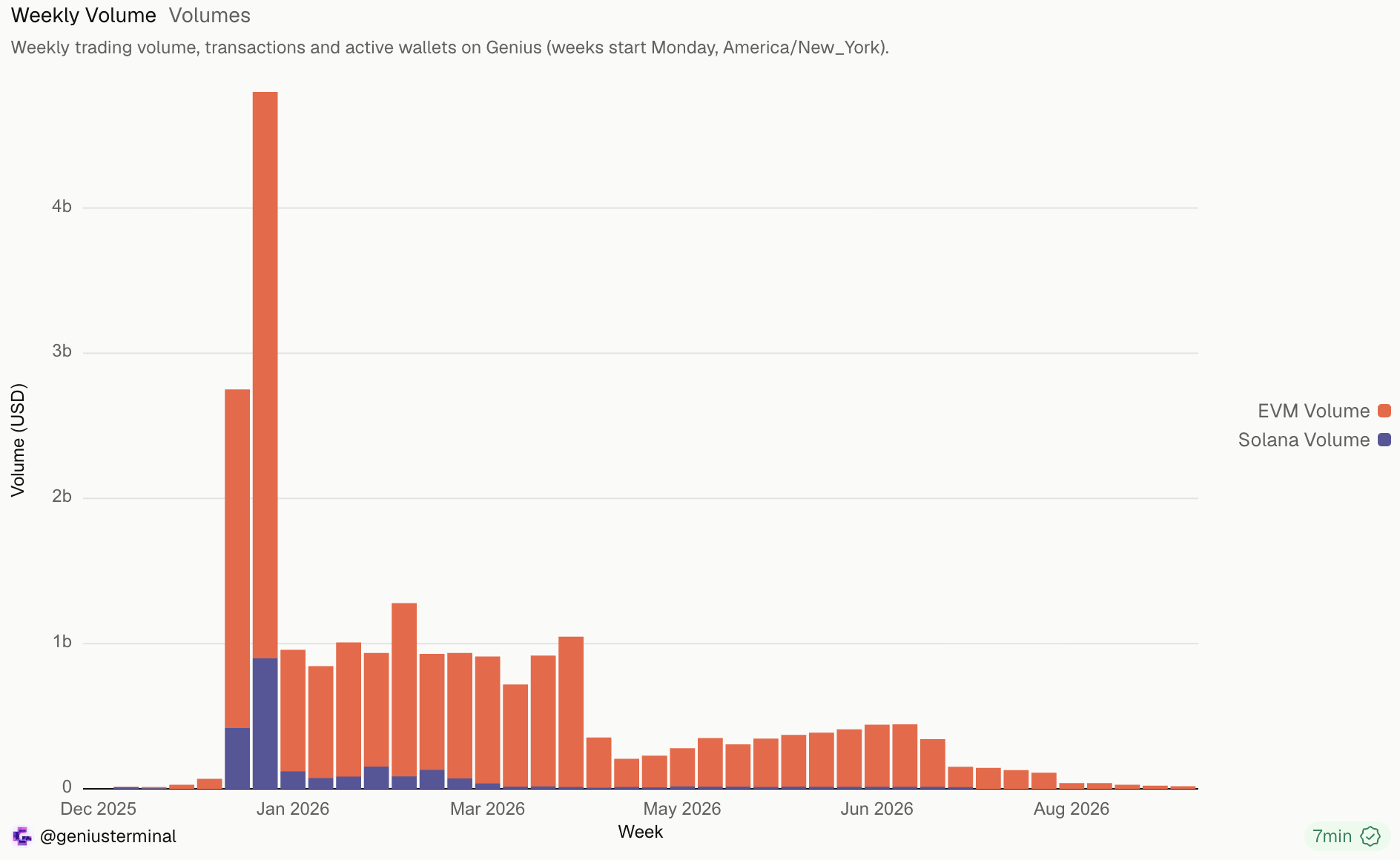
After the YZi Labs financing, however, growth did not hold up. According to Dune data cited in the source, Genius posted weekly trading volume above $4.7 billion around the financing period. Volume then fell sharply. In the week of Sept. 7, weekly volume was only $18 million.
The GENIUS token went live on April 14 and was listed on Binance spot on May 22. It opened at $0.43 and reached an all-time high of $0.82 before entering a prolonged decline. The launch of genius.fun gave the token a modest lift on the previous day, but it remained below its opening price.
A second version of the stock-paired meme narrative
genius.fun supports a broad set of pairings. Creators can pair tokens with stock assets from Binance bStocks, Ondo and Fourmeme's 4stock, or choose BNB, USDT and USDC.
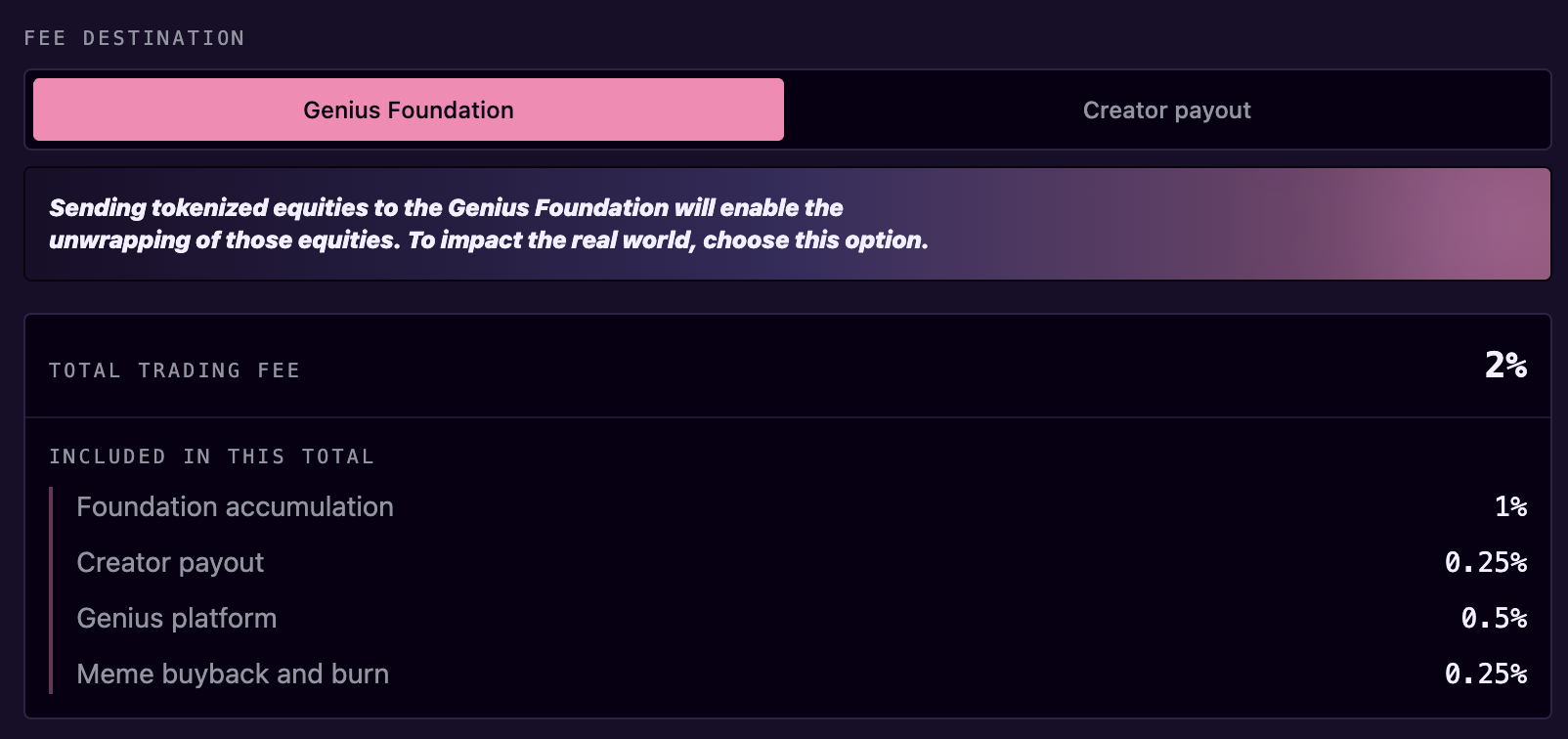
On fees, creators can receive as much as 1.25% in trading fees. A fixed 0.25% trading fee is used to buy back and burn meme tokens. Once a token raises 15 BNB, it is launched on PancakeSwap.
Creators can also choose the "Genius Foundation Mode" when creating a token. Under that setup, 1% of trading fees goes to the Genius Foundation treasury, while the creator's fee is cut to 0.25%.
According to the project, the treasury accumulates only stock tokens, and any meme tokens it receives are converted into the paired stock token. Once holdings reach a certain scale, the foundation could act as a legal entity holding shares in the real-world company and gain actual voting rights and dividend rights. The project has not said what that threshold is.
By press time, the Genius Foundation treasury had accumulated more than 27,000 BNCB, worth about $150,000. The source said that buildup was driven mainly by the popularity of Gstock.
That marks a shift from the earlier version of the stock-paired meme trade. The older framing focused on on-chain meme demand lifting stock-token prices and then influencing the underlying listed shares. genius.fun is trying a different route: use fees to build community capital, then use the foundation as a legal bridge to convert that capital into real-world equity and exercise influence from inside the company.
In theory, if meme trading continues on-chain, the foundation treasury would keep growing, its real-world equity stake would expand, and its influence over the company would increase with it. Follow that line far enough and the story becomes one of moving from a small shareholder position to a larger one, perhaps even to a board seat. At the far end of that narrative sits the idea of a community acquiring a listed company.
That is the pitch. Whether it can work is another matter.
Ownership, conversion and governance remain unresolved
In its documentation, Genius says the shared treasury is managed by a fixed foundation multisig, that the assets belong to the foundation, and that meme holders have no redemption rights.
That point matters. Meme holders make up the community, but under the stated rules the foundation is not simply holding stock tokens on the community's behalf. The assets belong to the foundation itself. If the community cannot redeem those stock tokens, the source asks a direct question: does the foundation have the right to sell them? The project has not explained that.
There is another gap. Genius has not said how many stock tokens the treasury must accumulate before they are converted into equity in a real-world company, nor has it explained how that conversion would happen. Until that path is disclosed, the mechanism remains incomplete in practical terms.
Even if the foundation eventually does convert stock tokens into real-world equity, the next issue is control. Under the rule that the assets belong to the foundation, who ultimately controls and exercises those shareholder rights: the meme community or the Genius Foundation? As the legal entity holding the shares, the foundation would in theory be the shareholder. Without a clear and enforceable framework, the community could end up supplying the trading activity and capital while someone else holds the rights attached to the equity.
And even if the foundation later hands those rights to the community, governance would still be difficult. The community would need a workable structure for governing itself and for participating in the governance of a real-world public company.
For now, genius.fun is still early. The project has not answered those questions, and the idea that meme traders could become on-chain shareholders in a way that leads to community control of a listed company remains untested.
At this stage, the main reason genius.fun has drawn so much attention is still CZ's endorsement effect. The source also noted that this cycle of stock-paired meme trading has already seen the rapid scam around JINQIAN/FAMI and the collapse of the 4Stock/BNC4 narrative. Against that backdrop, caution remains warranted.