


Weekly snapshot
The week of Aug. 31 to Sept. 6 brought a concentrated burst of activity across global payments, especially in bank-led stablecoins, regulatory approvals, cross-border settlement and fintech funding.
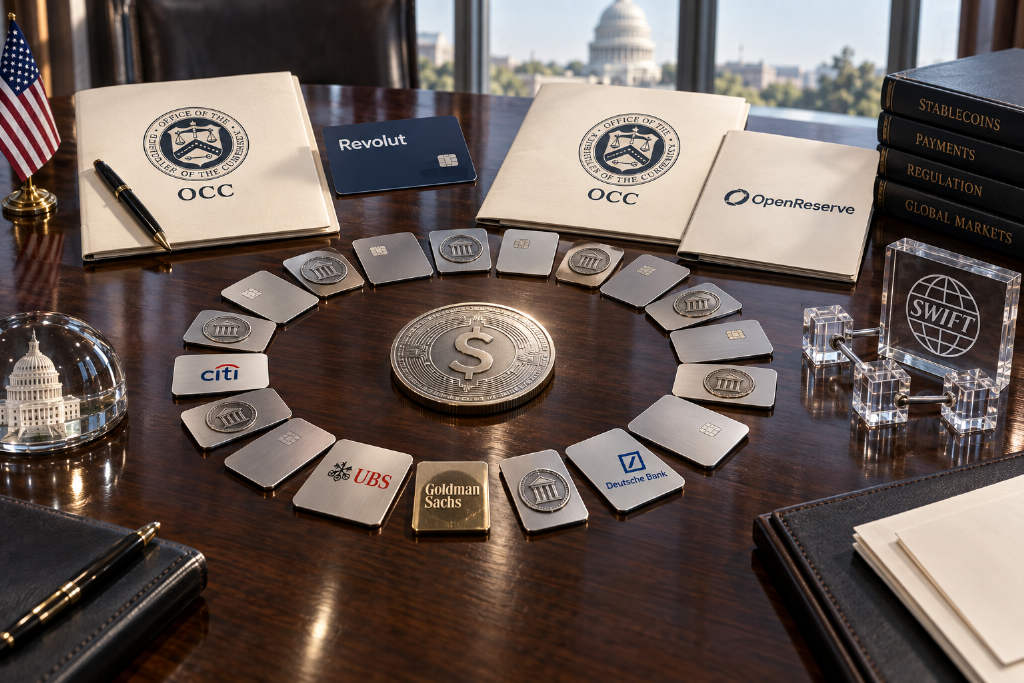
The biggest development came from the banking side. A group of 21 institutions, including 17 global systemically important banks, said they would create a joint stablecoin company in the second half of 2026 and launch a U.S. dollar stablecoin in the first half of 2027, with a euro stablecoin to follow. The institutions named in the report include Bank of America, Citi, Goldman Sachs, Wells Fargo, UBS, Deutsche Bank, Santander and Mitsubishi UFJ. JPMorgan, HSBC and BNP Paribas were not part of the announced group. The item was cited to PR Newswire on Sept. 1.
At the same time, Bloomberg reported on Sept. 4 that total stablecoin supply has pulled back by about $15 billion from its mid-May peak. The report said USDT shrank to about $184 billion in the first half, while USDC stood at about $72 billion, marking the first sustained contraction after the GENIUS Act took effect.
India’s UPI real-time payments network continued to expand in transaction count. NPCI data published Sept. 1 showed August volume reached 24.51 billion transactions worth 29.82 trillion rupees. Volume was up 22% year over year, with a daily average of 791 million transactions, but transaction value slipped 0.2% from the previous month.
In U.S. regulation, Revolut and Andreessen Horowitz-backed OpenReserve both received conditional preliminary approval for national bank charters from the Office of the Comptroller of the Currency on Sept. 3. Both companies included stablecoin issuance or distribution in their business plans.
Funding also rebounded sharply. Data cited from FinTech Global and crypto.news on Sept. 4 and 5 put total global fintech funding this week at $1.36 billion across 12 deals, up 3.5 times from $389 million the previous week. Funding tied to crypto payments and banking infrastructure came to $270 million, or 93% of total crypto venture funding.
Sector temperature check
Traditional payments
Traditional payments were rated 3 out of 5, with a flat trend. PayPal turned to layoffs after a failed acquisition attempt, Fiserv was reported to be considering a sale of its debit network, Wero launched in Luxembourg, and Visa released an A2A fraud product. The week’s signals pointed more to competition over existing volume than new expansion.
Crypto payments
Crypto payments were rated 5 out of 5 and trending higher. The 21-institution banking consortium, the SoFi-Kraken tie-up and weekend settlement completed by Citi and DBS on Swift’s shared ledger all suggested that bank-issued tokenized dollars were moving from rumor to live deployment.
Regulation
Regulation was rated 4 out of 5 and also moving higher. Singapore’s Monetary Authority of Singapore opened a consultation on stablecoin rules that require full reserves and ban yield payments. The U.S. Securities and Exchange Commission proposed transfer-agent rule changes to recognize blockchain records. The OCC issued two charter approvals, and South Korea published a tokenization roadmap.
Funding and M&A
Funding and deal activity were rated 4 out of 5. Weekly funding bounced back to $1.36 billion. Félix raised $200 million, TabaPay raised $155 million and agreed to buy a bank, GCash won approval for a $1.6 billion IPO, and PayTabs acquired Amazon’s Middle East payments unit.
Technology
Technology innovation was rated 3 out of 5. Swift’s shared ledger produced its first live multi-region transactions, NPCI was reported to be working on a unified agent protocol, and Mastercard Start Path brought in its first 22 agent commerce startups.
Key developments of the week
21 institutions move to form a stablecoin joint venture
In crypto payments, 21 global financial institutions announced plans to establish a joint stablecoin company. The group includes 17 G-SIBs as well as Fidelity, WisdomTree, Standard Bank and Sirius. The company is scheduled to be set up in the second half of 2026 and issue a U.S. dollar stablecoin in the first half of 2027. It said the product would be compatible with both GENIUS and MiCA.
The report described it as the largest bank-led stablecoin alliance so far, aimed directly at B2B payments and settlement use cases now served by USDT and USDC. CoinDesk and Ledger Insights also covered the announcement. Circle shares at one point fell about 6% on the day.
The move matters for stablecoin issuers, corporate treasury teams and card networks.
Bloomberg says stablecoin supply is down about $15 billion from its May peak
Bloomberg reported on Sept. 4 that total stablecoin supply had fallen by about $15 billion from the peak reached in May. The same report said USDT and USDC each declined by about $3 billion in the first half. PYMNTS later cited holdings of Treasuries and reverse repos at $134 billion for Tether and $63 billion for Circle.
That shift challenged, for the first time in the data, the simple policy narrative that stablecoin growth automatically translates into rising Treasury demand. It also suggested competition among issuers is shifting away from pure balance-sheet expansion.
OCC grants same-day conditional preliminary approval to Revolut and OpenReserve
On the regulatory side, the OCC gave conditional preliminary approval for national bank charters to Revolut and OpenReserve on the same day. Revolut, based in Connecticut, plans to distribute a Revolut-branded stablecoin issued by a third party. OpenReserve, based in Utah, plans to issue its own U.S. dollar stablecoin. The disclosure said OpenReserve must meet $210 million in paid-in capital and maintain a 12% tier 1 leverage ratio.
Cointelegraph and The Block framed the decisions as a sign that U.S. regulators are opening a full-license path for banks built around payments and stablecoins, while the sponsor-bank model faces more pressure.
SoFi, Payward and Kraken link bank stablecoin issuance with exchange distribution
SoFi entered a three-way arrangement with Payward, Kraken’s parent company. According to reports from CoinDesk and Cointelegraph on Sept. 3, Payward will connect to the SoFi Exchange Network for 24/7 dollar settlement, Kraken will list the bank-issued SoFiUSD stablecoin, and SoFi’s retail crypto order flow will route to Kraken Prime.
The report described it as the first case in which a stablecoin issued by a licensed U.S. bank is distributed through a leading exchange. It also called the structure a return of Silvergate SEN-style settlement rails inside a licensed bank setting.
Citi, FAB, OCBC and DBS advance live use of Swift shared ledger
In cross-border payments, Citi completed the first live U.S. dollar transactions on Swift’s blockchain-based shared ledger with First Abu Dhabi Bank and OCBC. Citi and DBS then completed the first weekend tokenized deposit payment from Singapore to New York, settling in minutes. The reporting was cited to PYMNTS on Sept. 3 and Ledger Insights.
The transactions were presented as evidence that tokenized deposits are moving into production environments and could provide a bank-native alternative to stablecoins. The pilot is expected to cover 17 banks by year-end.
MAS opens consultation on changes to the Payment Services Act
Singapore’s MAS released a consultation paper on Sept. 1 covering proposed amendments to the Payment Services Act. The paper would create a standalone stablecoin issuer license, require 100% segregated reserves, require redemption at par within five business days, and prohibit interest or yield payments to holders. The consultation runs through Oct. 16.
CoinDesk said the proposal aligns Singapore more closely with U.S. and EU positions against yield-bearing stablecoins, narrowing the compliance room for that business model.
PayPal, TabaPay, Félix and GCash all move in the same week
Traditional payments and corporate activity were also busy. PayPal started a new round of layoffs after the collapse of a $53 billion acquisition plan, aiming for $400 million in operating cost savings by year-end. The company cut 251 jobs at its San Jose headquarters and plans to reduce its workforce by about 20% over two to three years, according to Payments Dive and Axios on Sept. 1.
TabaPay raised $155 million led by FTV and said it would acquire OCC-chartered Transact Bank, which will be renamed TabaBank and is expected to close in the fourth quarter. Félix raised $200 million, including $87 million in equity led by Andreessen Horowitz and a $113 million credit facility. In the Philippines, the SEC approved a 92.3 billion peso IPO for GCash parent Mynt, equivalent to about $1.6 billion, with a listing planned for Oct. 20.
Why the week mattered
The 21-bank alliance moved from speculation to signed participation
The report notes that just one week ago, the market was still focused on reports that JPMorgan was evaluating a move. This week, 17 G-SIBs were formally on board. It highlighted three points. First, the absence of JPMorgan, HSBC and BNP Paribas showed that major banks are still split internally. Second, the group explicitly said it would work with both GENIUS and MiCA, pointing to transatlantic B2B settlement rather than retail use. Third, Circle shares first fell and then rose, with a 14% gain on Sept. 3, suggesting the market did not treat the consortium as an endgame threat to Circle.
Supply contracted while infrastructure capital accelerated
The report put two trends next to each other. Stablecoin supply has dropped by a net $15 billion since May, yet more than $500 million of capital this week flowed into stablecoin infrastructure. It named Félix, Cari, Diameter, OpenReserve and Kast. The argument was that the contest is shifting from issuance volume toward access points and real use cases.
It also cited a public remark from Airwallex product vice president Dan Kim: 「I ran into a wall trying to figure out how to make stablecoins useful ... that was a dead end.」 The company then moved toward last-mile stablecoin-to-fiat conversion.
Two OCC approvals added to a broader banking-license push
The report grouped the same-day approvals for Revolut and OpenReserve together with TabaPay’s bank acquisition and SoFi’s stablecoin issuance plan. Its conclusion was that a model in which processors and fintech firms hold bank licenses and issue stablecoins themselves is becoming a standard setup in the U.S., putting medium-term pressure on sponsor banks.
Swift live transactions gave tokenized deposits a concrete example
The live transactions involving Citi, FAB, OCBC and DBS arrived within two weeks of each other. The report said they gave practical backing to comments from the BIS general manager favoring tokenized deposits over stablecoins. For cross-border PSPs, that points to a market in which stablecoin rails and bank tokenized-deposit rails may compete at the same time around 2027.
MAS ban on yield tightens the room for yield-driven products
The report said Singapore has become the third major jurisdiction, after the U.S. and the EU, to clearly prohibit interest-bearing stablecoins. It contrasted that with Ethena Pay’s rollout across 48 countries offering 5% to 6% yield and said the compliance space for yield-driven stablecoin products is narrowing quickly.
Crypto and Web3 deep dive
Stablecoin data dashboard
| Metric | Value | Change / basis | Source |
|---|---|---|---|
| Total stablecoin market cap | About $305.6 billion | Up 0.6% over 7 days; down about $15 billion from the mid-May peak | DefiLlama data as of Sept. 8, Bloomberg Sept. 4 |
| USDT supply | About $183.4 billion to $184.6 billion | Roughly 60% market share; down about $3 billion in the first half, possibly the first annual contraction since 2022 | DefiLlama, CoinDesk Sept. 4 |
| USDC supply | About $74.7 billion | About $73.3 billion at the end of Q2; Q2 on-chain transfer volume of $14.8 trillion | DefiLlama, PYMNTS Sept. 6 |
| Second-tier stablecoins | USDe $4.37 billion, USD1 $4.27 billion, USDG $3.2 billion, PYUSD $2.91 billion, RLUSD $2.41 billion | RLUSD crossed $2 billion this week; USDG launched natively on Mantle | DefiLlama, Cointelegraph Sept. 3 |
| Issuer Treasury holdings | Tether $134 billion / Circle $63 billion | Treasuries plus reverse repos | PYMNTS Sept. 6 |
| Tokenized RWA market cap excluding stablecoins | About $39.15 billion | Up 1.5% over 30 days; 3.58 million holding addresses | rwa.xyz data as of Sept. 8 |
| Monthly stablecoin card payment volume | About $1.5 billion per month | Quoted by Stripe’s new stablecoin card lead; Visa’s 130+ programs and 50+ countries were cited as April background | Payments Dive Sept. 3 |
| Corporate adoption | 13% of midsize U.S. companies use stablecoins | PYMNTS survey | PYMNTS Sept. 3 |
The report added two caveats: there was no reliable public data this week for total weekly on-chain stablecoin transfer volume, and no update for cumulative crypto card top-up data.
Main thread: banks pushed on issuance, settlement and distribution at once
The report summarized the main storyline as a three-part push by the banking sector covering issuance, settlement and distribution.
- Issuance: 21 institutions announced the stablecoin venture for 2027 H1; SoFiUSD was listed on Kraken; OpenReserve won approval and plans self-issuance; Cari raised $32.5 million from seven regional banks to build a tokenized deposit network. The logic, according to the report, is that large banks are defending deposits and settlement fees while smaller banks are banding together to avoid marginalization. Open questions include why JPMorgan and HSBC were absent and how these projects coexist with proprietary tokenized deposit systems such as JPMD and Kinexys.
- Settlement: Swift’s shared ledger saw live transactions between Citi, FAB and OCBC, then a weekend live transaction between DBS and Citi. KB Kookmin Bank became the first South Korean bank to connect to JPMorgan’s Kinexys. The logic is to build 24/7 cross-border settlement on bank-native ledgers without relying on public-chain stablecoins. Questions remain around interoperability and finality rules through the December pilot period.
- Distribution: Revolut’s OCC approval supports its plan to distribute a private-label stablecoin; Kast launched a B2B stablecoin platform; Ethena Pay expanded to 48 countries; Félix raised $200 million to grow USDC remittances. The report’s line here was simple: whoever controls the user and merchant gateway gets to define what stablecoins are used for. With the U.S. and Europe moving against yield, fee levels and user experience may be what is left to differentiate consumer products.
The editorial view in the report said the core question is no longer whether banks will enter the market. The question now is which of the three rails — public-chain stablecoins, bank consortium stablecoins or tokenized deposits — will become the settlement layer. It argued that shrinking supply points to a top in retail speculative demand, while capital and licenses are concentrating in B2B settlement and cross-border payments. It identified the first half of 2027 as the likely window when the market structure starts to take shape.
Selected quotes from the week
- SoFi CEO Anthony Noto told CoinDesk: 「Financial systems shouldn’t close when the market is open.」
- A JPMorgan spokesperson, responding to the 21-bank consortium, told Banking Dive: 「We have no current plans to issue a stablecoin, but we will evaluate all options based on client demand and regulatory developments.」
- The MAS consultation paper said: 「Stablecoins are meant for payments, not for the public to use as investment products or bank-deposit-like interest-bearing instruments.」
- Tether said in response to Bloomberg: 「The current pause in stablecoin growth should not be misread as a ceiling on Treasury demand.」
- Airwallex product VP Dan Kim told Fortune: 「I ran into a wall trying to figure out how to make stablecoins useful ... that was a dead end.」
- Mridula Iyer, Citi’s head of services for South Asia, told CoinDesk: 「Completing a live transaction over the weekend shows that always-on cross-border payments are now real.」
Regulation in brief
United States: The SEC on Sept. 1 proposed rewriting transfer-agent rules so blockchain records could count as official books and explored using wallet addresses instead of postal addresses, with a 60-day comment period. The agency is also set to hold a 24/7 trading roundtable on Sept. 17. The OCC and FDIC finalized a definition of unsafe or unsound practices intended to narrow enforcement discretion and reduce debanking risk. The National Sheriffs’ Association shifted to a neutral stance on the CLARITY Act, and the Senate is scheduled to hold a procedural vote on Sept. 15. Wyoming’s FRNT integrated Chainlink Proof of Reserve. Two Thai businessmen sued Tether over a $42.4 million USDT freeze, creating the first judicial test of an issuer’s freeze authority.
G20: Finance ministers and central bank governors pledged to provide a clear path for digital-asset innovation, asked the Financial Stability Board for a report on cross-border effects of global stablecoins, and called for longer operating hours in large-value payment systems.
Asia: Alongside the MAS consultation, South Korea’s FSC released a three-stage tokenization roadmap on Sept. 4, starting in February 2027, with the third stage aimed at on-chain settlement linked to stablecoins. A Bank of Korea study said direct fiat-to-stablecoin trading pairs on Binance weigh on local currency demand and that annual purchases of KRW stablecoins reached $64 billion, the highest in Asia-Pacific. Japan’s Financial Services Agency sought tax relief for transfers of trust-based stablecoins. Australia’s ASIC warned crypto firms they must hold an AFS license by Sept. 30.
Mainland China and Hong Kong: The report said there were no major new policy moves this week. It added that Hong Kong still had two stablecoin license holders, HSBC and Anchorpoint, while mainland developments were concentrated in overseas expansion by UnionPay and Ant International.
Europe and the UK: Revolut completed the delisting of USDT in the EEA and Switzerland on Aug. 31 and automatically converted remaining balances to fiat. The ECB, EBA and FCA introduced no new stablecoin rules this week.
Traditional payments versus crypto payments
Growth
On the traditional side, UPI processed 24.51 billion transactions in August, up 22% year over year, while value was largely flat month over month. Brazil’s Pix set a one-day record of 318 million transactions on Sept. 4. Fiserv’s small business index was unchanged at 145 in August, with foot traffic down for a tenth straight month.
On the crypto side, total stablecoin supply stood near $305.6 billion, still $15 billion below its peak. RLUSD moved past $2 billion, USDC posted $14.8 trillion in Q2 on-chain volume, and stablecoin cards were running at about $1.5 billion in monthly payments.
Products
In traditional payments, Visa rolled out the upgraded A2A Protect globally on Sept. 1, with fraud interception up 50%. FIS launched an embedded banking platform on Sept. 3. X moved U.S. creator payments from Stripe to its own X Money on Sept. 2.
In crypto payments, SoFiUSD went live on Kraken, Ethena Pay launched across 48 countries, Kast introduced a B2B stablecoin platform on Sept. 1, and Stripe hired a former Uniswap executive to lead its stablecoin card business on Sept. 3.
Regulation
In traditional payments, the Federal Reserve said institutions joining FedNow will be eligible for rebates of up to $80,000 starting in 2027, while only 4% of institutions currently have full send-and-receive functionality enabled. India’s UPI began requiring masked phone numbers and account details on Sept. 4. Brazil’s central bank extended the Pix dispute period to 80 days and will remove the 500-real NFC limit in October.
In crypto payments, the main regulatory items were the MAS stablecoin consultation, the OCC’s two approvals, the SEC transfer-agent proposal, South Korea’s tokenization roadmap, and the G20 request for an FSB report on stablecoins.
Capital
Traditional payments posted $1.36 billion across 12 funding and M&A deals. TabaPay raised $155 million and bought a bank. GCash won approval for a $1.6 billion IPO. PayTabs acquired Amazon’s Middle East payments business for more than $100 million, according to Zawya on Sept. 5. Mollie completed its acquisition of GoCardless. Slice saw its valuation cut from $1 billion to $450 million.
Crypto venture funding totaled $292 million across 10 deals, with payments and banking infrastructure accounting for 93%. Félix raised $200 million, Cari raised $32.5 million on Sept. 2, OpenReserve secured a $25 million seed round, and Diameter Pay closed a $10 million Series A. In public markets, Circle rose 14% on Sept. 3 and Coinbase gained 10% the same day.
Applications
For traditional payments, Wero launched in Luxembourg on Sept. 2 and replaced Payconiq. The ECB continued work on a TIPS-Pix link with a 2028 pilot target. The Philippines’ QR Ph connected to Alipay+, and Uzbekistan became the 11th country to accept UPI.
For crypto payments, Swift’s shared ledger completed its first multi-region live transactions, KB Kookmin Bank connected to Kinexys, a Brazilian bank bought Citi tokenized notes, and Standard Chartered launched institutional spot crypto trading in the UAE on Sept. 3.
Regional developments
United States
The U.S. list was led by the 21-bank stablecoin alliance, OCC approvals for Revolut and OpenReserve, the SoFi-Kraken link, PayPal layoffs, Fiserv’s reported debit-network sale plan and a share-price decline of about 60% this year, the FedNow rebate plan, SEC transfer-agent changes and 24/7 trading roundtable, and the upcoming Senate vote on the CLARITY Act.
Europe and the UK
Wero launched in Luxembourg while Payconiq is set to close on Sept. 30. Mollie completed its acquisition of GoCardless and the combined company now serves 350,000 merchants. Revolut finished removing USDT in the EEA and also secured a U.S. banking approval. The ECB studied connectivity with Pix. OpenPayd integrated MSB USA ahead of a planned $1.145 billion SPAC listing. Russia moved into a mandatory rollout phase for the digital ruble.
Mainland China and Hong Kong
No major new policy change was highlighted this week. UnionPay International deepened partnerships with Kyrgyzstan’s Elcard and Armenia’s ArCa, with Central Asia transaction volume up about fourfold in the first half. Ant International obtained a payment-institution license from Brazil’s central bank. Nigeria’s Grey launched stablecoin-based direct payments into CNY accounts.
Southeast Asia and South Asia
The MAS stablecoin consultation remained a major topic. DBS and Citi completed weekend settlement on Swift’s shared ledger. GCash won approval for a $1.6 billion IPO, the largest in Southeast Asia. QR Ph connected to Alipay+ across 2.5 million merchants. UPI hit a new high in August. NPCI was reported to be preparing an AI agent payment protocol. Thailand finalized its digital-asset travel rule for implementation in February 2027.
Japan and South Korea
South Korea’s FSC released its three-stage tokenization roadmap. KB Kookmin Bank connected to JPMorgan’s Kinexys. The Bank of Korea released research on stablecoin exchange rates. Mitsubishi UFJ joined the 21-institution stablecoin consortium. Japan’s financial regulator sought tax relief for trust-based stablecoin transfers.
Middle East
PayTabs bought Amazon’s Middle East payment service, covering a nine-country PSP footprint. Standard Chartered launched institutional spot crypto trading in the DIFC. Qatar’s central bank joined AFAQ, meaning all six Gulf central banks are now connected. Saudi Arabia’s Nayla raised $17.9 million in a Pre-A round. Money20/20 Middle East is set for Sept. 14 to 16 in Riyadh.
Latin America and Africa
Brazil’s Pix hit a one-day record of 318 million transactions and the central bank loosened NFC limits. ECB-Pix connectivity work continued. Félix used its $200 million financing to expand USDC remittances. Uzbekistan launched a three-year pilot for a government-bond-backed som stablecoin.
Action points for industry participants
For traditional payments companies
- Reassess sponsor-bank dependence. With TabaPay buying a bank, Revolut and OpenReserve winning OCC approval, and SoFi issuing a stablecoin, firms that rely on sponsor-bank BINs or settlement accounts should evaluate by 2027 whether to hold a license directly, switch correspondent banks or connect to tokenized deposit networks such as Kinexys and Swift’s shared ledger.
- A2A and instant payments are entering a competition centered on risk controls and rebates. Visa’s A2A Protect and the FedNow rebate plan arrived in the same week, a sign that both card networks and central banks are trying to control the account-to-account layer. Acquirers and gateways should place A2A fraud scoring and two-way FedNow or RTP capability on their 2027 product roadmap.
- Watch the “more volume, flat value” pattern in UPI and Pix. Both systems are pushing into NFC and cross-border use, so the defensive focus for card businesses in emerging markets is moving from online activity toward small-ticket offline payments.
For crypto payments companies
- Submit comments to MAS by Oct. 16. Singapore’s proposed ban on interest, full reserve segregation and five-day redemption would directly affect the distribution model for products such as XSGD and USDC in Asia. Licensed and prospective applicants need a clear position on the treatment of foreign stablecoins.
- Secure distribution and settlement positions before the bank consortium launches. The 21-bank stablecoin is due in the first half of 2027, while the Swift shared-ledger pilot runs through December. The report said smaller issuers and infrastructure providers should win exchange listings, card programs or regional bank partnerships before then to avoid being pushed to the retail edge.
- Track the Sept. 15 CLARITY vote and the Tether freeze lawsuit. The first affects market-structure legislation and stablecoin yield provisions in 2026. The second is the first court test of an issuer’s freeze power. Products involving merchant balances should have freeze, appeal and disclosure procedures ready.
Watch list for next week
The first event to watch is the Senate’s procedural vote on the CLARITY Act on Sept. 15, which requires 60 votes. The report said failure there would likely push market-structure legislation into 2027. Also on the calendar is the SEC’s Sept. 17 roundtable on 24/7 trading, where discussion of stablecoins and tokenized deposits as the cash leg will be closely watched.
Money20/20 Middle East runs in Riyadh from Sept. 14 to 16. The report expects announcements tied to SAMA open banking, instant payments, Gulf stablecoins and cross-border transfers. It also flagged details on the PayTabs-Amazon payments deal and Standard Chartered’s UAE expansion as items to follow.
Circle’s Arc mainnet is scheduled to go live on Sept. 16, which the report described as Circle’s direct response to the banking consortium. The next question is whether stablecoin supply can stop falling. The report said readers should keep tracking DefiLlama’s weekly supply data and whether NPCI formally unveils its AI agent payment protocol at Global Fintech Fest in Mumbai from Sept. 9 to 11.
The original report closed by saying all figures and events were drawn from public reporting, with links to original sources, and that the editorial analysis reflected judgments based on public information rather than investment advice.