
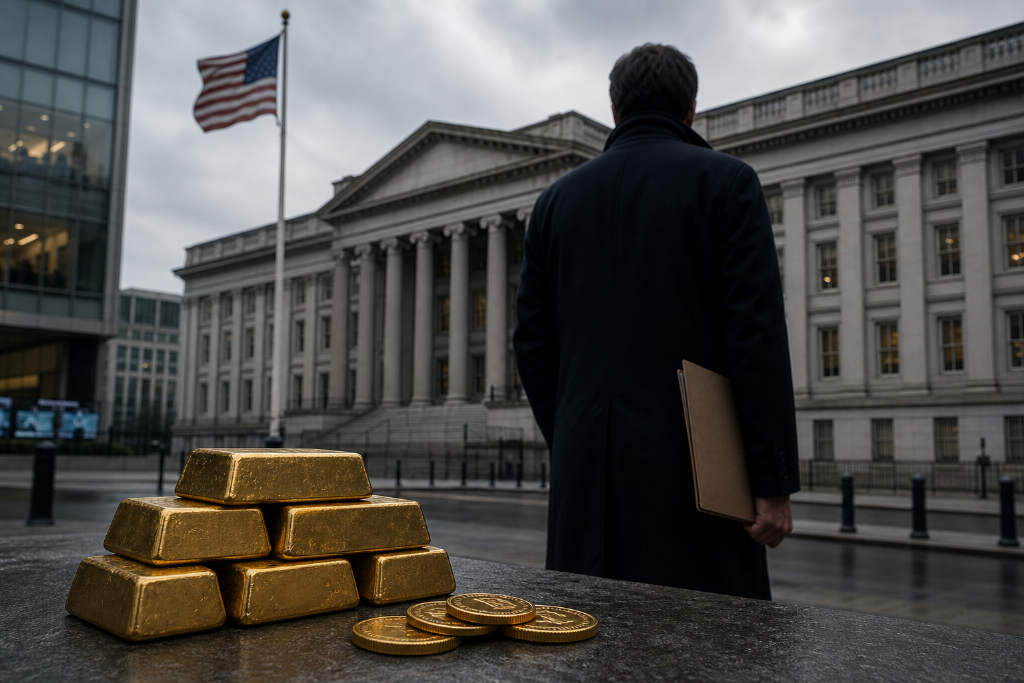
Gold rallied sharply after the U.S. Treasury unexpectedly stepped up its intervention in the government bond market, adding momentum to a weaker dollar and reviving the so-called debasement trade. Spot gold (XAU) rose above $4,640 an ounce during the session, reaching its highest level in more than three months since mid-May. On a weekly basis, the metal has now posted gains for three straight weeks, up more than 6% over that span.
Bridgewater founder Ray Dalio publicly urged investors to allocate as much as 15% of their assets to gold as a key hedge against a potential U.S. debt crisis. Longtime gold bull Peter Schiff also said bullion would soon climb back above $5,000.
Gold rebounds after a deep pullback earlier this year
ABMedia said gold had come under pressure in the first half of the year after touching a record high near $5,600 in late January. Prices later fell by about $1,000 from that peak.
Two factors were cited as the main reasons for the earlier decline. First, the Federal Reserve showed a firm independent stance, with new Chair Kevin Warsh sending hawkish signals that damped expectations for aggressive rate cuts. Second, escalating tensions in the Middle East and rising inflation concerns led the market at one point to price in the possibility of rate hikes returning, lifting real yields and hurting demand for gold.
That correction, however, appeared to end after the Treasury’s latest policy intervention.
Treasury buyback expansion revives debasement concerns
The immediate catalyst for the latest move came after U.S. Treasury Secretary Scott Bessent announced an expanded buyback of long-dated government bonds to curb elevated government financing costs. He also said a series of fiscal initiatives would be introduced to address rising long-term borrowing costs.
That move quickly fueled concern over fiscal dominance and a dilution of monetary credibility. The dollar came under pressure, with the U.S. Dollar Index (DXY) falling to its lowest level in more than three months.
Bloomberg data cited in the report showed that gold ETFs recorded net inflows of more than 28 tons last week, the biggest weekly addition since January. ABMedia said the figures pointed to a broad return of both institutional and retail money. Justin Lin, an analyst at Global X ETFs, said: 「Under the debasement narrative, macro capital is rotating into hard assets such as precious metals on a large scale.」
The rally is no longer tracking the usual yield playbook
One of the notable features of the current advance is that it has broken with the market’s usual logic for pricing gold. Traditionally, non-yielding gold benefits when interest rates fall because the opportunity cost of holding it declines. This time, though, gold continued to climb even after gains in 30-year U.S. Treasuries faded and long-end yields remained elevated following the Treasury’s buyback announcement.
Charu Chanana, chief investment strategist at Saxo Markets, said: 「Even with long-dated bond yields staying high, gold has remained resilient. That suggests this rally is no longer just about lower yields. The market is now materially pricing in dollar weakness and a loss of confidence in U.S. fiscal and monetary credibility.」
Dalio backs up to 15% gold allocation, Schiff reiterates $5,000 view
Against the backdrop of heavy U.S. debt pressure and fiscal policy intervention, several Wall Street figures have openly backed gold. Dalio said investors should reduce bond exposure and allocate as much as 15% of their portfolios to gold as protection against a possible U.S. debt crisis.
Christopher Wong, a strategist at OCBC, said the current rally still has room to run and investor participation is continuing to broaden. He added that a healthy consolidation after a sharp short-term rise would be constructive for the bullish setup. The main near-term risks, he said, are a rebound in the dollar or another sharp rise in real yields.
ABMedia also noted that Schiff said on Aug. 12 that gold’s pullback had ended and that prices would soon return above $5,000.
The report said that as long as the underlying issues of an expanding U.S. fiscal deficit and policy intervention remain unresolved, gold, as a non-sovereign credit hedge, could make another push higher this year after breaking through the $4,640 resistance area.