
Sprott Asset Management says the retreat in gold and silver since the start of 2026 should be read as a cyclical correction inside a longer-running bull market, not as the end of the upswing that gathered pace in 2025.
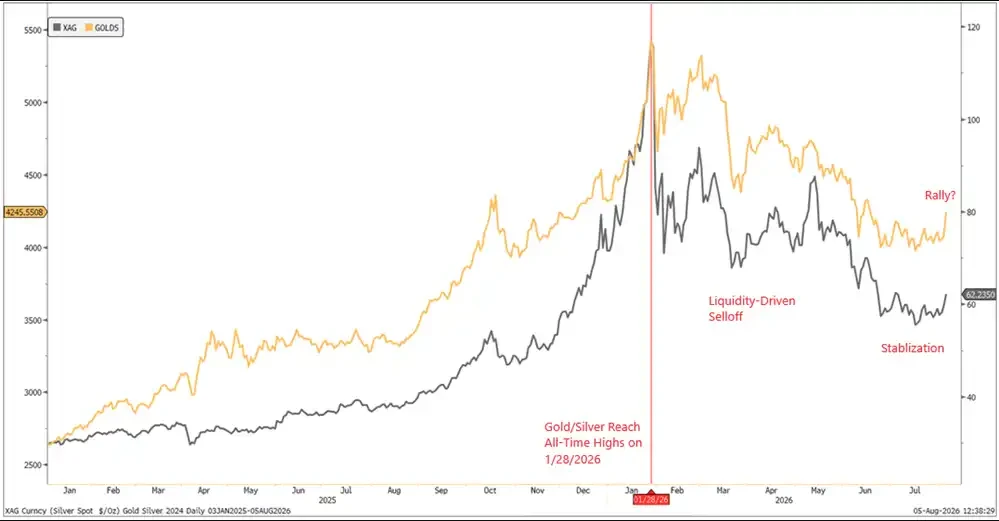
On Aug. 7, gold briefly moved above $4,350 an ounce, its highest level in seven weeks, after holding in the $4,000-$4,100 range. The report asks a direct question: after gold climbed 64.58% and silver jumped 147.95% in 2025, does the sharp pullback in the first seven months of 2026 signal a trend reversal, or a rebalancing after leverage and market sentiment were cleared out?
Gold and silver were still down for the year at the end of July
As of July 31, gold closed at $4,046.15 an ounce, down 6.33% year to date. Silver closed at $57.60 an ounce, down 19.63% for the year. Even with those declines, both metals were still trading well above their levels from a year earlier.
For investors, the report says the key issue is not whether gold and silver have corrected, but whether the long-term demand drivers behind the previous rally have changed.
Gold steadied near $4,000 as futures money began to return
Sprott is not arguing that precious metals cannot fall further. Its point is narrower: the latest decline has not yet damaged the structural supports behind the longer-term case.
According to the report, gains in 2025 were so large, and fresh highs in early 2026 added so much leverage and profit-taking pressure, that the market became vulnerable to a washout. Sprott said geopolitical conflict in March unexpectedly tightened global liquidity, forcing some leveraged investors to sell gold to raise cash. In the second quarter, easing tensions between the U.S. and Iran, lower oil prices, a stronger dollar and expectations that U.S. rates could stay higher for longer added pressure to precious-metals prices.
By early summer, part of that selling pressure had faded. Gold found support again near $4,000 from physical demand and central-bank buying, then rose above $4,350 on Aug. 7. Silver was more volatile, but it also stabilized in the $55-$60 range and at one point traded back above $60.
Futures positioning showed signs of money returning. Based on Saxo Bank's compilation of CFTC data, hedge funds had already increased exposure to precious metals in the week ended Aug. 4, before gold completed its technical breakout. Net speculative longs in silver futures rose 32% from a week earlier. Net longs in gold also increased and reached their highest level since January.
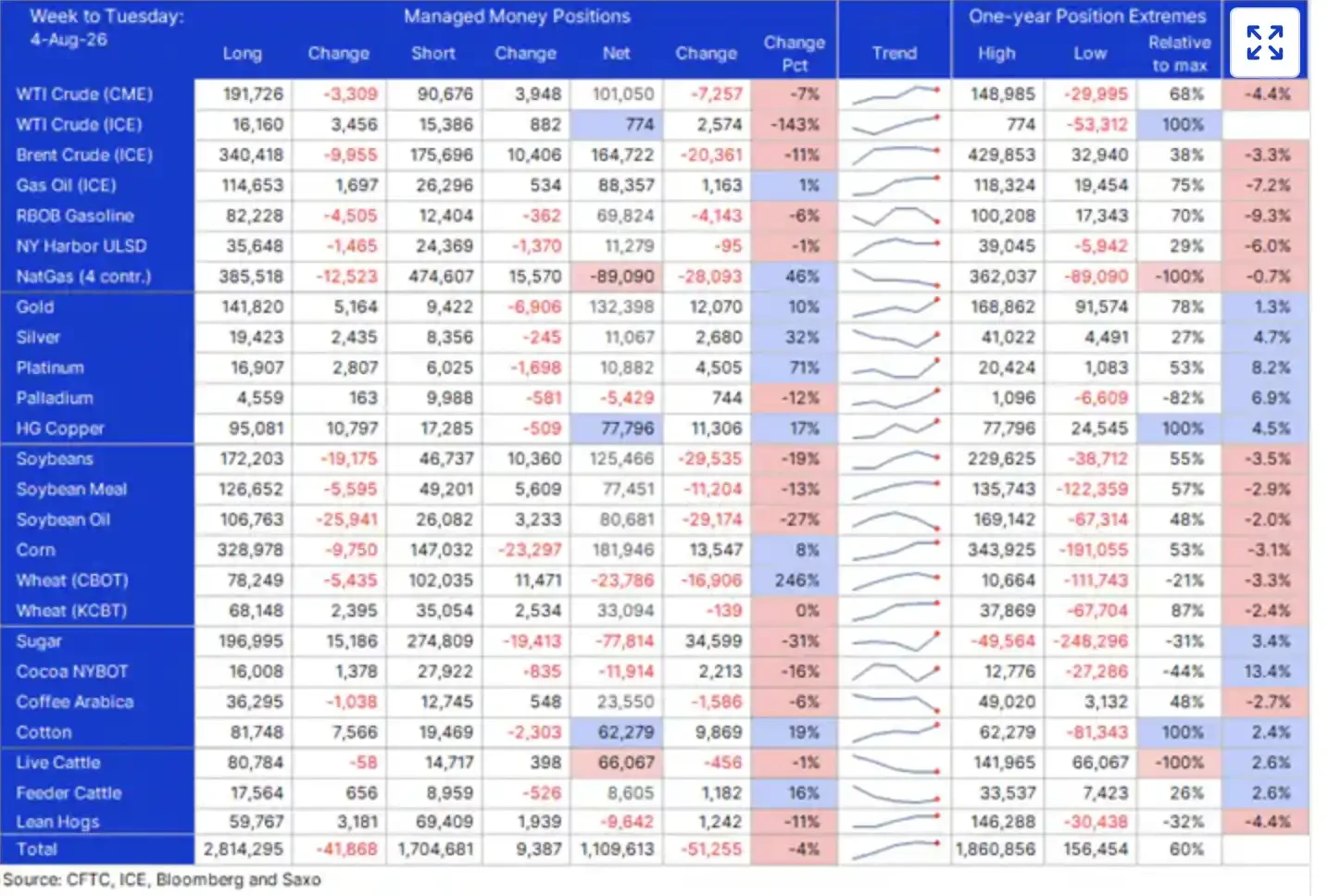
At the same time, speculators cut about $13 billion in bullish dollar positions in one week, the biggest weekly reduction in six years. Even so, overall dollar positioning remained clearly net long, so the data alone do not establish that the dollar trend has reversed.
The report adds that Commitments of Traders, or COT, data are more useful for tracking short-term sentiment than for proving a new bull run. They show that precious metals are attracting speculative capital again, but not that a fresh one-way advance has already started.
In the week ended Aug. 4, managed-money net longs in gold rose to 132,000 contracts, the highest since January. Net longs in silver increased 32% to about 11,000 contracts, though total positioning remained relatively low.
Central-bank buying recovered in the second quarter, but first-half demand stayed weak
The long-term support for gold still depends heavily on central banks and sovereign investors.
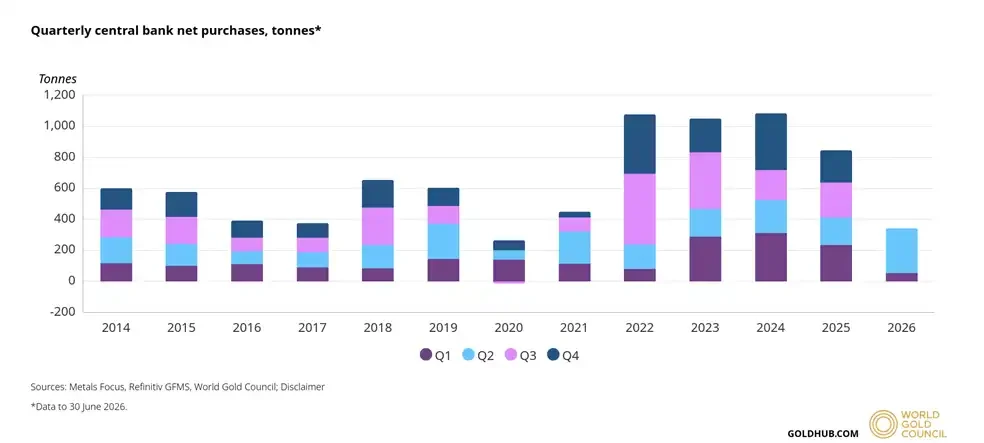
World Gold Council data showed net gold purchases by central banks worldwide reached 289 tonnes in the second quarter of 2026. That was roughly five times the revised 57 tonnes recorded in the first quarter, up 62% from a year earlier, and the highest second-quarter total on record.
There is another side to those figures. Because first-quarter purchases were revised sharply lower, net central-bank buying in the first half of 2026 totaled 345 tonnes, the lowest first-half level since 2022. The report says that means official demand recovered visibly in the second quarter, but it is still too early to say whether it has returned to a sustained acceleration.
Among the countries that have disclosed data, Poland and China were the more notable buyers in the second quarter, adding about 51 tonnes and 33 tonnes respectively. The report ties continued official-sector accumulation to long-term factors including sovereign debt expansion, fiscal deficits, geopolitical fragmentation and reserve diversification.
Because gold is not tied to any single sovereign credit, the report says some central banks still treat it as a strategic asset outside traditional foreign-exchange reserves. Such buying may not keep pushing prices higher in the short run, but it can support spot demand when ETF outflows, deleveraging or weaker investor sentiment pressure the market.
Whether central-bank purchases can maintain that pace is one of the variables Sprott sees as important in judging how firm support near $4,000 really is.
Silver deficits are set to widen even as industrial demand slows
Silver trades on a more complex set of drivers than gold. It has monetary and investment characteristics, but industrial demand, mine supply and inventory changes also matter.
The World Silver Survey 2026, published in April by the Silver Institute and Metals Focus, said the global silver market posted a deficit of 40.3 million ounces in 2025. That gap is expected to widen to 46.3 million ounces in 2026, which would mark the sixth straight year of undersupply.
Persistent deficits mean above-ground inventories still need to absorb the gap between supply and demand. But the report also says industrial demand in 2026 is not rising across the board.
It projects silver industrial demand will fall to 639.6 million ounces in 2026, down about 3% from a year earlier. Demand from the photovoltaic sector is expected to drop 19%. The report attributes that mainly to high silver prices pushing solar manufacturers to reduce silver use per unit, rather than to a broad-based expansion in every industrial segment.
Grid investment, electrification, AI infrastructure and advanced manufacturing remain longer-term demand sources for silver, but the report does not treat that as evidence that every industrial category is growing in 2026. It also notes that the widening deficit is not driven by industrial demand alone. Mine supply, recycled supply and shifts in investment demand matter as well.
That helps explain why silver usually moves more sharply than gold. On the way up, a smaller market, tighter inventories and speculative inflows can amplify price moves. On the way down, concern over industrial demand, tighter liquidity and leveraged position clearing can deepen the decline.
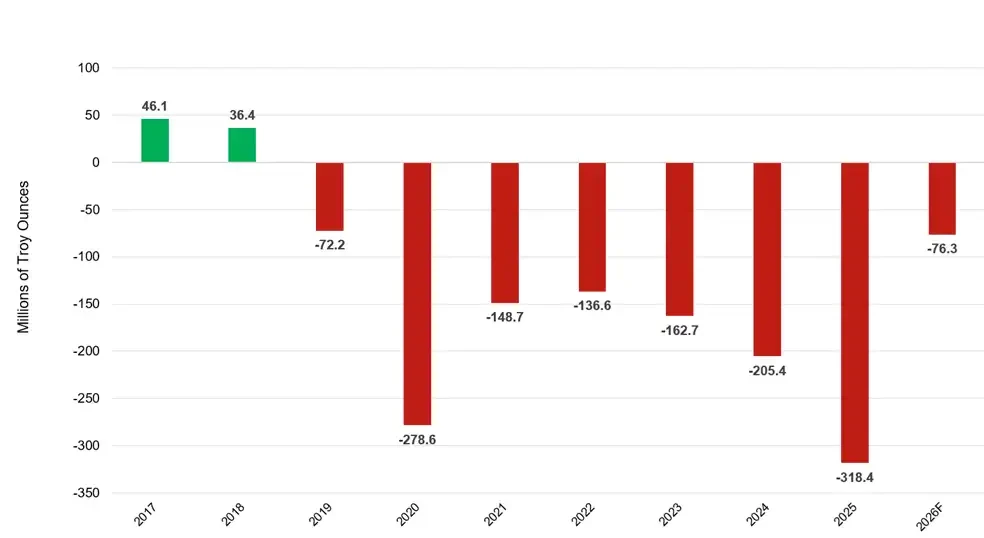
Silver fell nearly 20% in the first seven months of 2026, underperforming gold. With prices now stabilizing in the $55-$60 range, the market is reassessing the impact of ongoing deficits, a pickup in investment demand and support from gold's rebound.
The long-term case remains, but a short-term reversal is not yet confirmed
Sprott's long bullish view on precious metals is clear. Still, saying that a correction is not the end of the bull market is not the same as saying a new leg higher has already been confirmed.
The largest source of disruption, according to the report, remains the macro environment. If the dollar strengthens again, real rates continue to rise or global liquidity tightens once more, rebounds in both gold and silver could be interrupted. Silver may stay more volatile than gold because of its industrial exposure, smaller market size and heavier use in leveraged trading.
Central-bank buying and a structural silver deficit are medium- to long-term supports, but neither prevents sharp drawdowns. Second-quarter official buying recovered, yet first-half demand still ran below the levels seen in recent years. Silver remains in deficit, but industrial demand is slowing. COT data show money returning, though futures positioning could reverse quickly if the dollar or U.S. Treasury yields move higher.
In that context, the move above $4,350 matters for more than the headline price. After gold stabilized near $4,000, the market began testing again whether the long-term bull case for precious metals still holds.
Sprott says the next phase for gold and silver depends mainly on four variables: whether central-bank gold buying keeps its strength, whether silver deficits continue to draw down inventories, whether the dollar and real rates turn higher again, and whether futures inflows can continue.
Based on the data available now, the report supports the view that the long-term bullish framework has not been broken. It stops short, however, of saying that a new one-way rally has already begun.