
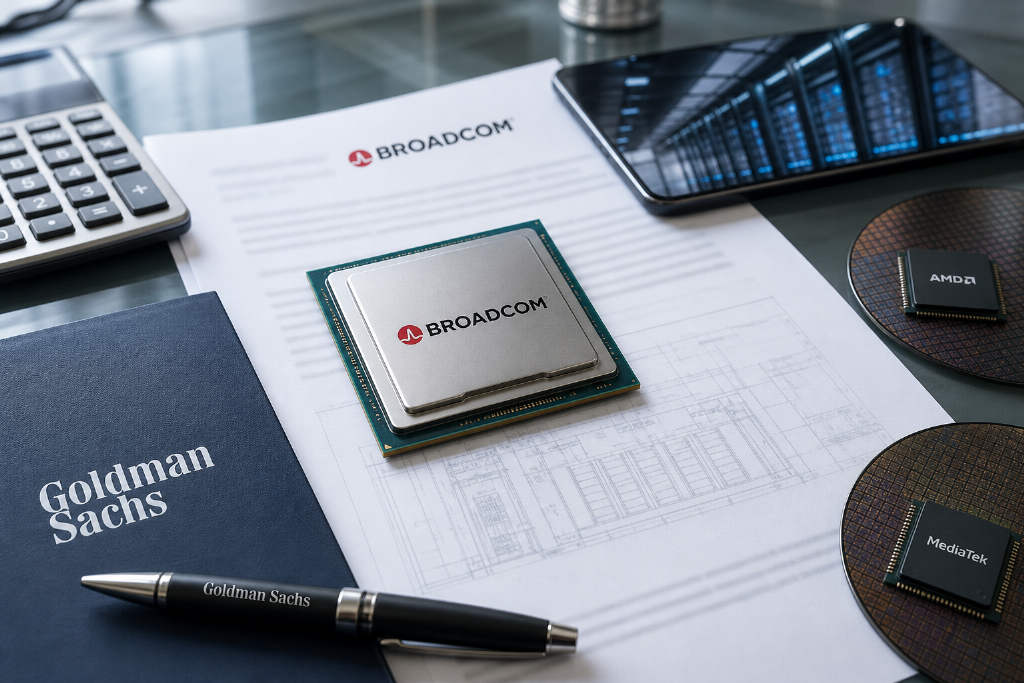
Goldman Sachs said market anxiety over MediaTek and AMD taking application-specific integrated circuit, or ASIC, orders from Broadcom has pushed expectations into overly conservative territory, opening what it sees as a buying window.
In a preview of Broadcom’s second-quarter results published on Aug. 18, Goldman kept its Buy rating and reiterated a $525 price target for Broadcom (AVGO), or 34% above the current price of $392. The bank said investor concerns around competition have been overdone and that Broadcom’s AI revenue guidance and networking momentum are not fully reflected in current expectations.
Goldman sees consensus as too low on FY2027 AI revenue
Goldman expects Broadcom to generate about $57 billion in AI revenue in FY2026, broadly in line with market consensus. For FY2027, it forecasts AI revenue of $133 billion, which is 12% above consensus. According to the report, that gap suggests the market is systematically underestimating Broadcom’s competitive position for next year.
The bank described current expectations as conservative. It said spending by key customers remains strong, but news that MediaTek and AMD are entering the ASIC market has made investors more cautious.
That caution is already visible in valuation, Goldman said. Broadcom is trading at about 38x expected FY2026 price-to-earnings, which the bank said is not aggressive compared with AI chip peers. If the market starts to fully price in Broadcom’s FY2027 AI revenue potential, there is still room for multiple expansion.
Three issues could drive the post-earnings move
Goldman highlighted three topics that it believes will determine the direction of Broadcom’s shares after earnings:
- quantified guidance for FY2027 AI revenue
- an update on the ASIC competitive landscape
- order readiness for FY2027 data center deployments
The report said investors are focused less on this quarter’s revenue number and more on the shape of competition next year.
Mass production and delivery remain central to Goldman’s case
Goldman acknowledged that MediaTek has entered the custom chip market. Even so, it argued that Broadcom’s moat is not limited to design capabilities. The bank placed equal weight on Broadcom’s ability to manufacture at scale and its delivery track record.
Custom XPUs differ from general-purpose GPUs, the report said. Once a customer picks a partner and moves into mass production, switching costs become high. Goldman said Broadcom has shown over the past few quarters that it can meet the demands of hyperscale customers for large-scale deployment. On that basis, it expects Broadcom’s share at key customers to remain stable, with MediaTek’s impact showing up more in incremental order allocation.
Goldman also pointed to networking as an area the market may be undervaluing. The report said data center expansion is driving volume growth for Broadcom’s Tomahawk 6 switch chips. As AI clusters scale from the thousand-GPU level to the ten-thousand-GPU level, networking is taking a larger share of total AI infrastructure cost. Goldman said Broadcom’s position as the leading supplier of Ethernet switch chips has been overshadowed by the competition narrative.
Data center capacity is the physical bottleneck
Goldman said demand for AI chips is not the limiting factor. The bottleneck sits in data center physical capacity.
The bank listed data center availability as one of its three main focus areas for the earnings call. It said investors need clarity on shipment trends for XPU customers over the past 90 days, along with readiness for FY2027 data center deployment in land, power, and facilities.
That framing brings the competition debate back to physical constraints. Even if MediaTek wins some orders, the pace of the entire supply chain would still be affected if data centers cannot be deployed on schedule. Goldman said Broadcom’s advantage lies in shipping capability and the depth of its customer relationships, qualities it views as more important than price competition in a market that is prioritizing certainty.
Model assumptions and downside risks
Goldman’s model projects Broadcom’s total FY2027 revenue at $186.986 billion, operating margin at 67.5%, and earnings per share at $21.40. Its $525 target price is based on 30x normalized EPS of $17.5. The bank said that multiple is not excessive for a chip company with more than 70% of revenue tied to AI.
The downside risks listed in the report include slower AI infrastructure spending, loss of share in custom compute, inventory digestion in non-AI businesses, and intensifying competition at VMware. Goldman described those items as factors to watch, not developments it considers already underway.
The debate now centers on proof from management
The market is treating Broadcom as an ASIC supplier facing competitive pressure, while Goldman is framing it as one of the more predictable beneficiaries of AI infrastructure expansion. In Goldman’s view, MediaTek’s entry has changed the narrative, but it has not altered Broadcom’s underlying advantages in mass production and customer relationships.
The stock’s move after earnings, the report said, will depend on whether management can back that case with data.
The source article stated that the piece was a整理 and interpretation by Chaoxiang Research of a third-party broker report from Goldman Sachs dated Aug. 18, 2026, combined with public market information. It also said that the ratings, target price, earnings forecasts, and related judgments cited in the article reflect the views of the broker’s analysts and their institution, not those of Chaoxiang Research, and do not constitute investment advice.
The article also carried a risk reminder, saying markets involve risk, investment decisions should be made independently, and the piece should not be used as a basis for buying or selling any security.