


Goldman Sachs has initiated coverage on ChangXin Memory Technologies (CXMT) with a Buy rating and a 12-month price target of CNY129, less than one month after the Chinese DRAM maker went public.
In a report dated Aug. 23 titled CHIPS IV: China semiconductor self-sufficiency accelerates, Goldman said the target rests on a growth model that runs through 2030. The bank’s case combines wafer capacity expansion, sustained growth in conventional DRAM shipments, rising HBM revenue, and stronger domestic memory demand tied to AI computing buildouts in China and customer efforts to diversify supply chains.
At the time of the report, CXMT was trading at about 10x Goldman’s forecast 2027 price-to-earnings ratio, while the CNY129 target implies about 24x 2027 forecast earnings. Goldman also made clear that this valuation depends on a relatively optimistic set of assumptions. Beyond expansion and yield improvement, the bank expects DRAM prices to stay elevated in a tight supply setting and projects CXMT’s gross margin to rise from 41% in 2025 to 82% by 2030.
CXMT listed on Shanghai’s STAR Market on July 27 under stock code 688825. At listing, the company had roughly 66.881 billion A-shares outstanding, with about 4.503 billion shares beginning trading in the first batch. According to its prospectus, the proceeds are mainly intended for production-line upgrades in wafer manufacturing, DRAM technology upgrades, and forward-looking technology research and development.
Goldman’s new report extends those investments into a much longer capacity story.
Capacity forecast points to more than a doubling by 2030
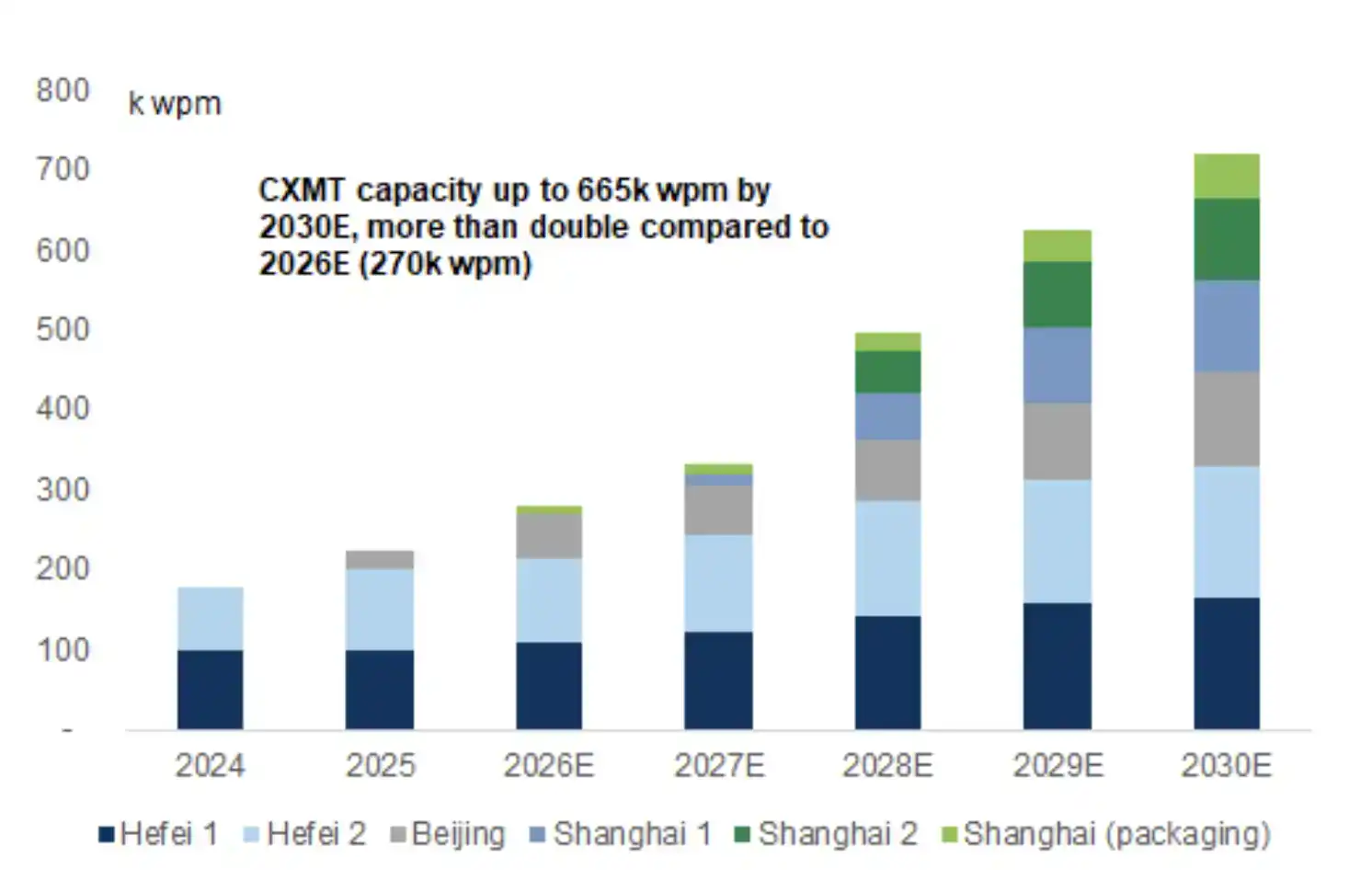
Goldman expects CXMT’s monthly wafer capacity to increase from 270,000 wafers in 2026 to 447,000 in 2028, then to 665,000 by 2030. That is more than double the 2026 level.
The bank ties that forecast to heavier capital spending. It expects average annual capex from 2026 to 2030 to reach CNY84 billion, above about CNY50 billion over 2022 to 2025. On a narrower comparison, average annual capex for 2024 to 2025 was about CNY60 billion.
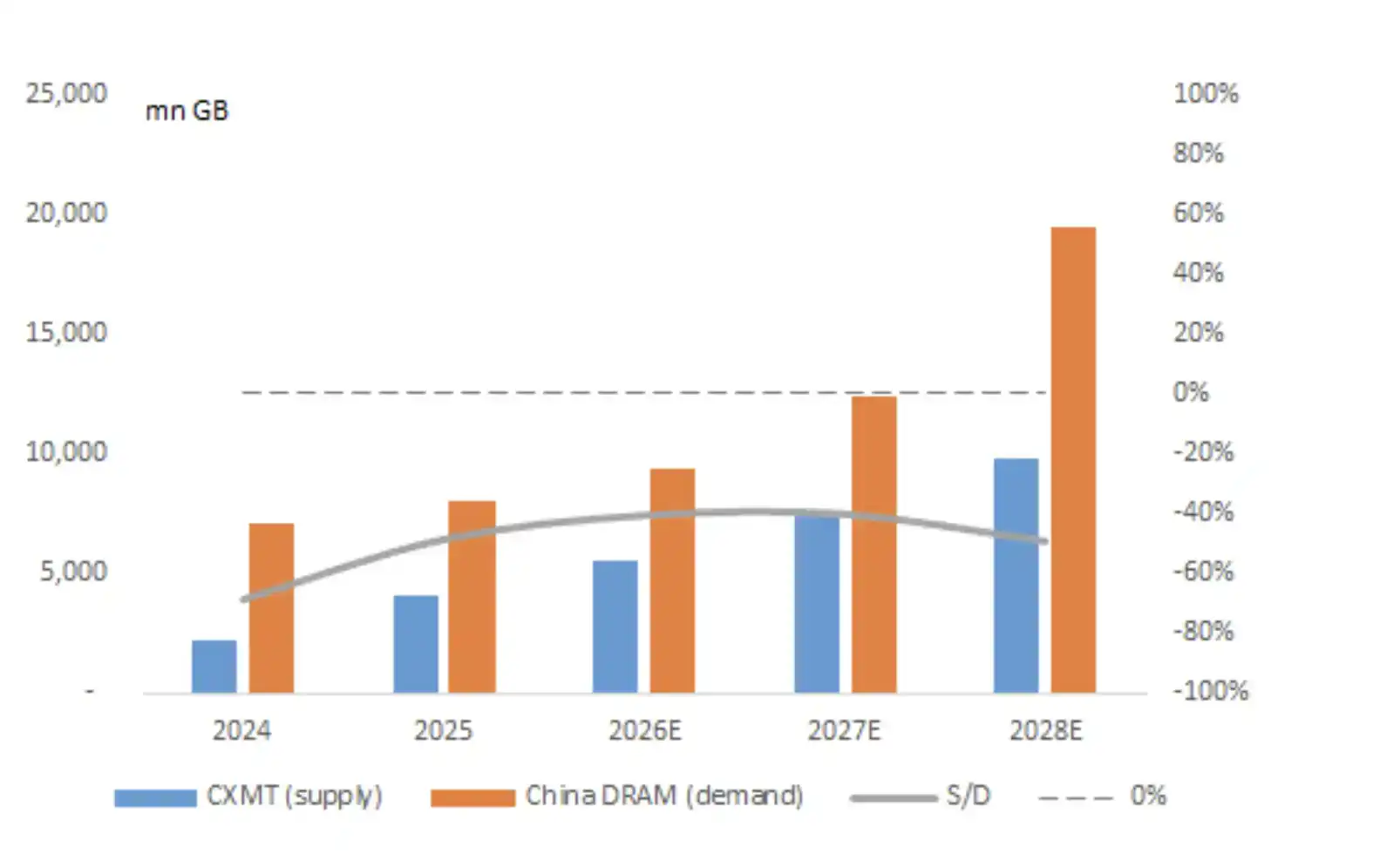
With capacity expansion, better yields and product-spec upgrades all moving higher, Goldman estimates CXMT’s total DRAM supply will grow at a 34% compound annual rate between 2026 and 2030, reaching 9.837 billion GB by 2030.
By 2028, Goldman expects CXMT’s conventional DRAM supply to reach 41% of Samsung’s and 50% of SK hynix’s supply for the same period, up from 28% and 35% in 2025.
One of the strongest calls in the report is that CXMT’s supply could cover about 50% of China’s DRAM demand by 2028. Goldman noted that this is a forecast of future supply capacity, not a statement that the company already holds half of the domestic market.
AI demand and supply reallocation form the demand backdrop
Goldman forecasts China’s DRAM market will grow at a 50% compound annual rate from 2026 to 2028, reaching $257 billion by 2028. It attributes that growth mainly to AI server shipments and stronger demand for server DRAM and HBM, while smartphones, PCs, networking equipment and automobiles remain part of the base demand mix.
On the supply side, the report says major global memory makers including Samsung, SK hynix and Micron are shifting more resources toward HBM and other AI-related products. That, in Goldman’s view, squeezes conventional DRAM supply. In an environment of higher prices and limited supply, consumer-electronics makers may also have greater incentive to qualify new suppliers to reduce single-source risk.
Goldman wrote that even though CXMT’s process node still trails leading global vendors by several generations, U.S. and other overseas customers may still qualify its mobile DRAM and conventional DRAM products, particularly for smartphones and PCs.
That leaves CXMT with two lines of expansion in Goldman’s framework: meeting China’s domestic DRAM demand and local substitution needs on one side, while filling part of the conventional DRAM gap left by global producers redirecting capacity toward HBM on the other.
The bank also flagged a limit to that view. Willingness to validate products does not guarantee large-scale orders. Overseas customer adoption, it said, is still subject to geopolitics and trade restrictions, and that remains one of the report’s main risks.
HBM is the key to margin expansion in Goldman’s model
Conventional DRAM provides the volume base in Goldman’s view. HBM determines whether CXMT can move into the higher-value part of AI memory.
The report describes HBM as a vertically stacked multi-layer DRAM product that gives AI accelerators higher bandwidth, larger capacity and better power efficiency. Compared with ordinary memory, HBM manufacturing involves front-end DRAM die production, high-precision through-silicon vias, advanced-node logic wafers, thermal management and reliability control. The technical and supply-chain barriers are much higher.
Goldman expects CXMT’s HBM products to start contributing revenue in the fourth quarter of 2026. It forecasts HBM’s share of revenue will rise from 2% in 2026 to 27% in 2030. HBM supply is projected to grow at a 207% compound annual rate from 2026 to 2028, reaching 1.179 billion GB in 2028.
At the same time, Goldman identified HBM as the most uncertain part of the whole model. It said CXMT’s HBM technology is still at an early stage and is not expected to enter U.S. customer supply chains in the near term. By contrast, overseas customers appear more willing to validate the company’s mobile DRAM and conventional DRAM products.
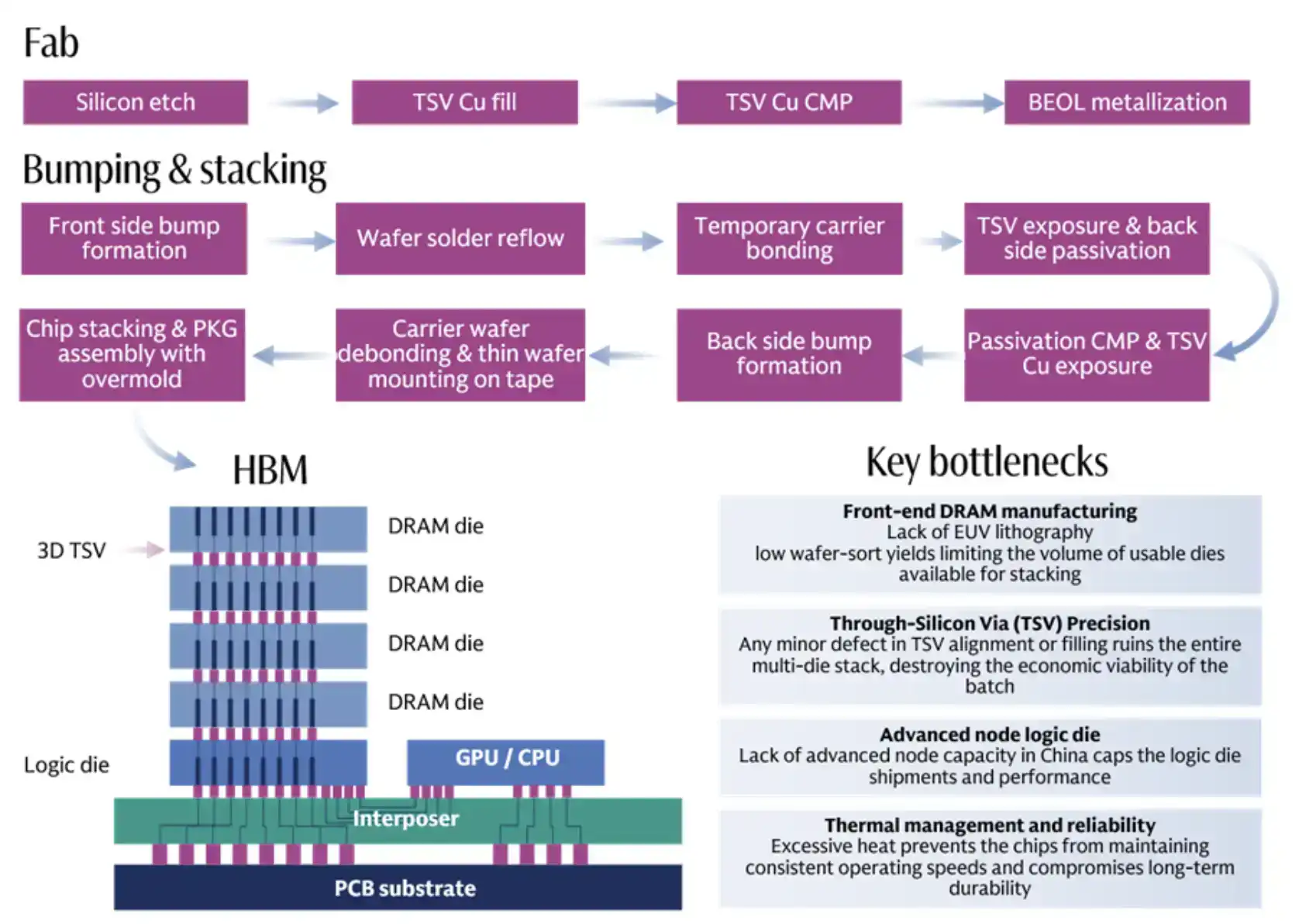
In practical terms, Goldman’s view is that CXMT may be able to scale conventional DRAM supply relatively quickly through expansion, but entry into the higher-value HBM market still depends on manufacturing progress, local packaging ecosystem support, advanced logic wafers, thermal reliability and customer certification.
How Goldman arrives at the CNY129 target
Goldman expects CXMT’s net profit to grow at a 47% compound annual rate from 2026 to 2030. Over the same period, conventional DRAM revenue is forecast to grow at a 34% compound annual rate, while HBM revenue is projected to rise at a 166% compound annual rate.
The CNY129 target is not derived by simply applying a 24x multiple to 2027 earnings. Goldman said it first assigns CXMT a target 2030 P/E of 16.6x based on the relationship between peer valuations and earnings growth, then discounts that back to 2027 using a 12.7% cost of equity. That process produces the CNY129 target, which implies about 24x forecast 2027 earnings.
Goldman listed three main factors behind the valuation case. The first is China’s AI infrastructure expansion, which supports demand for server DRAM and HBM. The second is that conventional DRAM supply globally is being constrained as HBM expansion absorbs resources, pushing consumer-electronics customers to diversify suppliers more actively. The third is CXMT’s scarcity value as a scaled Chinese DRAM producer, which Goldman believes supports a domestic semiconductor valuation premium.
The more aggressive part of the case lies in margin assumptions. Goldman projects that with DRAM prices staying high, shipment volumes rising, and product mix shifting toward DDR5, LPDDR6 and HBM, CXMT’s gross margin can climb from 41% in 2025 to 82% in 2030. Over the same period, operating expense ratio is forecast to fall from 27.4% to 7.9%.
That means the CNY129 target requires more than just shipment growth. New fab capacity has to come online on schedule, additional output has to turn into shipments, the DRAM upcycle has to last, HBM has to take a larger share of revenue, and those changes have to translate into a much stronger profit profile.
Main risks remain competition, pricing and customer access
Goldman said memory remains a cyclical business. When demand is strong, capacity expansion can lift both revenue and profit. If new capacity is released in concentration, though, a reversal in supply-demand balance can quickly pressure pricing and earnings.
For CXMT, the report points to three major risks. First, Samsung, SK hynix and Micron are still expanding DRAM capacity and developing next-generation products, and stronger-than-expected competition could weigh on CXMT’s shipments and profit. Second, Goldman’s margin model depends on DRAM demand and prices staying firm; if AI or consumer-electronics demand comes in below expectations, both shipment volume and gross margin could face pressure. Third, geopolitical conditions may limit CXMT’s ability to enter global customer supply chains, reducing overseas growth room.
In Goldman’s framing, the CNY129 target is not a statement of results already achieved. It is a concentrated bet that capacity expansion, a strong memory cycle, domestic substitution and HBM upgrades can all materialize at the same time.