
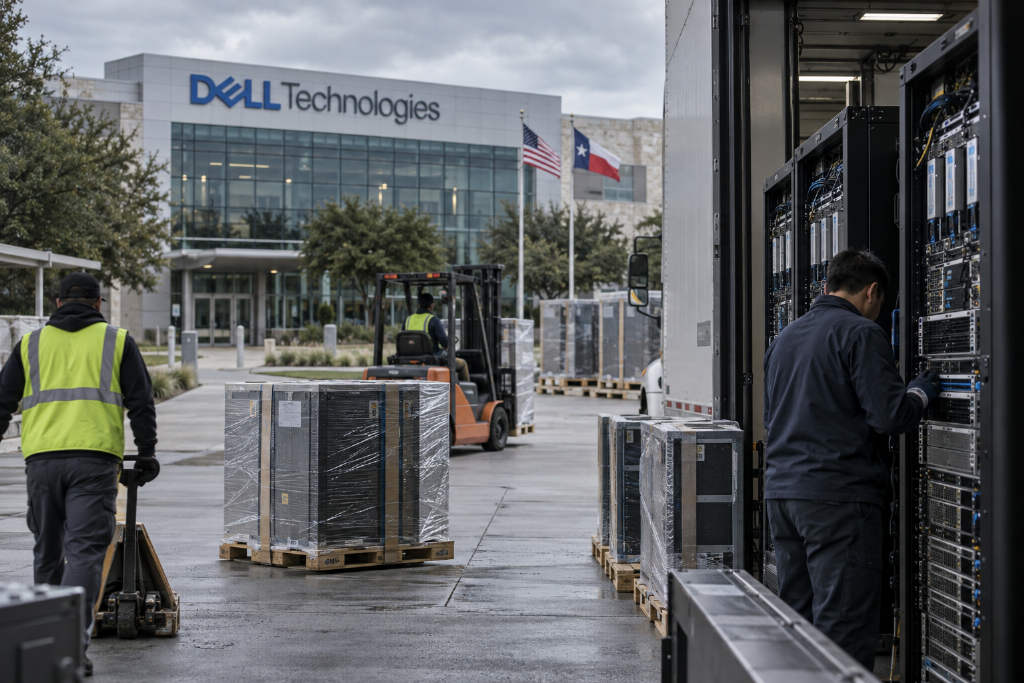
Goldman Sachs said in a report dated Oct. 8, 2026 that Dell can deliver AI servers about four to six weeks faster than competitors, allowing customers to monetize infrastructure earlier. The bank said that speed advantage supports Dell’s premium pricing relative to OEM and ODM peers.
Goldman maintained its Buy rating on Dell with a $570 price target, versus a current share price of $574.55 cited in the report. The note was based on an investor field visit to Dell’s headquarters in Round Rock. Management participants included Chief Financial Officer David Kennedy and Infrastructure Solutions Group President Arthur Lewis. Goldman said the central issue is whether Dell’s competitive moat can extend from component access into design, supply chain management, manufacturing and deployment, and whether that can sustain demand for AI servers.
Differentiation goes beyond component access
Dell management pushed back on the idea that AI infrastructure is becoming commoditized. Goldman wrote that AI deployments often involve dozens of design iterations, and said Dell has differentiated capabilities in four areas: system design, supply chain sourcing, manufacturing and deployment.
Dell said it uses its scale to secure components, completes L11 and L12 integration testing before systems leave the factory, and deploys large clusters more efficiently than peers. Goldman said customers using Dell’s offering can begin production and generate revenue roughly four to six weeks earlier, which underpins premium pricing.
The report also described a strict order-validation process. For new cloud customers, Dell reviews end-customer contracts and financing arrangements. Dell Financial Services is used mainly as a short-term bridge between shipment and deployment, and not as a source of long-term financing for new cloud customers.
Memory seen as the key bottleneck in 2027
Goldman said supply remains the main bottleneck for AI infrastructure growth. Dell expects tightness in the memory market to continue into next year. The company said memory supply should increase through yield improvements, but demand growth is still running ahead of supply growth, making the 2027 environment tighter.
Dell pointed to two company-level advantages. First, its direct sales team gives it early visibility into changes in customer demand, helping it shift memory allocation away from weaker end markets such as PCs and toward AI and server opportunities. Second, Dell’s scale and forecasting accuracy make it a preferred partner for component suppliers.
Goldman added that Dell’s recently announced long-term agreements are focused on securing supply and do not lock in component prices. Pricing continues to reset quarterly. The report said the AI supply chain is broadly constrained across memory, storage, CPUs and other components, increasing the value of procurement scale.
Storage and operating leverage are the main margin drivers
Goldman said the main drivers of future margin expansion are storage and operating leverage. AI server margins remain in the mid-single-digit range, and Dell said that represents a reasonable balance between profitability and competitive positioning.

Dell has not tried to expand server margins aggressively. Instead, it continues to pass through component cost swings, especially in memory pricing, to avoid hurting demand elasticity. Goldman said the more important margin opportunity comes from higher attach rates for Dell’s own IP-based storage products.
Management highlighted strong momentum in unstructured data storage, including PowerScale, object storage, Project Lightning and data platform capabilities. Goldman said AI server revenue requires relatively little incremental operating expense, and scale benefits across ISG continue to support earnings growth.
Enterprise AI adoption is still early
Goldman said enterprise AI adoption remains in its early stages, with infrastructure representing only one part of a broader transformation. Dell said successful AI deployment requires not only compute infrastructure, but also data preparation and business-process redesign.
Dell expects most enterprise environments to move toward hybrid architectures that combine frontier models in the cloud with on-premise open-weight models. The company said that approach can lower total cost of ownership while preserving control over data and security. Adoption is still concentrated among technically mature users such as financial institutions, though Dell expects broader enterprise uptake to accelerate as organizations complete the required transformation work.
Dell also described itself as “customer zero,” using agentic AI in ISG software development and internal operations as experience it can share with customers.
What Goldman is watching
In Goldman’s framework, the first test of Dell’s ability to defend premium pricing will be memory supply in 2027. Delivery speed, order quality and storage attach rates will also need to hold up for the bank’s Buy thesis to remain intact.
This article is a整理 and interpretation of a third-party brokerage research report from Goldman Sachs dated Oct. 8, 2026, combined with public market information. Any ratings, price targets, earnings forecasts and related judgments cited here are the views of the brokerage analysts and represent the position of their institution only. They do not constitute investment advice.
Markets carry risk, and investment decisions should be made independently. This article should not be used as a basis for buying or selling any security.