
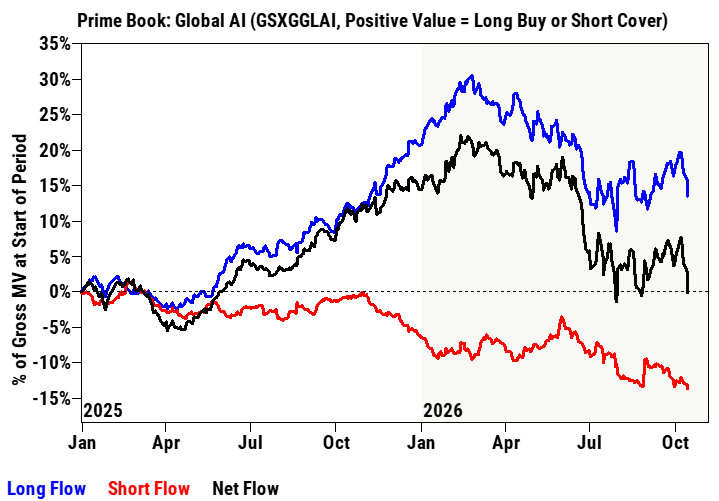
Hedge funds were net sellers of global AI stocks for five consecutive trading days from Oct. 8 to Oct. 14, fully reversing all cumulative net buying built up since the start of 2025, according to a recent report from Goldman Sachs Prime head Vincent Lin. In Goldman’s framing, nearly two years of net buying was erased within a week.
At the same time, Goldman’s prime brokerage book showed heavy net selling across global equities. One-day net selling reached -2.1 standard deviations on a one-year lookback. North America and emerging Asia led the declines, with South Korea and Taiwan seeing the most concentrated selling.
Five trading days erased a multi-quarter build-up
Goldman Prime data showed the latest AI stock sell-off was second only to the slump seen in July this year in the bank’s historical records. Net selling in global AI stocks, defined here as constituents of GSXGGLAI, ranked as the second largest over the past year. The ratio of long selling to short selling was about 3.5 to 1, indicating that the move was driven mainly by long holders cutting exposure rather than short sellers pressing bets further.
Flow data showed hedge fund net flows into the AI basket falling back to the starting point seen in early 2025. Long flows have retreated steadily from the peak reached around February to March this year, while short flows stayed near the low area of roughly -13% through the period. Goldman’s chart described a full round trip: the entire net-buying cycle across 2025 to 2026 was reversed in one week, while shorts kept adding during the decline.
Just last week, Goldman said hedge funds’ net exposure to the Mag7 in its prime book accounted for nearly 22% of total U.S. exposure, the highest level on record. Five days later, those same funds were rushing for the exit.
South Korea and Taiwan were hit hardest
The direct impact of the sell-off has already shown up in several markets. South Korea’s benchmark index fell into a bear market, and Seoul triggered a circuit breaker. Taiwan recorded a historic one-day foreign net outflow of about $9.3 billion. Several Asian central banks were also forced to intervene in currency markets.
TMT directional long-short funds lost 2.7% in a single day, a move equivalent to -2.6 standard deviations. Their losses for October widened to 4.5%.
Positioning looks cleaner on a one-year view, not on a three-year one
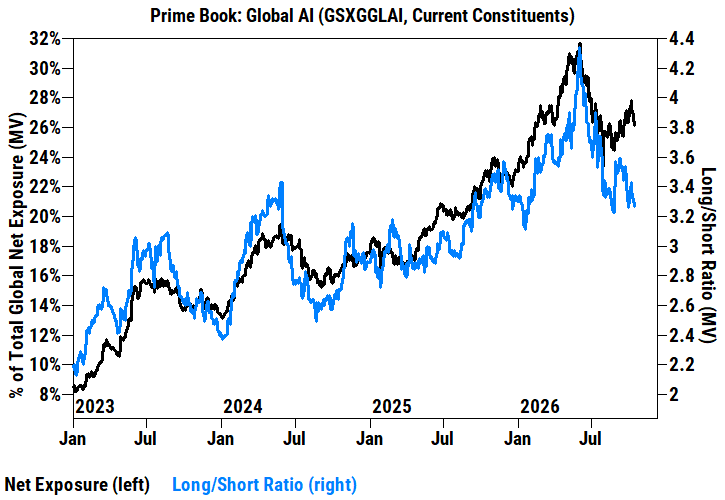
Even after this week’s heavy selling, AI positioning still looks elevated on a longer horizon. Goldman data showed global AI net exposure at 26.1% of global single-stock net market value, down from the early-June peak of 31.7%. That places the position in the 49th percentile over the past year, but still in the 83rd percentile over the past three years.
The long-short ratio in AI portfolios has fallen to 3.27 from a June peak of 4.34. On a one-year basis, that sits in the 7th percentile. On a three-year basis, it remains in the 64th percentile.
Rachel Hu from Goldman’s Asia team said trading feedback from Taiwan showed the degree of capitulation in the current sell-off was weaker than in July, a sign that more selling pressure may still be ahead.
JPMorgan’s market intelligence division has its TPM positioning indicator at about the 46th percentile, a neutral range and well above the 19th percentile low reached in late July. As presented in the report, that suggests there is still room for further deleveraging before major technology catalysts arrive.
Defensive rotation spread beyond AI
The shift was not confined to AI. Goldman’s prime brokerage book showed a broader defensive rotation across equities. Eight of the 11 U.S. sectors saw net selling, led by information technology and industrials. Within technology, software, semiconductors and semiconductor equipment, and IT services all posted net selling.
Buying, by contrast, was concentrated in healthcare and consumer staples. Goldman described this as a marginal increase in defensive positioning. In Thursday morning trading, both healthcare and consumer staples rose more than 2%, helping support the Dow, while the Nasdaq slid toward a one-month low. CoreWeave fell another 8.5%. The Philadelphia Semiconductor Index dropped for a seventh straight day, wiping out about $2 trillion in related market value.
While discretionary human-led strategies were under pressure, quant funds stood out as the only clear winners in the report. Global systematic long-short funds gained 0.5% on the day, were up 1.9% for October, and led all strategies with a year-to-date return of 21.7%.
Leverage remains the fragile part of the setup
Goldman’s prime book showed gross leverage edged down by only 0.4 percentage points to 310.3%. That still sits in the 72nd, 91st, and 94th percentiles on one-year, three-year, and five-year views, respectively, close to a five-year high. Net leverage fell 1.5 percentage points to 73.3%. For October, the cumulative decline was 4.3 percentage points, placing it in the 6th percentile over the past year.
Goldman’s point is that a fund running 310% gross leverage and 73% net leverage has far more sellable exposure than the net number alone would suggest. When crowded longs and crowded shorts move against positions at the same time, deleveraging becomes the main path, and the exit is narrow. The report compared this setup to the late-July sell-off.
Rich Privorotsky from Goldman’s Delta-One business wrote in an overnight report: “In hindsight, the pain trade was long AI and short bonds. Now we are seeing both sides being unwound at once ... the market is discovering that compute demand can grow exponentially, but the capital available to finance it cannot.”
Goldman’s overall read is cautious
The central market debate is whether this is a dip-buying opportunity or the opening stage of a broader deleveraging cycle.
The report said JPMorgan leans toward the former and sees room to buy on weakness. Goldman’s flow trading desk had also been watching constructive year-end technical signals over the previous two days. Even so, Goldman’s broader conclusion was more cautious. AI net exposure still sits in the 83rd percentile on a three-year view, gross leverage is in the 94th percentile on a five-year basis, and foreign outflows from Asia have reached record levels. Taken together, those signals point to a deleveraging move that looks closer to the start than the finish.
Hedge funds have sold all of the AI positions they accumulated since 2025, but the report said positions built in 2023 and 2024 are still fully sitting on the books.