
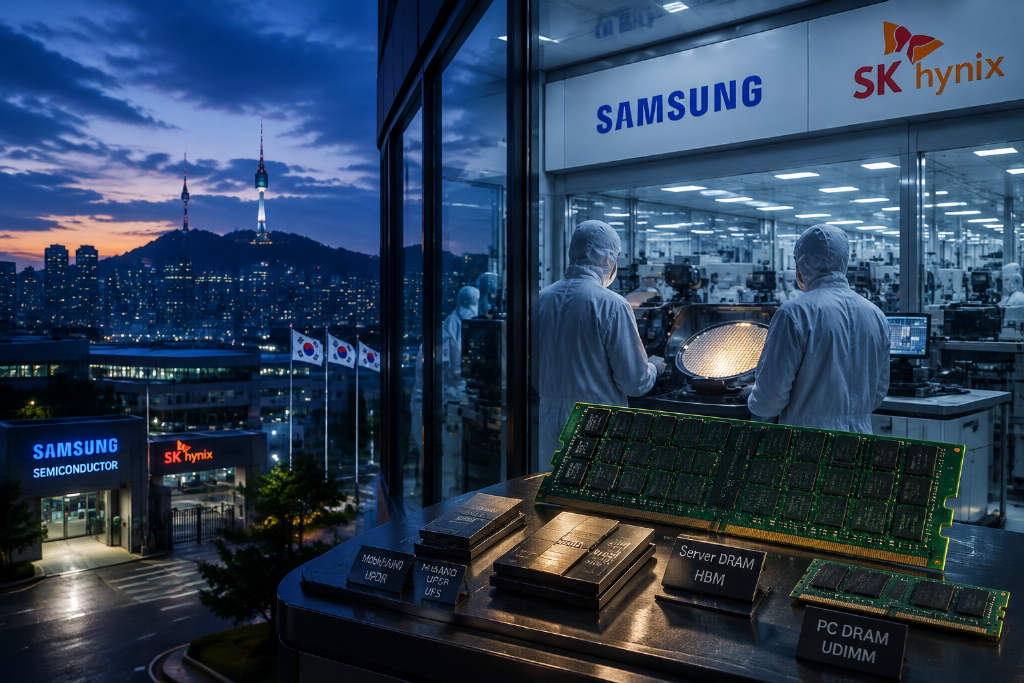
Goldman Sachs said in an Aug. 31 memory price tracking report that memory prices continued to climb in the third quarter, but the trend has split across product lines. TrendForce raised its 3Q26 forecast for PC DRAM price gains to 18%-23%, kept server DRAM at 13%-18%, cut mobile DRAM to 8%-13%, and projected NAND at about 20%, which Goldman said was broadly in line with its own view.
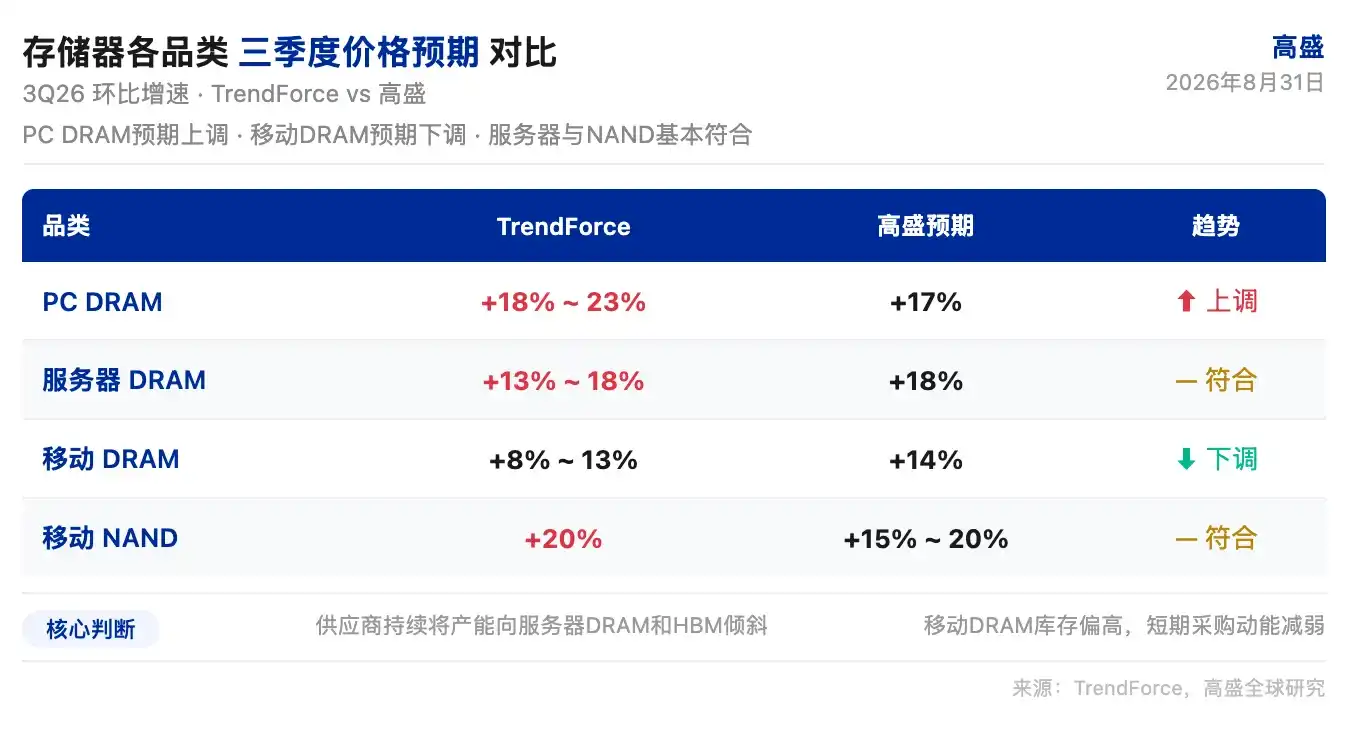
According to the report, the shared driver behind the price increases is that suppliers are still reallocating capacity toward server DRAM and HBM, leaving less supply for other categories. Goldman maintained buy ratings on Samsung Electronics and SK Hynix.
PC DRAM forecast revised higher as DDR5 discount stays at 6%
TrendForce lifted its 3Q26 PC DRAM price increase forecast from 15%-20% to 18%-23%, slightly above Goldman’s own estimate of 17% quarter over quarter.
August spot market data showed DDR4 8GB and DDR5 8GB prices each rose 2%, reaching $142 and $133, respectively. DDR5 remained at a 6% discount to DDR4, unchanged from July.
Goldman said the higher PC DRAM outlook reflects resilient downstream demand. PC end-market growth remains moderate, while AI PCs are driving a structural increase in memory capacity per device. The bank expects that pattern to continue into the fourth quarter.
Server DRAM stays firm and DDR5 premium widens
Server DRAM remained the firmest category in the third quarter. TrendForce kept its quarter-over-quarter growth forecast at 13%-18%, largely matching Goldman’s 18% estimate.
August spot pricing supported that view. DDR4 64GB modules were flat at $1,295, while DDR5 64GB modules rose 1% to $1,500. The DDR5 premium over DDR4 widened from 15% in July to 16%.
Goldman said demand from AI servers for high-bandwidth, high-capacity memory continues to support DDR5 pricing. At the same time, HBM output is still taking up DRAM fab capacity, and tight supply in server DDR5 is unlikely to ease in the near term.
Mobile DRAM outlook cut as inventory weighs on near-term demand
Mobile DRAM was the only category to see a lower forecast for the third quarter. TrendForce cut its 3Q26 mobile DRAM price increase forecast to 8%-13%, slightly below Goldman’s 14% quarter-over-quarter estimate, and said 4Q26 could slow further to 0%-5%.
TrendForce attributed the softer demand to elevated customer inventory. After stockpiling over the past few quarters, smartphone makers now hold relatively high DRAM inventories, reducing short-term purchasing momentum.
Still, TrendForce remained constructive on 2027 pricing, saying suppliers will keep prioritizing capacity for server DRAM and HBM, limiting supply growth in mobile DRAM. Goldman also said the current weakness in mobile DRAM is a timing issue rather than a reversal in trend, and that pricing in 2027 should still be supported by the supply side.
NAND pricing largely matches expectations
Mobile NAND is expected to rise 20% quarter over quarter in the third quarter, broadly matching Goldman’s 15%-20% forecast for NAND overall. Contract prices for eMMC/UFS 256GB in 3Q26 have already increased by about 20%.
Goldman said NAND supply and demand dynamics resemble those in DRAM. Suppliers are also steering capacity toward higher-value products, which limits supply growth for mobile NAND. The bank added that NAND demand is more elastic than DRAM, so swings in consumer electronics demand will have a more direct effect on prices. Goldman expects NAND price gains to narrow in the fourth quarter.
Goldman keeps buy ratings on Samsung Electronics and SK Hynix
Goldman said the fundamental backdrop for memory price increases has not changed, and suppliers’ capacity allocation remains the decisive factor. It described the short-term inventory adjustment in mobile DRAM as a pacing issue rather than a shift in demand trend. In Goldman’s view, Samsung Electronics and SK Hynix, as global memory leaders, remain the main beneficiaries of that trend.
The original article said the piece was a整理与解读 of a third-party brokerage report from Goldman Sachs dated Aug. 31, 2026, combined with public market information. It also noted that all ratings, target prices, earnings forecasts, and related judgments cited in the text are the views of the brokerage analyst and represent only the position of that institution, not Chaoxiang Research, and do not constitute investment advice.
The original article also stated that markets carry risk, decisions should be made independently, and the piece should not be used as a basis for buying or selling any securities.