
Goldman Sachs, in its latest report, framed Robinhood’s prediction-market business as a key variable in the company’s valuation and focused much of its analysis on Rothera, a prediction-market exchange owned 45% by Robinhood, 45% by Susquehanna International Group (SIG), and 10% by MIAX. Because Robinhood controls the business, it consolidates all of Rothera’s revenue and expenses into its financial statements, then allocates 55% of net profit to other shareholders through non-controlling interests.
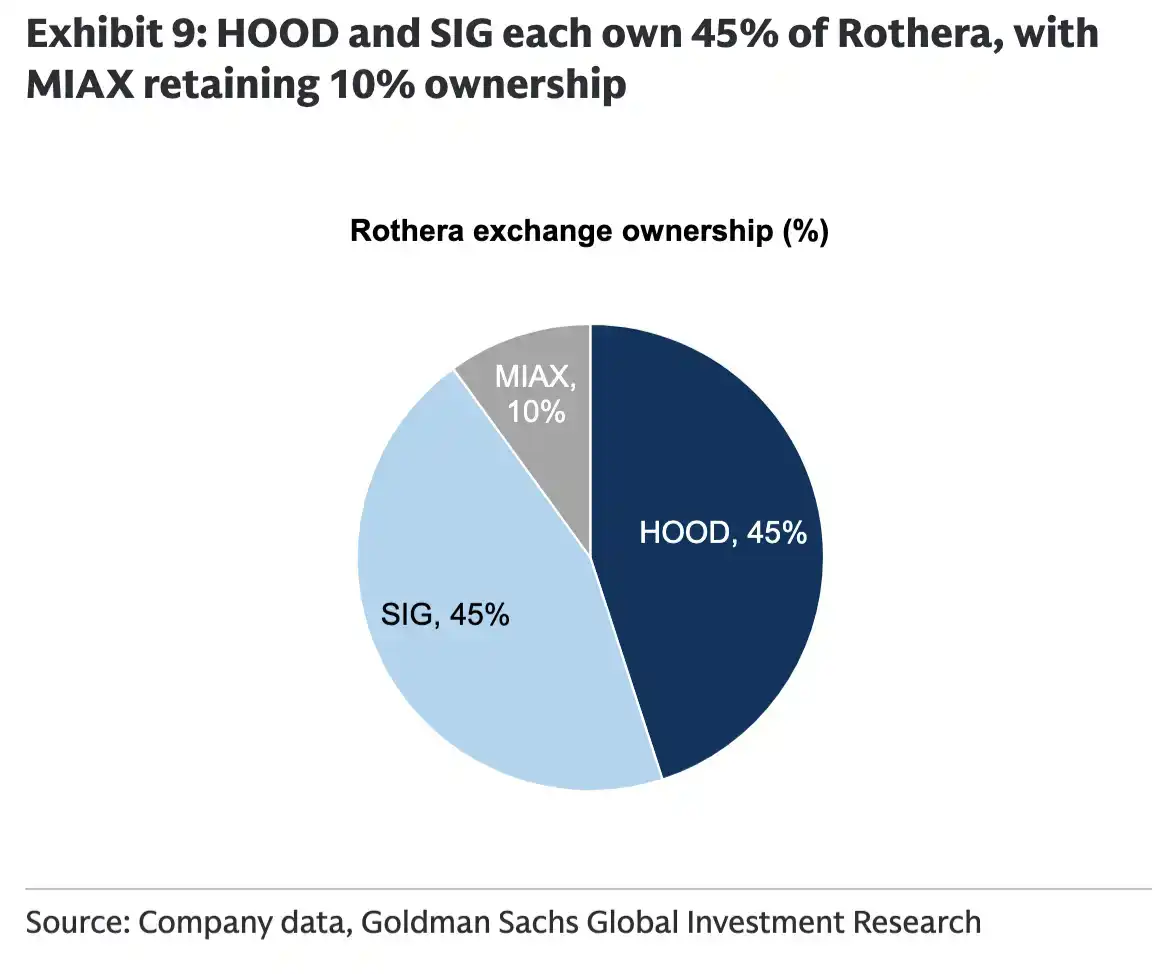
That accounting structure matters. Rothera’s revenue shows up in full on Robinhood’s top line, but only 45% of the exchange’s net profit is attributable to Robinhood shareholders.
Rothera reached the global top five within months of launch
Goldman says Robinhood is moving prediction markets beyond a fast-growing brokerage product and toward a trading infrastructure stack in which the company has direct control.
Rothera launched in late May 2026 and scaled quickly. Goldman estimates the exchange generated about $17 million in revenue in its first 41 days of operation, which translates to around $150 million in annualized revenue. The bank also puts pre-tax margin at 45%.
Trading volumes show the same early acceleration. Rothera handled about 2 million contracts in May 2026, then jumped to 2.09 billion in June, 1.688 billion in July, and 593 million in August.
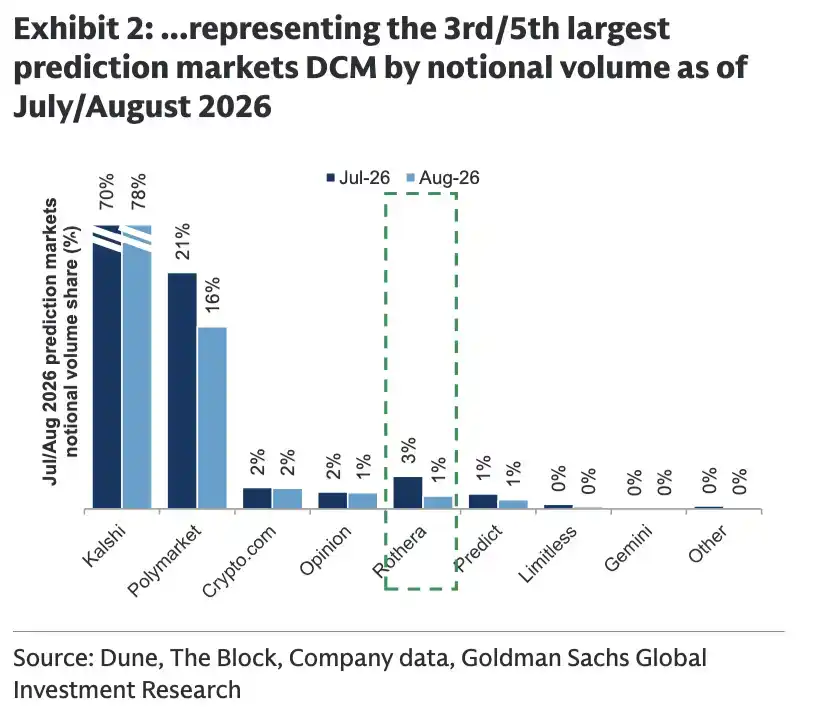
By notional trading volume, Rothera ranked as the world’s third-largest designated contract market in July 2026 and fifth in August, according to Goldman. The bank grouped it with Kalshi, Polymarket, Crypto.com, and Opinion among the leading platforms.
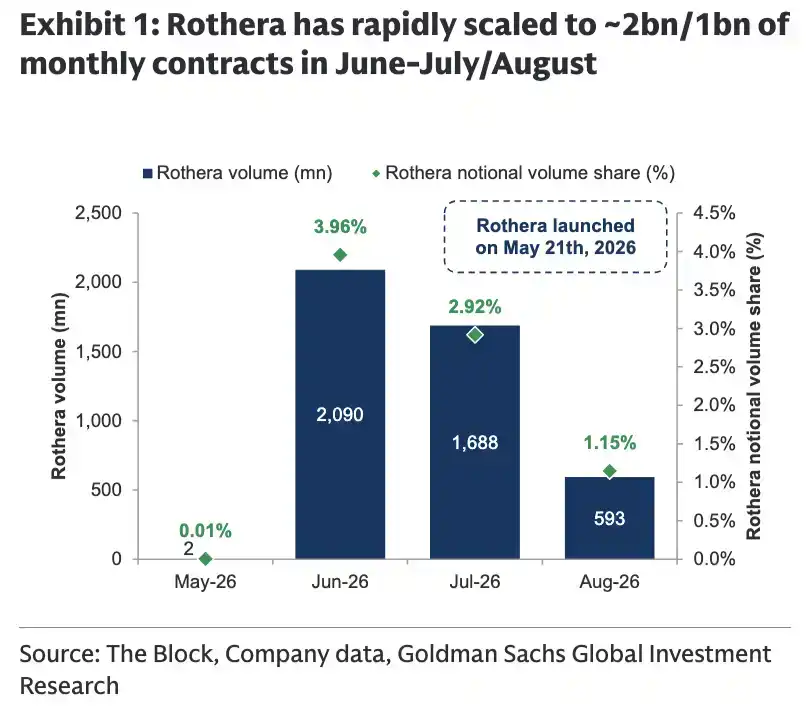
Goldman also says the platform is still in an early expansion phase. Its notional volume share fell from about 3% in July to about 1% in August, and both volume and ranking remain sensitive to sports calendars, headline events, and market cycles. A top-five position in the short term, the report says, shows Robinhood’s traffic-conversion strength, but does not yet prove that Rothera has secured a stable place in the market.
Product mix remains narrow. Rothera initially offered almost entirely sports-event contracts, and only started adding political and economic products in August 2026. Those two newer categories accounted for about 1% of volume each that month. Goldman’s read is that activity is still highly dependent on sports, while product diversification has only just begun.
Robinhood is trying to capture both brokerage and exchange economics
Before Rothera went live, Robinhood offered prediction-market access mainly as a futures commission merchant, or FCM, routing customer orders to designated contract markets such as Kalshi and ForecastEx. Robinhood collected brokerage fees, while outside exchanges collected matching and clearing fees.
With Rothera online, Robinhood can participate in both layers of the transaction chain. Part of the economics that previously went to outside venues can now remain inside its own ecosystem. Goldman argues that this changes the role of prediction markets inside Robinhood: the product is no longer only a retail trading feature, but also an entry point into exchange infrastructure.
Goldman ties the exchange’s edge to liquidity and lower fees
Liquidity is central to the prediction-market business, Goldman says. Unlike equities, prediction markets involve a large number of contracts across themes, outcomes, and expiries, making order flow easier to fragment. If there are not enough buyers and sellers, spreads widen and the trading experience weakens.
Goldman points to two liquidity sources that it sees as hard to replicate. The first is Robinhood’s retail base. At the time of the report, Robinhood had about 14 million monthly active users. As more prediction-market orders are routed to Rothera, that user base can keep supplying retail flow.
The second is SIG’s market-making capability. SIG is a large global market maker and also owns 45% of Rothera, giving it an incentive to keep posting quotes and supporting liquidity on the venue. In Goldman’s view, Robinhood supplies the retail order flow while SIG helps absorb and match liquidity, forming the backbone of the exchange’s early growth.
Pricing is the other part of the story. Goldman estimates that most event contracts on Rothera trade in the $0.25-$0.30 range, or in the symmetric $0.70-$0.75 range. Under its dynamic fee model, the average exchange-level fee for retail takers is about 0.38%-0.42% per $1 of notional contract value, well below the roughly 1.17%-1.31% charged by other major prediction-market exchanges.
Rothera does not use a flat fee schedule. Fees vary with contract price and trader type. The closer a contract is to $0 or $1, the lower the trading fee; the closer it is to $0.50, the higher the fee. Professional trading firms and market makers also pay more than ordinary retail users.
Goldman says that structure is designed to lower participation costs for retail traders while charging more to professional firms to help support liquidity on the platform.
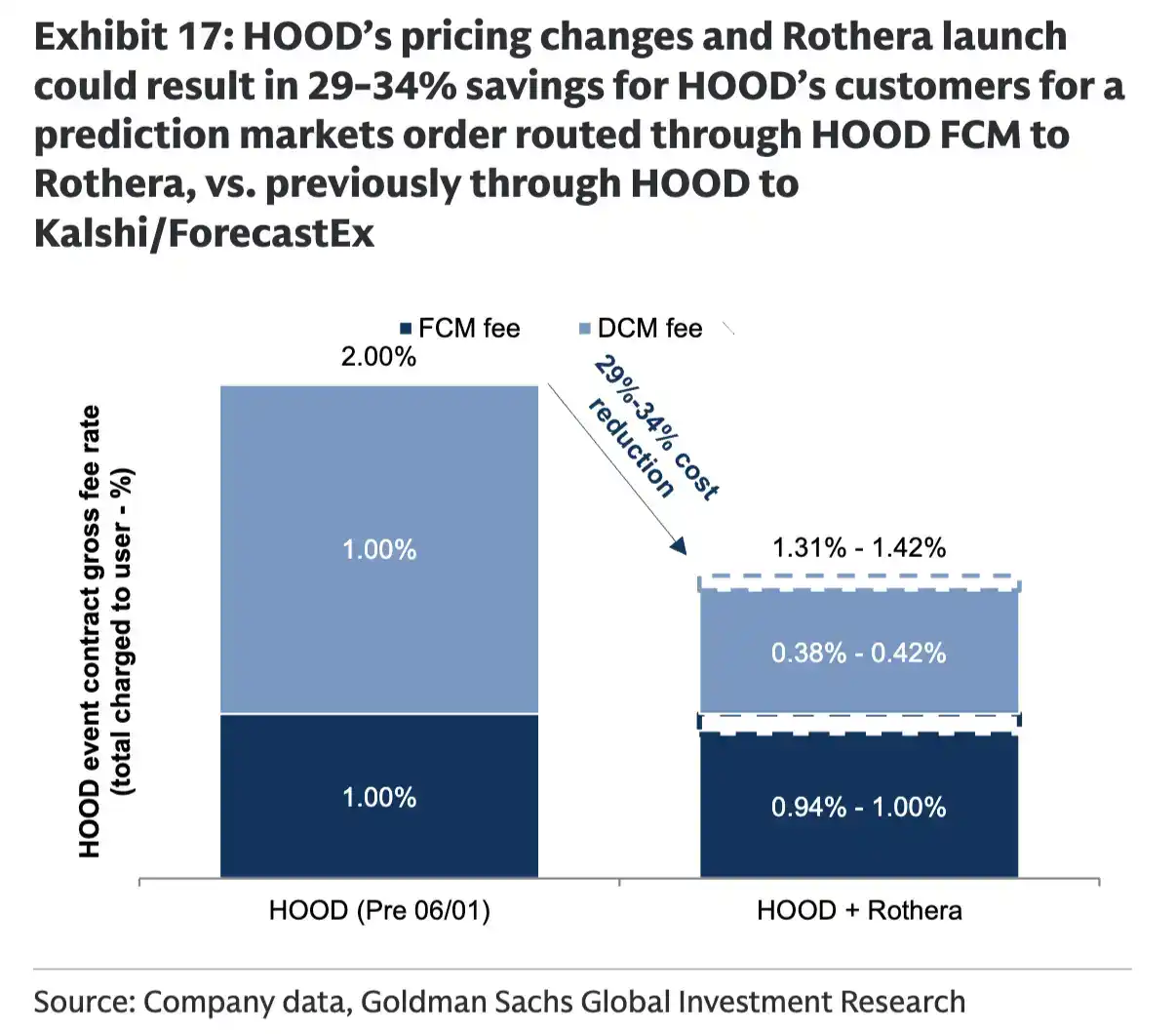
Robinhood also changed its customer pricing after the launch of Rothera. Customers previously paid a fixed all-in fee of about 2%. After the shift to variable pricing and partial order routing to Rothera, Goldman estimates the average all-in fee paid by customers dropped to 1.31%-1.42%, implying savings of about 29%-34%.
For Robinhood, lower customer fees do not necessarily mean lower platform revenue. Because the company now earns both brokerage fees and exchange fees from Rothera, Goldman estimates Robinhood’s gross notional take rate, before non-controlling interests, may rise from about 1.25% to 1.31%-1.42%.
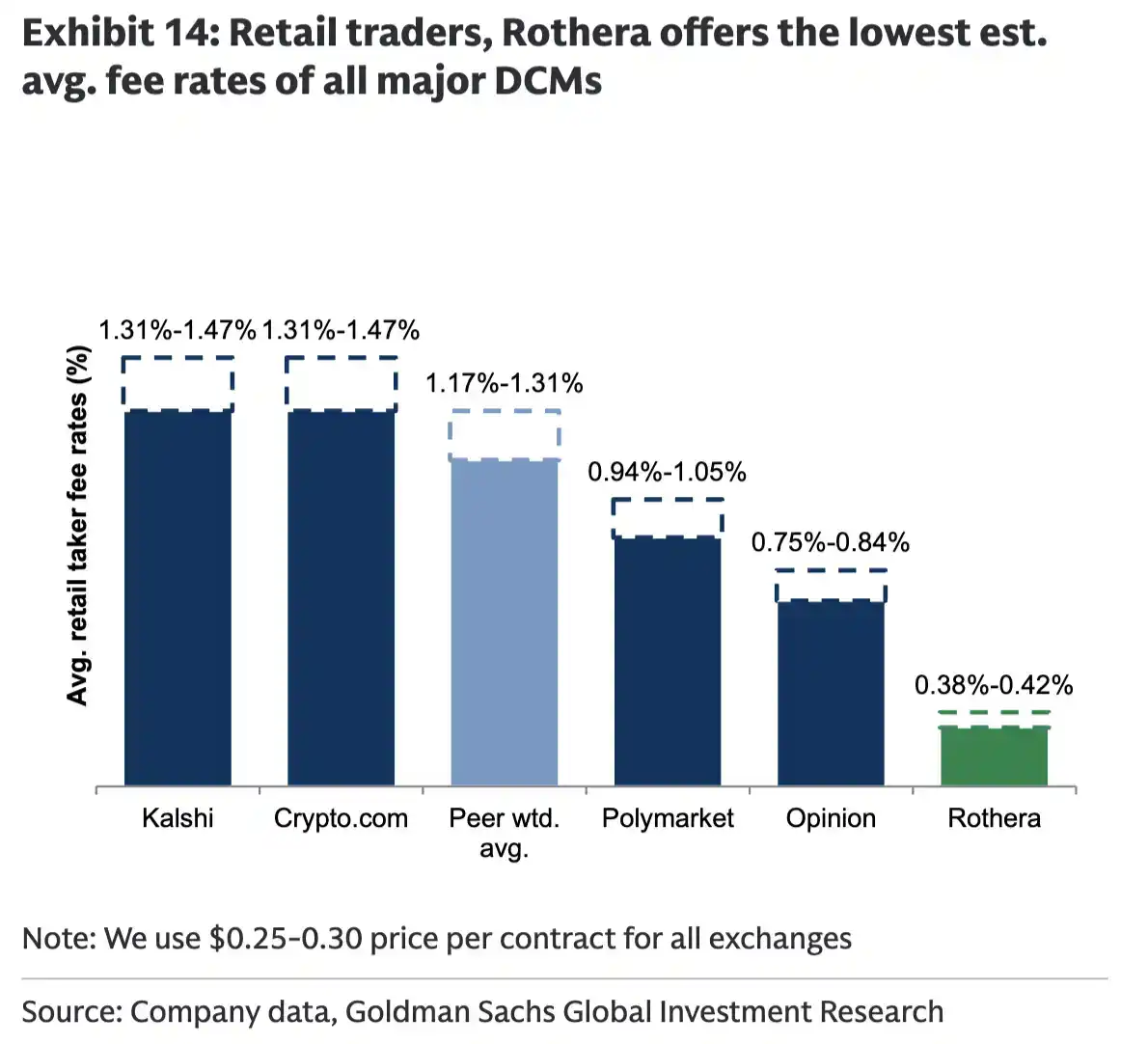
After accounting for the fact that only 45% of net profit belongs to Robinhood, Goldman estimates the company’s effective prediction-market take rate is about 1.11%-1.19%, slightly below the earlier level of about 1.25%. In other words, Goldman sees the value of this model in long-term scale rather than an immediate jump in effective monetization. The trade-off is lower customer costs, higher volume potential, and tighter control over the trading stack.
At present, Robinhood is the only FCM connected to Rothera. Goldman says that if lower fees attract other brokers, the exchange could pick up order flow from outside the Robinhood ecosystem and create a cycle of lower fees, more traffic, and deeper liquidity. Until that happens at scale, the venue remains heavily dependent on internal routing from Robinhood.
Goldman’s forecasts put prediction markets at the center of Robinhood’s growth case
Goldman projects Rothera’s revenue will rise from $87 million in 2026 to $307 million in 2027 and $444 million in 2028. That would account for 2%, 5%, and 6% of Robinhood’s total revenue in those years.
Net profit attributable to Robinhood from Rothera is projected at $14 million in 2026, $58 million in 2027, and $94 million in 2028. As early investment falls and revenue scales, Goldman expects fixed-cost leverage to improve. The report says margins could eventually move toward the roughly 55%-70% range seen at mature derivatives exchanges.
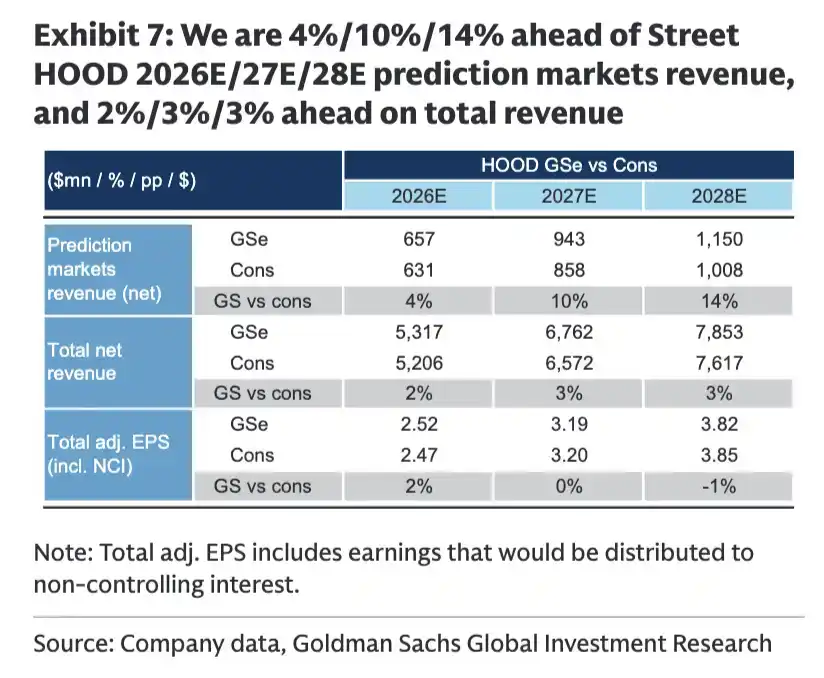
Rothera is only one piece of the broader prediction-market business. Robinhood also earns prediction-market revenue on the brokerage side. Goldman estimates total prediction-market net revenue at Robinhood will reach $657 million in 2026, $943 million in 2027, and $1.15 billion in 2028, equal to 12%, 14%, and 15% of total company revenue.
Within that mix, Rothera’s share of Robinhood’s prediction-market revenue is expected to rise from about 13% in 2026 to 33% in 2027 and 39% in 2028. Goldman’s point is that the exchange could move from a supplemental source of revenue to a major part of the segment.
This is also why Goldman’s forecasts sit above market consensus. The bank’s prediction-market revenue estimates for 2026 through 2028 are 4%, 10%, and 14% above consensus, while its total revenue estimates are 2%, 3%, and 3% higher.
Still, the higher revenue outlook does not fully carry through to earnings per share. Goldman says its adjusted EPS forecast for Robinhood in 2027 is broadly in line with consensus, while its 2028 estimate is about 1% below consensus. Non-controlling interest allocations, product investment, and cost structure continue to shape shareholder returns.
The report also says Rothera could eventually move into other exchange-traded products, with perpetual futures singled out as one possibility. Goldman describes that as more of an option value than a firm revenue line at this stage, since any launch would depend on regulatory approval, market demand, and execution.
Valuation ranges from $1 billion to $19.5 billion across scenarios
Goldman runs base, bull, and bear cases for Rothera’s 2027 revenue, profit, and equity value.
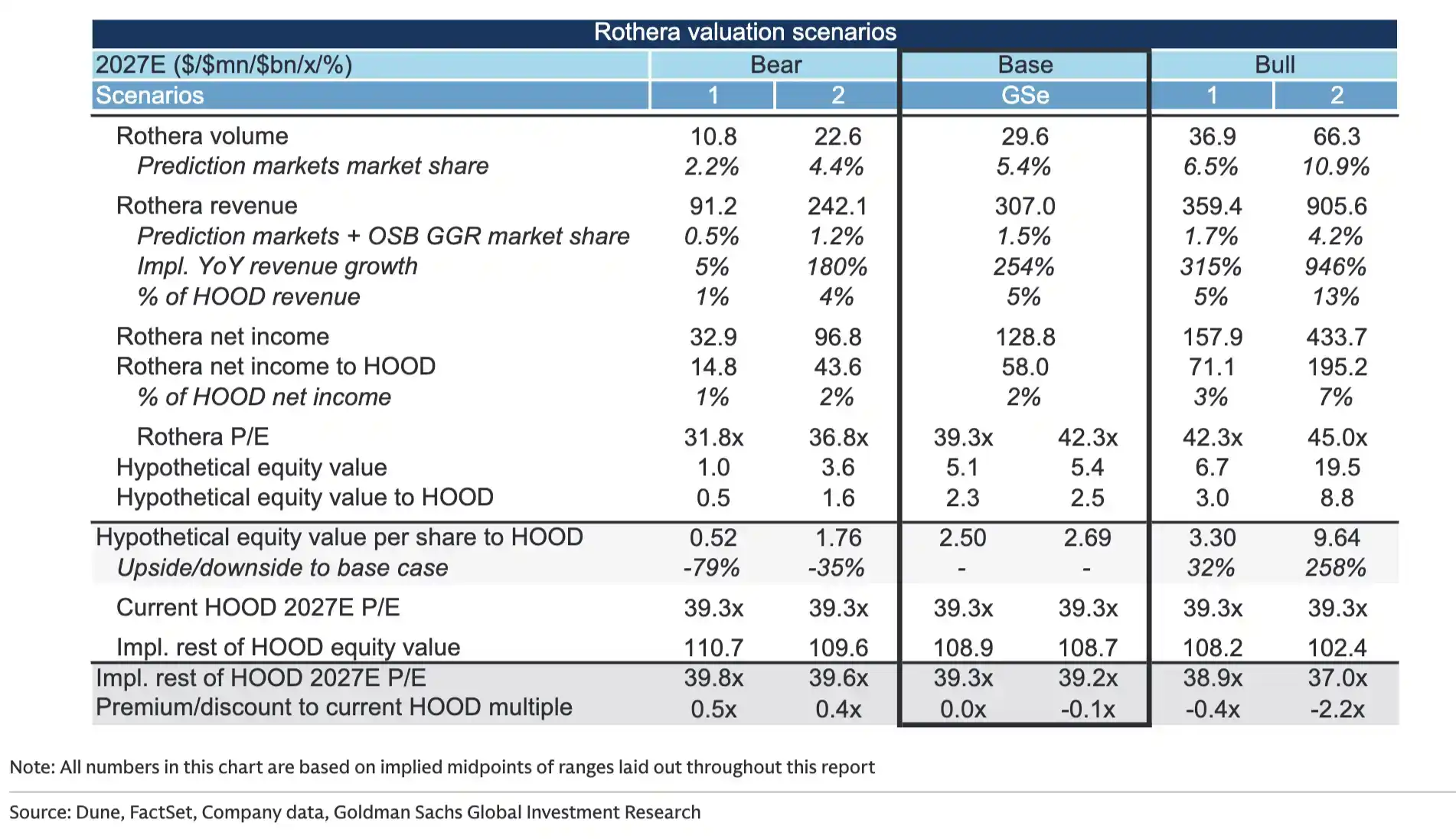
In the base case, Goldman expects 2027 revenue of $307 million and net profit of about $129 million, of which roughly $58 million would be attributable to Robinhood. That implies total equity value for Rothera of about $5.1 billion to $5.4 billion, with $2.3 billion to $2.5 billion attributable to Robinhood, or $2.50 to $2.69 per share.
In the bull case, 2027 revenue could reach $359 million to $906 million, with net profit attributable to Robinhood of about $71 million to $195 million. That translates to total equity value of $6.7 billion to $19.5 billion, and $3 billion to $8.8 billion attributable to Robinhood, or $3.30 to $9.64 per share.
In the bear case, 2027 revenue could be only $91 million to $242 million, with net profit attributable to Robinhood of about $15 million to $44 million. That would imply total equity value of $1 billion to $3.6 billion, and $500 million to $1.6 billion attributable to Robinhood, or $0.52 to $1.76 per share.
Goldman combines prediction markets and online sports betting gross gaming revenue into one addressable market because it sees substantial overlap between the two. On that basis, it estimates an annualized revenue pool of about $18 billion in 2026, rising to $20 billion-$21 billion in 2027.
Under that framework, Rothera’s revenue share is about 1.5% in the base case, 1.7%-4.2% in the bull case, and 0.5%-1.2% in the bear case.
The top-end valuation of $19.5 billion rests on aggressive assumptions. Goldman says Rothera would need to generate $906 million in revenue in 2027, implying 946% year-over-year growth. Robinhood would need to keep sending large volumes of orders to the platform, SIG would need to maintain market-making support, more outside FCMs would need to join, and the product set would need to expand beyond sports into politics, economics, and possibly other derivatives.
That helps explain why the valuation range is so wide. Goldman argues that Rothera’s value depends not only on growth in prediction markets, but also on whether it can evolve from an internal Robinhood venue into a stand-alone infrastructure platform that attracts outside brokers and traders.
Goldman says Rothera explains part, not all, of Robinhood’s rich valuation
Goldman adds that Rothera can explain part of Robinhood’s current premium valuation. By Goldman’s measure, Robinhood is trading at about 39.3x FY+2 price-to-earnings, around the 87th percentile of the company’s valuation range over the past five years, which suggests the market is already pricing in strong growth expectations.
After stripping out the value attributable to Robinhood from Rothera, the rest of the business still trades at about 39.2x-39.3x FY+2 earnings in the base case, 37.0x-38.9x in the bull case, and 39.6x-39.8x in the bear case.
Goldman is explicit that this does not make the rest of Robinhood’s business cheap. Even in the base case, the valuation of the remaining operations stays around the 87th percentile of its historical range and remains well above the averages for brokers and crypto-related companies. Goldman says it is willing to accept that premium mainly because it expects Robinhood to deliver 22% revenue growth from 2026 to 2028 and to keep launching products at a fast pace.
The report ends with a narrow point rather than a broad one: Rothera adds a new support to Robinhood’s valuation, but the case still depends on sustained execution. Trading volumes, outside broker adoption, the ability of non-sports contracts to scale, and regulatory room for further product expansion will determine where Rothera ultimately lands within Goldman’s $1 billion to $19.5 billion valuation range.
What looks clear for now is that prediction markets have moved beyond being a new Robinhood product. They are becoming a material input in how the company’s revenue outlook and valuation framework are discussed.