

Goldman Sachs said in its latest preview for the U.S. semiconductor sector that most major sub-segments are likely to beat second-quarter expectations, but that outcome may not necessarily be bullish for share prices. The bank’s main argument is straightforward: the Philadelphia Semiconductor Index rose 88% during the second quarter, while the S&P 500 gained only 14% over the same period, indicating that a substantial portion of the positive earnings outlook has already been embedded in valuations.
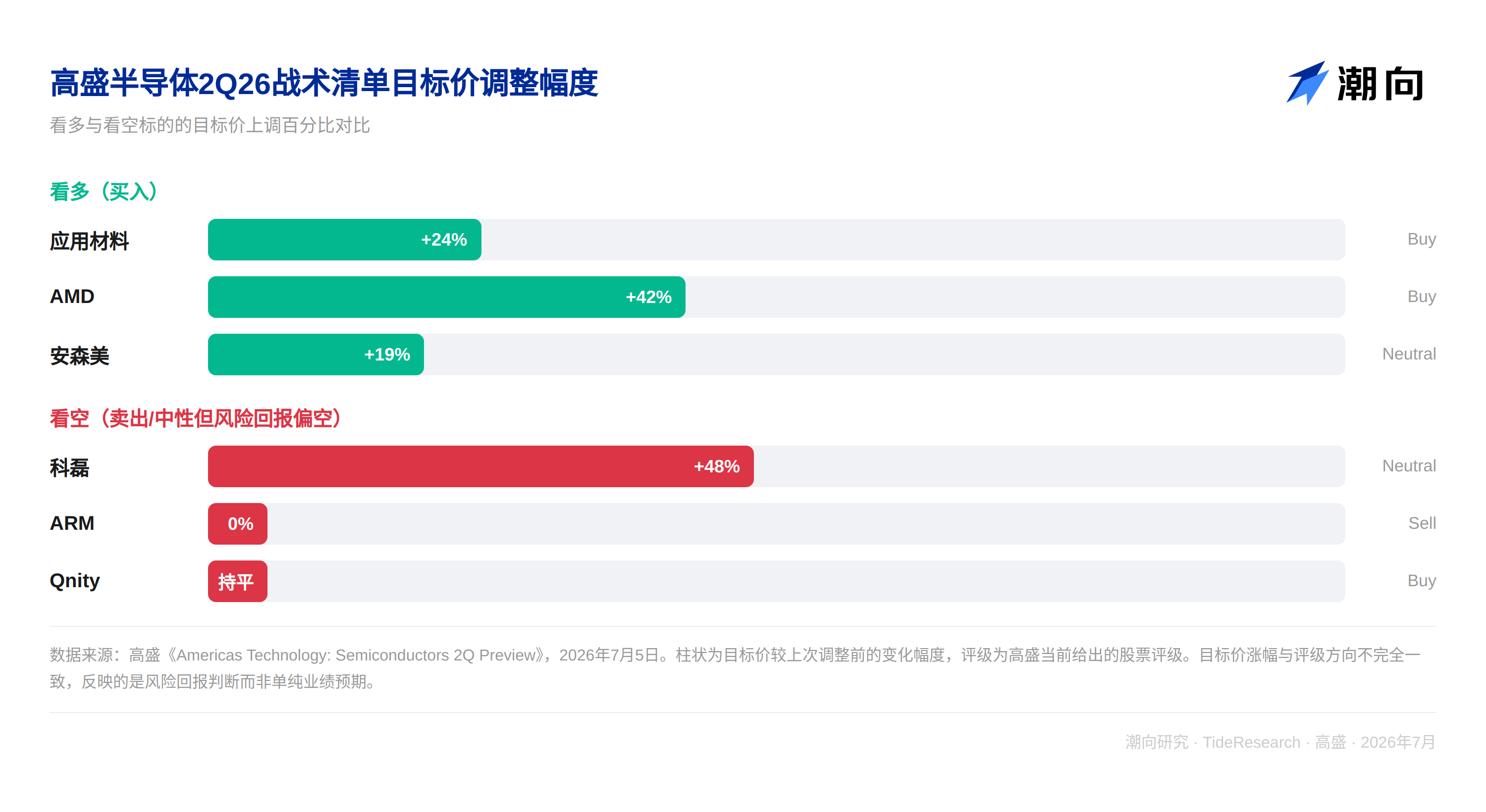
That makes the report more notable for its rating logic than for its earnings forecasts alone. Goldman’s stance suggests that ratings are increasingly decoupled from near-term operating performance. Companies that are all expected to outperform may still receive sharply different tactical views, depending less on the quarter itself and more on how much optimism their stocks have already discounted.
Goldman’s preferred themes: equipment, compute and storage
Across the sector, Goldman remains most constructive on three themes: semiconductor equipment, compute and storage. It also turned more positive on analog chips overall. In compute, the bank sees support from higher capital expenditure plans among hyperscale cloud operators, creating room for upward revisions in server CPU demand and certain ASIC programs. In storage, Goldman favors HDD and NAND exposure, arguing that neither category is seeing a meaningful wave of new supply in the near term.
For semiconductor equipment, Goldman expects wafer fab equipment spending to be pulled forward, with long-duration visibility extending into 2028. In analog, the bank prefers companies with heavier exposure to industrial, aerospace and defense, and data center end markets. Its reasoning is that recovery in those segments appears steadier than in consumer electronics, making earnings realization more predictable.
Same earnings setup, different ratings
Goldman’s tactical list keeps Applied Materials, AMD and Onsemi as preferred names, while placing KLA, ARM and Qnity in a weaker risk-reward bucket. ARM best illustrates the distinction. Goldman still describes ARM’s operating fundamentals as solid, but it flags two issues: continued smartphone weakness that could pressure royalty revenue, and operating expenses running above expectations. On their own, those concerns would likely imply only a somewhat softer third-quarter guide rather than a bearish stance.
What weighs more heavily on ARM, in Goldman’s view, is the stock’s prior run-up. Shares had already priced in multiple quarters of optimistic assumptions, leaving little room for even a modest shortfall. In other words, the rating pressure is driven less by a collapse in fundamentals and more by the fact that valuation has become less forgiving after a large rally.
KLA represents a different kind of disconnect. This capital spending cycle is more concentrated in DRAM expansion, but DRAM manufacturing structurally requires less inspection and metrology intensity than logic production. That dynamic is not a reflection of weaker execution at KLA. Rather, it is a result of how spending is being allocated across the semiconductor supply chain. Goldman raised its target price on KLA from $155 to $230, yet kept the stock at neutral because even a modest beat could still leave it lagging peers.
Why Goldman still favors Applied Materials, AMD and Onsemi
Goldman’s bullish stance on Applied Materials is tied to expected DRAM demand, which it believes could make the company one of the strongest growers in the sector in 2026. The bank also sees visibility extending through 2028 and argues that pricing power remains a possibility. Based on that view, Goldman lifted its target price from $520 to $645.
For AMD, the core driver is server CPU demand. Goldman expects that business to support a second-quarter beat even if the PC segment remains a partial drag. The bank raised AMD’s target price from $450 to $640 and said its 2027 earnings-per-share forecast stands 13% above the broader market consensus, underscoring a more constructive long-term earnings view.

Onsemi’s case is more about expectations resetting. The stock had previously fallen 30% amid market speculation around a potential acquisition of Synaptics, which pushed sentiment and near-term expectations lower. Goldman argues that this creates a more attractive risk-reward profile and raised its target price from $80 to $95. The common thread across these three names is that their stocks have not yet advanced to a level where future upside is fully exhausted by prior optimism.
Storage shows the logic most clearly, while Qnity sits in a gray zone
Goldman’s framework becomes even more visible in storage. It raised SanDisk’s target price from $1,200 to $2,200 and projected that the company’s 2026 EPS could come in more than 30% above consensus. Seagate’s target was lifted from $700 to $960. In both cases, the bank cited tight HDD and NAND supply and continued pricing strength as the basis for a constructive view.
Western Digital, however, was treated more cautiously. Goldman raised its target price from $400 to $650 but kept the stock at neutral. The reason was not a weak operating outlook. Instead, the stock had already climbed 240% year to date, significantly outperforming the Philadelphia Semiconductor Index. In Goldman’s framework, that prior move limits how much additional upside can be justified, even if industry fundamentals remain supportive.
Qnity is perhaps the most nuanced example in the report. The wafer manufacturing materials company, spun out from a traditional materials business, remains a longer-term positive in Goldman’s eyes because of improving foundry utilization and solid operational execution. The bank still keeps a buy rating on the stock. Yet in its tactical grouping for this earnings period, Goldman classifies Qnity as offering weaker risk-reward because the stock has already risen so much that the upside runway is no longer as wide as before.
That sets Qnity apart from names like ARM or KLA. In Goldman’s framing, Qnity is not a case of deteriorating fundamentals or structural business headwinds. It is simply a company that may still be attractive fundamentally but no longer looks as inexpensive or as asymmetrically attractive after its prior appreciation. The distinction helps complete the full spectrum of the bank’s rating logic.
The broader takeaway: earnings beats and stock upside are not the same thing
The broader message from the report is that sell-side ratings are not pure judgments on business quality or quarterly execution. They are also a measure of the gap between expected earnings power and how much of that earnings power has already been reflected in market pricing. That is why Goldman can remain constructive on industry demand while simultaneously sounding more selective on individual stocks.
ARM and KLA, in this context, are not portrayed as companies with collapsing fundamentals. ARM is more a case of valuation being punished after a strong prior rally, while KLA is affected by the specific composition of this investment cycle rather than by a failure in its own operations. The report effectively argues that investors should pay as much attention to what the market has already priced in as to whether the quarter itself is strong.
The original article also noted that Goldman has or seeks investment banking relationships with many of the companies mentioned in the report. That does not automatically invalidate the analysis, but it does reinforce the need for independent verification when reading broker target prices, ratings and earnings estimates. For investors, the practical conclusion is clear: in a single earnings season, beating expectations and having room for further stock gains are not the same thing.