Goldman Sachs said on Aug. 23 that Samsung Electronics’ 2026 shareholder return pool is expected to range between KRW 90 trillion and KRW 110 trillion, below what the market had been anticipating. The firm kept its Buy rating on Samsung’s common stock and a KRW 490,000 target price, which it said implies 74% upside. In Goldman’s view, the key driver of valuation recovery is not a one-off return size, but the continued expansion of free cash flow and a stable return mechanism. Samsung has outlined a phased payout plan, including about KRW 30 trillion in cash dividends in the third quarter, with the remaining amount to be executed after January 2027 results are confirmed. Goldman estimated Samsung’s 2024-2026 cumulative free cash flow at about KRW 270 trillion and said the company’s 2027 and 2028 return pools could rise to KRW 179 trillion and KRW 232 trillion, respectively, if the current 50% FCF payout policy remains in place. The report also flagged risks from weaker memory supply-demand conditions, a sharp drop in smartphone margins and further OLED market-share losses.
Goldman Sachs said Samsung Electronics’ 2026 shareholder return pool will likely land between KRW 90 trillion and KRW 110 trillion, a midpoint that came in below market expectations. Earlier media reports had suggested this year’s return size could reach KRW 150 trillion.
The bank kept its Buy rating on Samsung’s common stock and set a KRW 490,000 target price, which it said implies 74% upside from the current share price.
Samsung is one of the world’s largest technology companies, with global No. 1 market share in memory chips, OLED panels, smartphones and televisions. Goldman expects earnings from the memory business to remain strong, while HBM is also making meaningful progress.
Samsung has not opted for a one-time, large-scale payout like SK Hynix. Instead, it laid out a phased return plan. The company said it plans to pay about KRW 30 trillion in cash dividends in the third quarter, with the final amount to be decided by the board at the end of October. The rest will be executed after January 2027 results are confirmed, through dividends, buybacks and cancellations.
Goldman estimated that Samsung’s cumulative free cash flow from 2024 through 2026 will total about KRW 270 trillion. Using a 50% payout ratio, that implies total returns of about KRW 135 trillion. After subtracting the KRW 20.9 trillion in dividends and KRW 8.4 trillion in buybacks already paid in 2024-2025, Goldman said 2026 returns would come to about KRW 106 trillion, near the top end of Samsung’s guidance range.
The mix is expected to tilt toward dividends. Goldman forecast around KRW 30 trillion in third-quarter dividends in 2026, just above KRW 40 trillion at year-end, for full-year dividends of roughly KRW 76 trillion. The remaining KRW 30 trillion or so would be handled through buybacks and cancellations.
Goldman pointed to two reasons for the heavier dividend mix: Samsung is close to the threshold where dividend income is taxed separately, and financial affiliates face regulatory limits on how much stock they can hold in non-financial group affiliates.
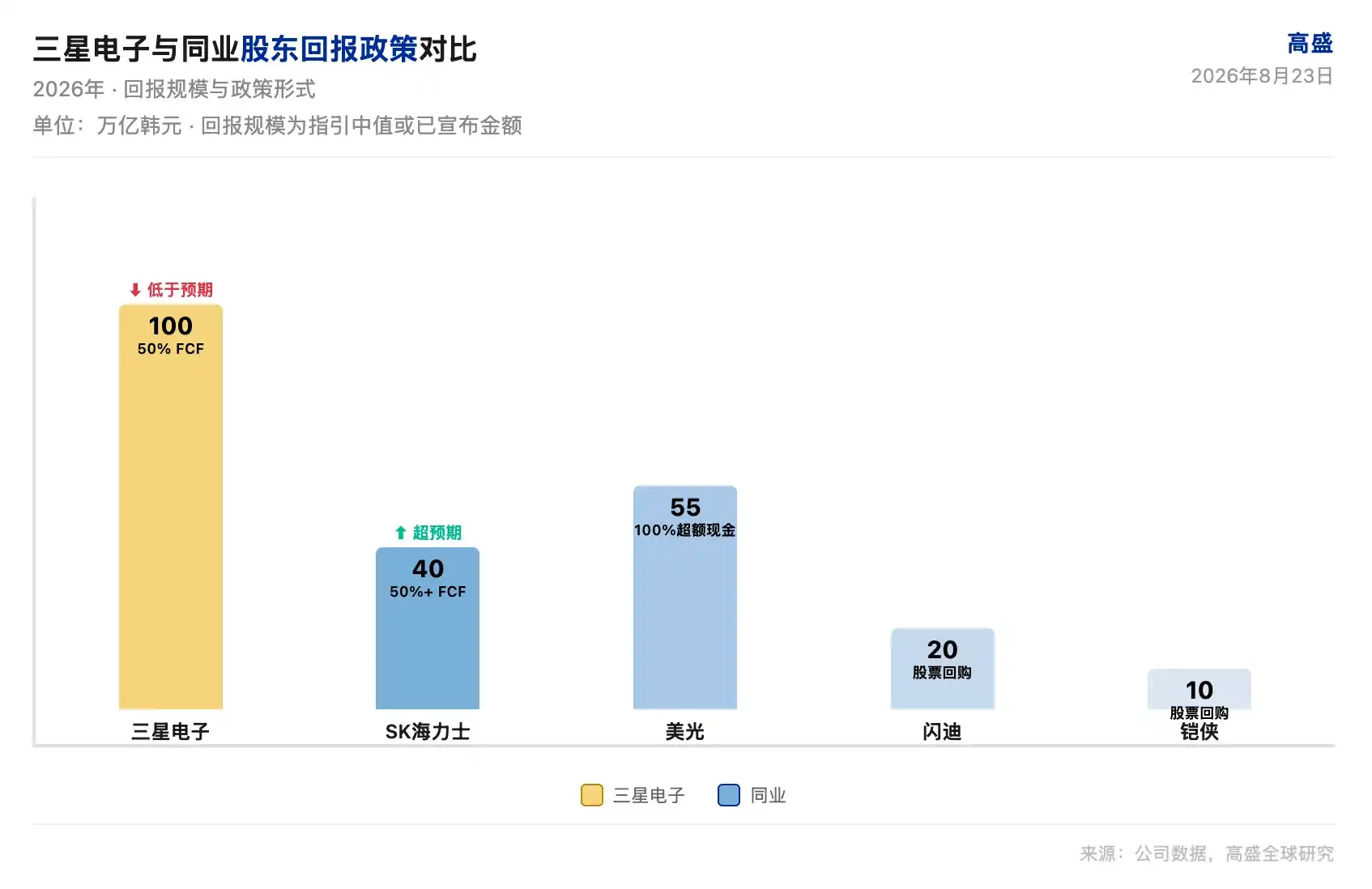
Peers have moved more aggressively. Micron has said it will return 100% of excess cash to shareholders. SK Hynix has pledged to return more than 50% of free cash flow and has launched a KRW 40 trillion buyback. SanDisk and Kioxia are also expanding repurchase programs. Samsung’s near-term payout package is smaller than those peers, but Goldman said continued FCF expansion in 2027-2028 could bring its return capacity closer to, or even above, industry levels.
Samsung has not disclosed a return plan for 2027 and beyond. Goldman expects FCF to grow meaningfully and said the stability of shareholder returns should improve. Even under the current 50% FCF payout policy, Goldman projects return pools of KRW 179 trillion in 2027 and KRW 232 trillion in 2028.
The bank assumes Samsung will raise its quarterly common dividend to about KRW 10 trillion starting in 2026, with an additional larger year-end dividend. Based on changes to its cash-flow assumptions and buyback and dividend forecasts, Goldman lifted its 2026-2028 EPS estimates by 1%, 7% and 11%. Its ROE expectations also moved higher, from 52%, 48% and 39% to 53%, 52% and 43%.
Samsung’s shares currently trade at 1.7 times 2027 forecast book value and 1.2 times 2028 forecast book value, with ROE in the 40% to 50% range over the same period. Goldman said the risk-reward profile remains attractive and that sustained, large-scale shareholder returns should lift valuation multiples.
The KRW 490,000 target price is based on a 2026-2027 EV/EBITDA SOTP valuation. The target price for preferred shares is KRW 360,000, based on a 27% discount to common shares. Downside risks include weaker memory supply-demand conditions, a sharp drop in smartphone margins and further market-share losses in OLED panels.
Goldman’s view is that the market’s short-term expectations for Samsung’s payout plan were too high, but continued FCF expansion and a stable return mechanism offer longer-term certainty. In its framing, Samsung’s shareholder return story is a structural improvement, not a one-off event.
This article was originally published by Bit.Fan. For more cryptocurrency news and market insights, visit www.bit.fan. Disclaimer:
The market information, project data, and third-party content displayed on this platform are for industry information sharing only and do not constitute any form of investment advice or return commitment.
Cryptocurrency trading carries high risks. Users should fully assess their risk tolerance and make independent decisions. All profits, losses, and legal responsibilities are borne by the users themselves.